
Cornerstone Guide
Essential Aquarium Equipment
Walking into an aquarium shop for the first time can make fishkeeping look much more complicated than it really is. There are shelves full of filters, pumps, lights, heaters, test kits, treatments, cleaning tools, decorations, and gadgets that all seem to promise a better aquarium.
You do not need all of them.
A beginner freshwater aquarium needs a relatively simple collection of equipment that does a few important jobs well: circulate and filter the water, maintain suitable conditions for the fish, let you monitor water quality, and make routine maintenance manageable.
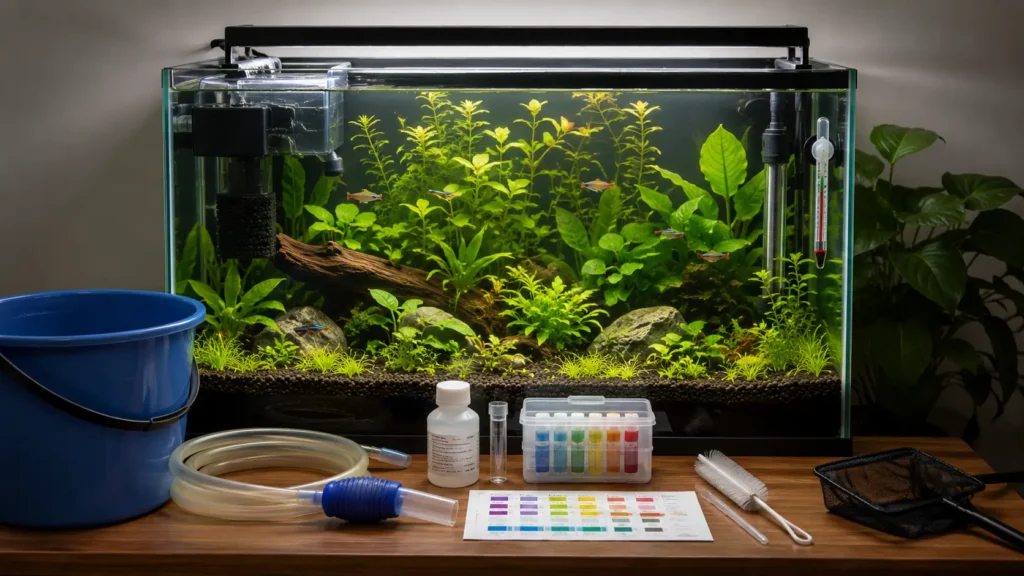
The exact equipment depends on what you plan to keep. A tropical community aquarium may need a heater, while a tank designed for species suited to cooler conditions may not. A planted aquarium may need more capable lighting than a fish-focused setup with a few undemanding plants.
That is why it helps to choose your future fish before filling a shopping cart with equipment.
This guide separates the essentials from the nice-to-have extras so you can build a practical freshwater aquarium without buying equipment you do not actually need.
What Equipment Do You Need for a Freshwater Aquarium?
For a typical beginner freshwater aquarium, your basic equipment list will usually include:
- An appropriately sized aquarium
- A suitable aquarium stand
- A filter
- A heater if required by your fish
- A thermometer
- Aquarium lighting
- A lid or cover when appropriate
- Suitable substrate
- Water conditioner when required for your source water
- A water-testing kit
- A siphon or gravel-cleaning tool
- An aquarium-only bucket or maintenance container
- Plants, hiding places, and suitable decorations
- Food appropriate for the fish you plan to keep
You may eventually add other equipment, but these basics cover most of what a beginner needs to establish and maintain a conventional freshwater community aquarium.
Buy equipment according to the tank and livestock rather than assuming one setup works for every species.
Choosing the Right Aquarium
The aquarium itself is the first major piece of equipment, and its size affects almost everything else you buy.
Very small tanks can look beginner-friendly because they cost less and take up less room. In practice, a smaller volume of water can change more quickly when waste, temperature, or chemistry shifts.
A larger tank is not automatically better, either. It weighs more, requires a stronger stand, takes more water to maintain, and generally costs more to equip.
The most useful approach is to choose the fish first and then select an aquarium that accommodates their adult size, swimming behavior, social requirements, and planned group size.
Do not choose a tank around the size of juvenile fish at the store. Research how large they become and how they behave as adults.
Do You Need an Aquarium Stand?
A filled aquarium is heavy.
Water is only part of that weight. You also have the glass or acrylic tank, substrate, rocks, wood, filter equipment, and decorations.
Use a level, stable support that is appropriate for the aquarium’s dimensions and filled weight. Follow the tank manufacturer’s support requirements.
An ordinary shelf, desk, cabinet, or dresser should not automatically be considered suitable just because the empty aquarium fits on top.
The stand should also leave enough access for maintenance. If filters, cords, or hoses become impossible to reach, routine aquarium care gets unnecessarily difficult.
The Aquarium Filter
A filter is one of the most important pieces of equipment in a conventional freshwater aquarium.
Beginners sometimes think a filter mainly removes visible dirt. It does more than that.
Aquarium filtration can involve three broad functions:
Mechanical Filtration
Mechanical media captures suspended debris as water passes through the filter. This can improve water clarity and prevent larger particles from continually circulating through the aquarium.
Biological Filtration
This is particularly important.
Filter media provides surface area where microorganisms involved in the nitrogen cycle can establish themselves. These microorganisms help process ammonia into nitrite and then nitrate.
The filter therefore becomes part of the aquarium’s biological waste-processing system, not just a dirt collector.
Chemical Filtration
Some filters can hold media designed to remove or alter particular dissolved substances. Activated carbon is a familiar example.
Chemical filtration is not something every freshwater aquarium needs continuously. Use specific media when it serves a clear purpose rather than assuming more filter media automatically means better water.
How to Choose an Aquarium Filter
Choose a filter that is suitable for your aquarium volume and inhabitants.
Common options include:
- Sponge filters
- Hang-on-back filters
- Internal filters
- Canister filters
Each has advantages.
Sponge filters are simple and provide gentle biological filtration, making them particularly useful for shrimp tanks, breeding setups, and some smaller aquariums.
Hang-on-back filters are convenient and popular for freshwater community tanks.
Internal filters keep most of the equipment inside the aquarium and can work well where suitable.
Canister filters are often used on larger aquariums or setups where the keeper wants greater media capacity and external filtration.
You do not need the most expensive filter. You need one appropriate for the tank, livestock, and maintenance routine.
Does a Freshwater Aquarium Need a Heater?
It depends on the fish.
Many popular tropical freshwater fish require temperatures above what an unheated room reliably provides. In those aquariums, a heater helps maintain an appropriate and reasonably stable temperature.
Other freshwater species are naturally suited to cooler conditions and may not require additional heating.
Research your fish before buying the heater.
If you do need one, choose a heater suitable for the aquarium volume and temperature difference involved. Follow the manufacturer’s instructions for installation, immersion, orientation, and safe operation.
Positioning a compatible heater near good water circulation can help distribute warmed water through the tank.
Why You Still Need a Thermometer
A heater setting is not the same thing as an independent temperature measurement.
Use an aquarium thermometer to check the actual water temperature.
When a heater is installed, placing the thermometer some distance away from it can help you see whether heat is being distributed effectively through the aquarium rather than measuring only the water immediately beside the heating element.
A thermometer is inexpensive compared with most aquarium equipment and gives you information you cannot reliably get by touching the glass.
Aquarium Lighting
Lighting lets you see the aquarium and provides light for live plants when they are included.
The amount and type of lighting you need depends largely on the setup.
A fish-focused aquarium with a few undemanding plants has very different lighting needs from a heavily planted aquascape.
More light is not automatically better. Excessive lighting can encourage unwanted algae, especially when light duration and plant growth are poorly balanced.
A timer can make the lighting schedule more consistent, although it is a convenience rather than a requirement for starting the aquarium.
Choose lighting according to your plants and tank depth rather than simply buying the brightest unit available.
Do You Need an Aquarium Lid?
A lid or cover can serve several useful purposes.
Depending on the aquarium and livestock, it may:
- Reduce evaporation
- Help prevent jumping fish from leaving the aquarium
- Limit accidental objects entering the tank
- Provide a mounting area for lighting
Whether a lid is essential depends partly on the species you keep. Some fish are much more likely to jump than others.
Make sure the cover still allows appropriate equipment installation and gas exchange.
Choosing Aquarium Substrate
Substrate is the material covering the bottom of the aquarium. Gravel and sand are the most familiar options, although planted and specialized aquariums may use other substrates.
Do not choose substrate based only on color.
Consider the animals you want to keep. Bottom-dwelling fish may interact with the substrate constantly, and some species have particular feeding or digging behavior that makes one texture more appropriate than another.
Plants can also influence your choice.
Some aquatic plants attach to wood or rocks and do not rely heavily on substrate. Others grow through the bottom material and may benefit from a substrate designed with rooted plants in mind.
Avoid sharp or unsuitable material that could injure the animals you plan to keep.
Do You Need Aquarium Water Conditioner?
If your source water contains chlorine or chloramine, it needs to be appropriately treated before being used with aquarium livestock and biological filtration.
Municipal drinking-water disinfectants help make tap water safe for people, but that does not make untreated tap water appropriate for fish.
An aquarium water conditioner designed for your source-water disinfectant is therefore a basic supply in many freshwater setups.
Follow the product instructions rather than estimating the amount.
If you use well water or another source, do not assume you need the same treatment. Understand the water you actually have.
Why You Need an Aquarium Water Test Kit
Aquarium water can look perfectly clear while still containing harmful dissolved compounds.
That is why a test kit is equipment rather than an optional science experiment.
Useful tests for beginners commonly include:
- Ammonia
- Nitrite
- Nitrate
- pH
- General hardness when relevant
- Carbonate hardness when relevant
You should also monitor temperature with a thermometer.
Testing is particularly important while establishing the nitrogen cycle, after adding livestock, when changing your maintenance routine, and whenever fish behave unusually.
Clear water tells you what the aquarium looks like. Testing helps tell you what is happening chemically.
Aquarium Siphon or Gravel Cleaner
A siphon makes partial water changes much easier.
Depending on the design and substrate, it can also help remove accumulated debris from appropriate areas of the aquarium floor.
You do not need to make every piece of substrate spotless during each water change. The goal is routine maintenance, not sterilization.
A simple siphon is one of those pieces of equipment that may not seem exciting when you are setting up the tank, but you will appreciate it once regular maintenance begins.
Keep a Bucket Just for the Aquarium
An aquarium-only bucket or maintenance container is inexpensive and useful.
Keep it separate from normal household cleaning equipment.
A bucket that has previously held detergents, soaps, cleaners, or other household chemicals is not a good choice for aquarium work because residues may remain.
Labeling your aquarium bucket can prevent someone else in the household from borrowing it for cleaning.
You may eventually want more than one container, especially if you prepare replacement water separately.
Plants, Wood, Rocks, and Hiding Places
Decorations are not just about making an aquarium attractive.
Plants, wood, caves, rocks, and other suitable structures can provide hiding places, visual barriers, territories, spawning sites, or grazing surfaces depending on the species.
Choose decorations around the fish.
A shy species may benefit from substantial cover, while a highly active schooling fish still needs open swimming space.
Avoid unstable rock arrangements, sharp decorations, or materials that could negatively affect water chemistry unless that effect is intentional and appropriate for the livestock.
Do You Need an Air Pump?
Not every freshwater aquarium requires a separate air pump.
Gas exchange depends heavily on water movement at the surface. A filter that creates adequate circulation and surface movement may already provide what the aquarium needs.
An air pump can still be useful.
It may power a sponge filter, operate an air stone, or provide additional water movement and aeration where required.
Whether you need one depends on your filter, stocking, temperature, aquarium design, and livestock.
Do not buy an air pump simply because bubbles are traditionally associated with fish tanks. Buy one when it performs a useful job in your setup.
Aquarium Equipment You May Not Need Immediately
Beginners are often encouraged to buy equipment for problems they do not have yet.
Depending on your setup, you may not initially need:
- UV sterilization
- Automatic feeders
- CO2 injection equipment
- Dosing pumps
- Advanced aquarium controllers
- Specialized chemical filter media
- Multiple electronic monitoring devices
These products can have legitimate uses. They simply are not universal requirements for starting a basic freshwater community aquarium.
Learn how your tank behaves before deciding which conveniences or advanced equipment would actually improve it.
Beginner Aquarium Equipment Shopping Checklist
Before leaving the store or placing an order, run through this checklist:
- Is the aquarium large enough for the adult fish?
- Is the stand appropriate for the tank?
- Is the filter suitable for the aquarium and livestock?
- Do my chosen fish need a heater?
- Do I have a thermometer?
- Is the lighting suitable for my plants?
- Do I need a lid for the species I plan to keep?
- Is the substrate appropriate?
- Do I have water conditioner if my tap water requires it?
- Can I test ammonia, nitrite, nitrate, and pH?
- Do I have a siphon?
- Do I have aquarium-only maintenance equipment?
- Do the fish have appropriate cover and swimming space?
If those basics are covered, you probably do not need another cart full of gadgets before setting up your first aquarium.
Essential Aquarium Equipment FAQ
What Equipment Is Absolutely Necessary for a Freshwater Aquarium?
A conventional freshwater aquarium generally needs an appropriate tank and stand, filtration, a thermometer, suitable lighting, water-testing supplies, water preparation where required, maintenance equipment, and habitat appropriate for the fish. A heater is also necessary when the chosen species require heated water.
Does Every Aquarium Need a Filter?
Most conventional beginner aquariums use a filter because filtration provides water movement, removes debris, and offers important surface area for biological filtration. Specialized aquarium systems can work differently, but they require more understanding than a typical beginner setup.
Does Every Freshwater Aquarium Need a Heater?
No. The need for a heater depends on the species and the natural temperature of the aquarium. Tropical species commonly require heating, while some temperate freshwater fish are suited to cooler conditions.
Do I Need Both a Heater and a Thermometer?
If you use a heater, an independent thermometer is strongly useful because it lets you verify the actual water temperature instead of relying only on the heater setting.
Do Beginners Need a Water Test Kit?
Yes. Testing ammonia, nitrite, nitrate, pH, and other relevant parameters helps you monitor cycling and water quality. Harmful dissolved compounds cannot be reliably identified simply by looking at the water.
Do I Need an Air Pump If I Have a Filter?
Not necessarily. If the filter creates adequate circulation and surface movement, a separate air pump may not be required. Air pumps remain useful for sponge filters, air stones, and aquariums that need additional aeration.
Do I Need Live Plants?
Live plants can provide valuable habitat and make an aquarium more interesting, but they are not mandatory for every freshwater setup. If you do not use live plants, provide other appropriate cover and structure based on the needs of your fish.
Is a Gravel Vacuum Necessary?
A siphon or gravel-cleaning tool is highly useful for regular partial water changes and removing accumulated debris. The exact cleaning technique depends on whether you use gravel, sand, planted substrate, or another bottom material.
Can I Use a Household Bucket for Aquarium Water?
Use a clean container reserved for aquarium work. Avoid buckets or tools that have held detergents, soaps, cleaners, or other household chemicals.
Do Aquarium Starter Kits Contain Everything I Need?
Not always. Some kits include a filter, lighting, heater, or thermometer, but you may still need substrate, water conditioner, testing supplies, a siphon, maintenance equipment, and other items. Check the actual contents rather than assuming “starter kit” means complete setup.
Should I Buy Fish at the Same Time as the Equipment?
Usually not. Set up the aquarium first, prepare the water, establish biological filtration, and confirm the tank is ready before normal stocking. Buying the equipment is only the beginning of setting up a freshwater aquarium.
What Aquarium Equipment Should I Buy First?
Start with the aquarium, suitable stand, filter, temperature-control equipment where necessary, thermometer, lighting, water-testing supplies, water conditioner where required, substrate, and maintenance tools. Decorations and plants should then be chosen around the needs of your planned fish.
Conclusion
Essential aquarium equipment is much simpler than the shelves of products in an aquarium shop might suggest.
Start with the equipment that performs a clear job: a suitable aquarium and stand, reliable filtration, temperature control when needed, an independent thermometer, appropriate lighting, water-testing supplies, water conditioner where required, and basic maintenance tools.
Then build the environment around the fish you actually plan to keep. Choose substrate, plants, hiding places, filtration strength, and heating based on their adult needs rather than buying fish that happen to fit the equipment you already own.
Most importantly, do not spend your entire budget on decorative or advanced equipment while skipping the basics. A sophisticated light or electronic controller cannot replace biological filtration, water testing, or regular maintenance.
Once your essential equipment is in place, set up the aquarium and give the biological filter time to develop before normal stocking.
Your first freshwater aquarium does not need to be complicated. Reliable equipment, suitable fish, stable water, and a maintenance routine you can actually keep up with will take you much further than a tank filled with gadgets you do not know how to use.
Sources
How to Set Up and Look After a Freshwater Tank/Aquarium — Ornamental Aquatic Trade Association (OATA): OATA’s freshwater aquarium guidance covers tank setup, filtration, heating, lighting, substrate, water treatment, maintenance, and water changes. It supports the guide’s recommendation to start with essential life-support and maintenance equipment rather than unnecessary accessories.
Providing a Home for Fish — Merck Veterinary Manual: Veterinary guidance from Merck explains the importance of maintaining appropriate aquarium water quality and routinely monitoring factors such as temperature, chlorine, and pH. It supports the recommendation that water-testing equipment and environmental monitoring are fundamental parts of responsible aquarium care.
Special Considerations for Fish — Merck Veterinary Manual: Merck describes a home aquarium as an ecosystem requiring water-quality monitoring, water changes, filtration, waste removal, and aeration. This supports the guide’s focus on equipment that maintains the aquarium environment rather than treating accessories as substitutes for basic husbandry.
Setting Up a Freshwater Aquarium — Aqueon: Aqueon’s beginner setup guide provides practical manufacturer guidance on installing filters, heaters, thermometers, substrate, decorations, and related freshwater aquarium equipment. It also supports locating suitable heaters near water circulation and positioning the thermometer away from the heating element.
Aquatic Life Support System Components — Merck Veterinary Manual: This veterinary reference explains mechanical, biological, and chemical components of aquatic filtration systems. It supports the distinction in this guide between removing particulate material, supporting biological filtration, and using chemical media for particular purposes.