

Java Fern ‘Thor’s Hammer’
Leptochilus pteropus 'Thor's Hammer'
- Care level
- Beginner
- Placement
- Hardscape, Midground
- Light
- Low, Medium
- CO₂
- Optional
Plant profile
Leptochilus pteropus
Common names: Java Fern, Java Water Fern


















A hardy, slow-growing rhizomatous aquarium fern that is normally attached to wood or stone rather than buried in substrate.
A slow-growing rhizomatous fern producing firm leaves from a horizontal rhizome. It tolerates low light and is commonly used in low-tech planted aquariums.
Starter values use the commonly reported optimum aquarium temperature range of 20–28°C and a broad pH tolerance of 5–8.
Injected CO₂ is not required for ordinary cultivation. Added CO₂ may improve growth, but the plant remains naturally slow-growing.
Some links may earn us a commission on qualifying purchases, at no extra cost to you. Check suitability, price and availability with the seller. How affiliate links work
 Neo-Helios S3 Plus Nano 13 W plant light
A compact lighting option to consider for the low-to-medium-light planting described above. The seller specifies tanks about 20-46 cm long and glass up to 15 mm thick.
Check your tank width, depth and planted area before choosing it. This compact unit is not presented as sufficient lighting for every tank or for high-light plants.
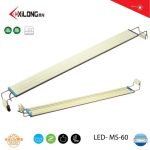 Xilong MS60 16 W aquarium plant light
A tank-top lighting option to consider for low-to-medium-light aquarium planting. The seller lists a 58.5 cm light body and mounting on tanks approximately 65-75 cm long.
Confirm the mounting range, water depth and planted coverage. Keep the unit above water. It is not presented as adequate lighting for high-light species or every aquarium size.
Position the plant on wood, stone, or another hard surface. The roots may grip the surface over time, but the horizontal rhizome must remain exposed.
Secure the rhizome gently to wood or stone using thread, plant-safe adhesive gel, or a loose tie until the roots gain a hold. Do not crush or completely coat the rhizome.
Remove old or damaged leaves near the rhizome with clean scissors. Avoid cutting healthy leaves unnecessarily because replacement growth is slow.
Divide a healthy rhizome into sections that each retain leaves and roots, or separate daughter plantlets that form on mature leaves once they have developed roots.
Black dots arranged on the undersides of mature leaves can be sporangia, the fern's reproductive structures, rather than disease.
Do not diagnose nutrient deficiency from one visual symptom alone. Review new versus old growth, lighting, water-column fertilization, CO₂ availability, and general plant health before recommending a correction.
You can write a note about what worked for you, or send a photograph. We check everything before it appears here.
Leptochilus pteropus 'Thor's Hammer'
Leptochilus pteropus 'Needle Leaf'
Leptochilus pteropus 'Soft'
Leptochilus pteropus 'Black Forest'