

Anubias Nana Thick Leaf
Anubias barteri 'Thick Leaf'
- Care level
- Beginner
- Placement
- Foreground, Hardscape, Midground
- Light
- Low
- CO₂
- Optional
Plant profile
Anubias barteri 'Snow White'
Common names: Anubias Nana Snow White, Anubias barteri Snow White

A miniature, slow-growing Anubias with very small leaves with extensive white or cream colouring and white, cream, and pale green with little darker green. Best used for specialist collector nano-aquariums where it can be observed closely; keep the rhizome exposed.
This miniature Anubias is commonly sold with very small leaves with extensive white or cream colouring. Its usual colour is described as white, cream, and pale green with little darker green. The actual plant may differ with cultivation, leaf age, aquarium conditions, and seller stock.
Leaves rise from a creeping rhizome, which is the firm horizontal stem that produces roots and new growth. The plant normally attaches to rock or wood and expands slowly rather than forming a quick carpet.
Variegation may differ between old and new leaves. Some leaves may be mostly green, while others may carry much more pale tissue.
It is normally used for specialist collector nano-aquariums where it can be observed closely. During the first few weeks, expect root attachment and slow adjustment. A firm rhizome, healthy roots, or one new leaf is a useful early sign.
Injected CO₂ is unnecessary for basic survival and is optional for normal aquarium care. A stable low-tech tank can support Anubias because it grows slowly and tolerates modest light.
Stable injected CO₂ may improve establishment, leaf production, root growth, and density. It may also help a cultivar show its intended colour or pattern more clearly, but it cannot guarantee a particular result.
For variegated forms, stable CO₂ can support the limited green tissue, but it will not prevent every white leaf from weakening. Do not use very strong light in an attempt to force more variegation.
Heavily white growth contains little chlorophyll. CO₂ may support the plant, but a fully white section may still decline because it cannot photosynthesise efficiently.
Balance CO₂ with light, nutrients, circulation, and oxygen. Avoid large CO₂ changes, especially when the plant is newly added or already melting.
Some links may earn us a commission on qualifying purchases, at no extra cost to you. Check suitability, price and availability with the seller. How affiliate links work
 Neo-Helios S3 Plus Nano 13 W plant light
A compact lighting option to consider for the low-to-medium-light planting described above. The seller specifies tanks about 20-46 cm long and glass up to 15 mm thick.
Check your tank width, depth and planted area before choosing it. This compact unit is not presented as sufficient lighting for every tank or for high-light plants.
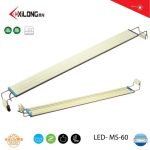 Xilong MS60 16 W aquarium plant light
A tank-top lighting option to consider for low-to-medium-light aquarium planting. The seller lists a 58.5 cm light body and mounting on tanks approximately 65-75 cm long.
Confirm the mounting range, water depth and planted coverage. Keep the unit above water. It is not presented as adequate lighting for high-light species or every aquarium size.
Choose a stable rock or wood surface with gentle water movement. Never bury the rhizome, even when the roots are placed close to substrate.
Use clean, sharp aquascaping scissors. Anubias grows slowly and normally needs only occasional trimming.
Selective leaf removal keeps the plant tidy. Rhizome division controls its spread, but the remaining sections may need several weeks to regain density.
A new section is ready to separate when it has enough leaves and roots to remain stable on its own. Avoid dividing a newly imported, melting, or heavily variegated weak plant.
Slow establishment is normal. Emersed-grown leaves may remain for a long time or may gradually be replaced by leaves produced underwater.
Limited older-leaf loss can be part of adjustment when the rhizome stays firm and roots or new leaves continue to form.
Very pale leaves have little chlorophyll. Growth is extremely slow, and fully white sections may weaken or fail to persist.
Yellowing, holes, twisted leaves, pale new growth, or slow growth do not prove one nutrient deficiency. Similar signs can result from physical damage, algae, adaptation, unstable CO₂, unsuitable light, poor flow, rhizome damage, or changing water conditions.
Old damaged leaves will not repair themselves. Remove only tissue that is fully decayed or no longer useful.
You can write a note about what worked for you, or send a photograph. We check everything before it appears here.
Anubias barteri 'Thick Leaf'
Anubias sp. 'Gabon'
Anubias barteri 'Gigantea'
Anubias sp. 'Chili Jalapeno'