

Bucephalandra Brownie Phantom
Bucephalandra sp. 'Brownie Phantom'
- Care level
- Beginner
- Placement
- Foreground, Hardscape, Midground
- Light
- Low, Medium
- CO₂
- Optional
Plant profile
Bucephalandra sp. 'Brownie Jade'
Common names: Brownie Jade Bucephalandra, Buce Brownie Jade



A slow-growing Bucephalandra trade form with rounded jade-green leaves, a visible central midrib, and possible blue or silvery details on new submerged growth.
This Bucephalandra is known for rounded leaves with a clearly visible central midrib. Older leaves are generally light to dark jade green. Newer leaves may show blue hints and small pale or silvery dots, although the intensity varies with the plant and aquarium.
It grows slowly from a creeping rhizome and forms a textured cluster rather than an upright stem or rosette. It is commonly placed on foreground or midground rocks and wood, where the rounded foliage contrasts with narrow-leaved plants and mosses.
During the first few weeks, expect the plant to concentrate on attachment and adjustment. Visible growth may be limited to new roots or a single new leaf.
A practical starting range is about 20–28 °C and mildly acidic to mildly alkaline freshwater. These are broad aquarium guidelines for unidentified trade-form Bucephalandra, not proven limits for this named form. Avoid sudden changes and watch the actual plant for stress.
No nutrient-rich substrate is required because the plant is normally attached to hardscape. Its exposed roots and leaves can use nutrients from the water column. Dose a complete aquarium fertiliser carefully when the tank’s livestock load and feeding do not provide enough nutrients.
Injected CO₂ is optional. This plant can be grown in a low-tech aquarium without injection when light, fertilising, flow, and water conditions remain stable.
Stable CO₂ may improve the speed and strength of new growth and can help the plant form a denser colony. It may also make colour or surface sheen more noticeable, but it cannot guarantee a particular colour, leaf size, or growth rate.
CO₂ adds another setting that must remain consistent. Sudden changes can make an already slow-growing plant harder to manage. Use moderate light, steady CO₂, and an appropriate fertiliser routine together. Do not raise the light simply because CO₂ is present.
Some links may earn us a commission on qualifying purchases, at no extra cost to you. Check suitability, price and availability with the seller. How affiliate links work
 Neo-Helios S3 Plus Nano 13 W plant light
A compact lighting option to consider for the low-to-medium-light planting described above. The seller specifies tanks about 20-46 cm long and glass up to 15 mm thick.
Check your tank width, depth and planted area before choosing it. This compact unit is not presented as sufficient lighting for every tank or for high-light plants.
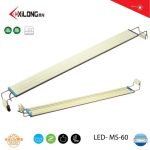 Xilong MS60 16 W aquarium plant light
A tank-top lighting option to consider for low-to-medium-light aquarium planting. The seller lists a 58.5 cm light body and mounting on tanks approximately 65-75 cm long.
Confirm the mounting range, water depth and planted coverage. Keep the unit above water. It is not presented as adequate lighting for high-light species or every aquarium size.
Choose a shaded or moderately lit surface with some water movement. Never bury the rhizome, even when the roots are placed close to substrate.
Because this plant grows slowly, frequent trimming is usually unnecessary. Use clean, sharp aquascaping scissors.
Selective leaf removal keeps the clump tidy. Rhizome division controls its spread and can create separate plants, but density develops slowly after cutting.
The practical propagation method is to divide the rhizome.
A new section is ready to separate when it has enough leaves and roots to remain stable on its own. Avoid dividing a newly purchased or melting plant.
Slow establishment is normal. A newly added plant may spend several weeks producing roots or replacing older leaves before obvious outward growth appears.
Plants grown above water before sale may shed some older leaves while producing leaves better suited to permanent submersion. Limited loss of older leaves can be part of adjustment when the rhizome stays firm and new growth eventually appears.
Leaf colour, size, and density can change under different light and nutrition levels. Compare new growth over several weeks rather than judging the plant from one older leaf.
Yellowing, holes, twisted growth, pale new leaves, or slow growth do not prove one nutrient deficiency. Similar signs can follow physical damage, algae, emersed-to-submersed adjustment, unstable CO₂, unsuitable light, poor flow, root or rhizome damage, or changing water conditions.
Remove only leaves that are fully damaged or decaying. An old damaged leaf will not repair itself, so judge improvement by the next leaves produced.
You can write a note about what worked for you, or send a photograph. We check everything before it appears here.
Bucephalandra sp. 'Brownie Phantom'
Bucephalandra sp. 'Brownie Blue'
Bucephalandra sp. 'Black Pearl'
Bucephalandra sp. 'Artemis'