
Care Guide
Rabbit Snail Care Guide
Rabbit snails are distinctive freshwater snails from Sulawesi, Indonesia, commonly sold under the genus Tylomelania. Their long conical shells, deliberate movement, and unusual faces make them popular in planted and shrimp aquariums. They are not a good choice for every soft-water tank, however, because shell health and long-term care depend on stable mineral-rich conditions.
Rabbit snails also reproduce very differently from pest snails. Rather than producing large jelly-like clutches, many Tylomelania give birth to relatively few well-developed young. That slow reproduction makes each animal more important to protect from poor water, starvation, aggressive tank mates, and shell erosion.

Rabbit Snail Natural History
Tylomelania species are native to Sulawesi freshwater systems, including ancient lakes and associated habitats. Different species and local forms can vary in shell shape, coloration, and environmental preferences.
The aquarium trade uses broad common names such as orange rabbit snail, yellow rabbit snail, and chocolate rabbit snail. Common names do not always identify the species precisely, so avoid assuming every Tylomelania requires exactly the same conditions.
Their slow movement and grazing behavior suit calm aquariums where they can explore substrate, wood, and hardscape without being harassed.
Tank Setup and Water Conditions
Use a fully cycled aquarium with stable water and enough floor space for grazing. Sand or smooth fine gravel allows the snail to move and forage comfortably, while wood and rocks provide additional biofilm surfaces.
Rabbit snails generally benefit from mineral availability that supports shell growth. Very soft acidic water can contribute to shell erosion over time. Test GH, KH, and pH rather than relying on appearance alone.
Keep ammonia and nitrite controlled and avoid abrupt parameter changes. Snails may close up during stress, but remaining withdrawn for long periods is a reason to check water quality and recent changes.
What Rabbit Snails Eat
Rabbit snails graze algae, biofilm, soft plant debris, and other edible material they encounter, but a clean aquarium may not produce enough natural food for a large snail.
Offer appropriate sinking foods and vegetable-based supplements. Place food where the snail can reach it without every fish consuming it first, then remove substantial leftovers before they deteriorate.
Do not use visible algae as the only feeding plan. A snail can slowly lose condition in a spotless tank even while appearing to graze all day.
Rabbit Snails and Live Plants
Rabbit snails are often kept in planted aquariums. They usually spend much of their time grazing surfaces and decaying material, but individual feeding behavior and plant species can vary.
Provide enough supplemental food so the snail is not forced to rely on whatever plant tissue is available. Delicate new growth may be more vulnerable than tough established leaves.
Secure newly planted stems and small carpeting plants because a large snail can uproot them simply by moving through the substrate.
Tank Mates
Peaceful fish and dwarf shrimp are common companions when water chemistry overlaps. Shrimp may graze the snail’s shell without harming it.
Avoid dedicated snail predators such as many puffers and loaches. Large aggressive fish and crayfish can also damage exposed soft tissue.
Compatibility includes chemistry. A fish or shrimp species that requires very soft acidic water may not be the best long-term partner for a snail that needs stronger mineral support.
Rabbit Snail Reproduction
Rabbit snails reproduce slowly compared with common ramshorn or bladder snails. Females can produce a small number of relatively large, developed young rather than laying hundreds of visible eggs around the tank.
This slow reproductive rate means they are unlikely to create the sudden food-driven population explosion associated with many hitchhiking snails.
If young appear, provide the same stable water, safe tank mates, and abundant grazing surfaces used for adults. Tiny juveniles can be more vulnerable to filter intakes and predatory fish.
Shell Health and Common Problems
Pitting, whitening, or erosion of older shell can indicate long-term exposure to unsuitable chemistry, although old damage does not rebuild into a perfect shell. Focus on protecting healthy new shell growth.
Check GH, KH, pH, diet, and source water before adding random calcium products. A measured mineral strategy is safer than repeatedly changing chemistry.
Sudden inactivity can also reflect ammonia, nitrite, temperature shock, or contamination. Snails are sensitive to some fish medications, especially products that are unsafe for invertebrates.
Frequently Asked Questions
Are Rabbit Snails Good for Beginners?
They can be when the keeper can provide stable, mineral-appropriate water, enough food, and peaceful tank mates.
Do Rabbit Snails Eat Live Plants?
They often focus on biofilm and softer material, but feeding behavior can vary. Provide adequate supplemental food and protect delicate plants.
Can Rabbit Snails Live With Shrimp?
Yes when water requirements overlap. Dwarf shrimp are generally behaviorally compatible with them.
Do Rabbit Snails Reproduce Quickly?
No. Tylomelania generally reproduce much more slowly than common pest-type aquarium snails.
Why Is My Rabbit Snail Shell Turning White?
Shell erosion can be associated with unsuitable mineral or acidic conditions. Test GH, KH, and pH and focus on healthy new growth.
Do Rabbit Snails Need Calcium?
They need appropriate mineral availability, but do not add calcium blindly. Build a stable water recipe based on measured hardness.
Can Rabbit Snails Live With Loaches?
Many loaches prey on snails, so they are a poor choice when you want to keep rabbit snails safely.
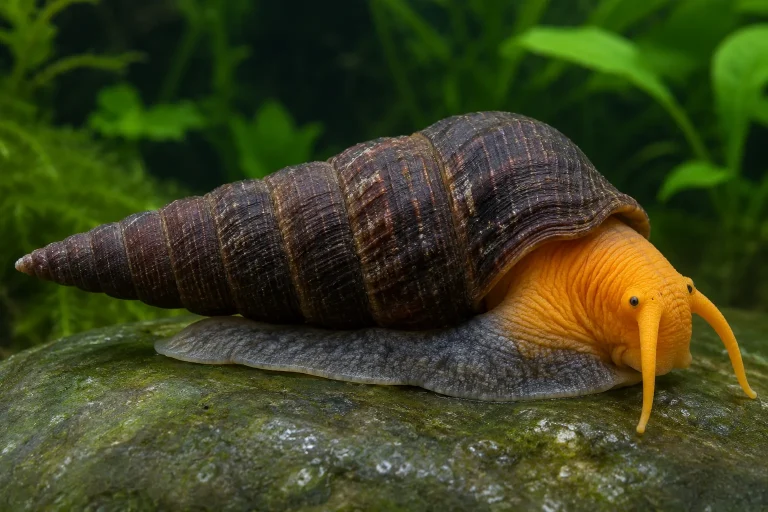
Gold Rabbit Snail
Tylomelania gemmifera
- Care level
- Advanced
- Adult size
- 5–9 cm
- Minimum tank
- 60 litres
- Temperature
- 25–30 °C
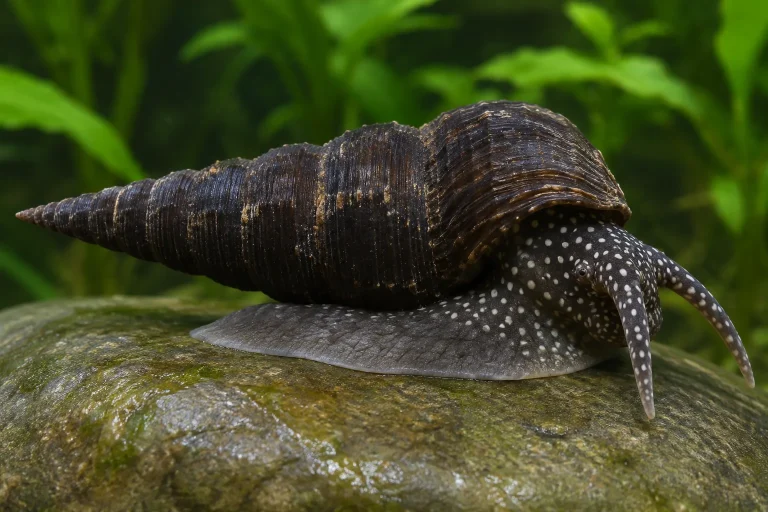
White Spotted Rabbit Snail
Tylomelania sp.
- Care level
- Advanced
- Adult size
- 5–9 cm
- Minimum tank
- 60 litres
- Temperature
- 25–30 °C
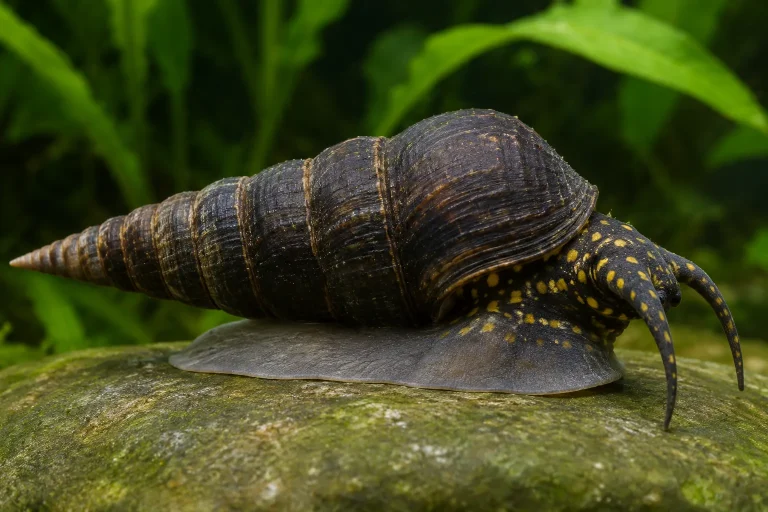
Yellow Spotted Rabbit Snail
Tylomelania towutica
- Care level
- Advanced
- Adult size
- 5–9 cm
- Minimum tank
- 60 litres
- Temperature
- 25–30 °C

Triangle Rabbit Snail
Tylomelania sinabartfeldi
- Care level
- Advanced
- Adult size
- 5–9 cm
- Minimum tank
- 60 litres
- Temperature
- 25–30 °C