
July 23, 2026
Vampire Crab Care Guide
Vampire crabs are often sold beside aquarium animals, but they should not be treated like fully aquatic crabs. The popular ornamental species in the genus Geosesarma are semi-terrestrial animals that spend much of their time on land and use shallow freshwater areas as part of a humid forest-floor habitat.
That makes their enclosure closer to a small tropical paludarium than a conventional fish tank. A successful setup needs secure land, freshwater access, high humidity, hiding places, and an escape-proof lid. Species identification also matters because “vampire crab” is a trade name used for more than one Geosesarma species.

What Are Vampire Crabs?
Vampire crabs are small semi-terrestrial crabs in the genus Geosesarma. Several colorful species from Java and other parts of Southeast Asia appear in the aquarium and terrarium trade. Geosesarma dennerle and G. hagen are among the best-known ornamental species.
Peer-reviewed work on Java’s vampire crabs confirms that these are distinct, habitat-specific species rather than simply color morphs of one universal “vampire crab.” That matters for responsible care and breeding. Whenever possible, buy animals identified to species and avoid mixing visually similar species in the same breeding group.
Their natural history also explains the enclosure design. These are not crabs that should live permanently underwater. They use humid terrestrial habitat associated with streams, wet ground, rocks, vegetation, burrows, and shallow freshwater.
How to Set Up a Vampire Crab Paludarium
The enclosure should provide substantially more usable land than water. Exact layouts vary, but the land portion needs to be stable, humid, and large enough for the crabs to forage, hide, dig, molt, and avoid one another. The water section should be freshwater, easy to enter and exit, and maintained cleanly.
Create gradual access between land and water. Steep smooth walls can trap a crab in the water, while loose rock piles can collapse. Cork bark, aquarium-safe wood, rocks, leaf litter, moss, and live tropical plants can provide cover and visual barriers when arranged securely.
The enclosure must be escape-proof. Vampire crabs climb surprisingly well and can use plants, cables, filter tubing, and decor to reach small gaps. Use a secure lid while still allowing appropriate ventilation.
Substrate
The terrestrial substrate should hold moisture without remaining waterlogged and foul. A layered paludarium substrate or moisture-retentive terrarium mix suited to tropical invertebrates can work, provided it is free from pesticides and harmful additives. Deep areas allow natural digging and retreat behavior.
Water section
The water area does not need to dominate the enclosure. Keep it freshwater, dechlorinated where required, and maintained with partial water replacement or gentle filtration appropriate to the volume. Avoid strong currents that make a small shallow water area difficult for the crabs to use.
Temperature, Humidity, and Water Quality
Vampire crabs need a warm, humid tropical environment rather than a dry terrestrial enclosure. Humidity should be high enough to prevent chronic drying while still allowing ventilation so stagnant, mold-prone conditions do not develop.
Because care ranges reported in the hobby can vary by species and source, avoid treating one temperature or humidity number as universal for every Geosesarma. Use species-specific information when available and measure conditions with a reliable thermometer and hygrometer rather than guessing from how the enclosure feels.
The water area still needs proper water quality. If municipal tap water contains chlorine or chloramine, treat it before use. Remove uneaten food and waste from the water so a small pool does not become polluted quickly.
What Do Vampire Crabs Eat?
Vampire crabs are opportunistic omnivores. A varied captive diet can include appropriately sized invertebrate foods, quality crustacean or omnivore foods, and suitable plant material. The goal is variety rather than depending on one dried food indefinitely.
Offer food on land where it is easy to monitor and remove. Small portions reduce the amount that decomposes in a warm humid enclosure. Uneaten animal protein should not be left to spoil.
Calcium and other minerals are relevant to crustacean exoskeleton formation, but do not treat powdered calcium as a substitute for a balanced diet or appropriate husbandry. Use products designed for invertebrates when supplementation is actually needed.
Molting and Hiding Behavior
Like other crustaceans, vampire crabs grow by molting their exoskeleton. A crab approaching or recovering from a molt may hide more than usual. Provide secluded areas where it cannot be constantly disturbed by tank mates.
A freshly molted crab is vulnerable until the new exoskeleton hardens. Do not pull at an animal that appears to be molting, and avoid dismantling hiding places simply because you have not seen one crab for a few days.
Finding a shed exoskeleton is normal. Do not immediately confuse it with a dead crab. A molt is hollow, while a dead animal contains body tissue.
Can Vampire Crabs Live Together?
Vampire crabs are often kept in small groups, but they are not conflict-free communal animals. Males can be territorial, and cramped enclosures with too few hiding places make encounters harder to avoid.
Provide more usable land area, cover, and visual barriers than the bare minimum needed to physically fit the animals. Multiple hides allow subordinate crabs and freshly molted individuals to retreat.
If you are building a breeding group, avoid keeping multiple unidentified Geosesarma species together. Hybridization, aggression, and loss of species identity are all reasons to keep clearly identified groups separate.
Vampire Crab Tank Mates
A species-focused paludarium is the simplest option. Fish and aquatic invertebrates complicate feeding, water depth, predation, and space use. Small animals may be eaten by the crabs, while larger or aggressive animals can injure them.
Do not choose tank mates based on the idea that the water section is “empty space” that needs to be filled. In a vampire crab enclosure, that water exists first to serve the crabs.
Breeding Vampire Crabs
Many Geosesarma have direct development, meaning females carry relatively large eggs and the young emerge as miniature crabs rather than passing through a long free-swimming marine larval stage. This makes captive breeding possible in an appropriately designed terrestrial paludarium.
Breeding success depends on having correctly identified mature males and females, suitable environmental conditions, enough food, and safe cover for juveniles. Tiny young can disappear into leaf litter and moss, so an enclosure that looks richly structured to you can provide important nursery habitat.
Adults may still prey on very small young opportunistically, so dense cover and adequate space matter. Do not assume every juvenile will survive simply because the species can reproduce in freshwater conditions.
Common Vampire Crab Care Mistakes
Keeping them in a fully aquatic tank
Vampire crabs are semi-terrestrial and need substantial land area.
Using an open-top enclosure
They can climb and escape through surprisingly small gaps.
Keeping the land permanently soggy
High humidity is important, but stagnant waterlogged substrate can create poor conditions. Moisture and ventilation both matter.
Providing too few hiding places
Cover is especially important for territorial interactions and molting animals.
Buying several trade colors and assuming they are the same species
The vampire crab trade includes multiple Geosesarma species. Species identification matters for breeding and long-term care.
Frequently Asked Questions
Are Vampire Crabs Fully Aquatic?
No. Popular Geosesarma vampire crabs are semi-terrestrial and need a paludarium with substantial usable land plus access to freshwater.
Do Vampire Crabs Need a Filter?
A small water section still needs clean water. Gentle filtration can be useful where the water volume and layout support it, while very small pools may instead be maintained through careful partial water replacement and waste removal.
Can Vampire Crabs Live Together?
They can be kept in appropriately structured groups, but males may be territorial. Provide enough land, multiple hides, visual barriers, and avoid overcrowding.
What Do Vampire Crabs Eat?
They are opportunistic omnivores. Offer a varied diet of suitable invertebrate or crustacean foods, appropriate animal protein, and plant material rather than relying on one food.
Can Vampire Crabs Live With Fish?
A species-focused paludarium is usually simpler. Fish add complications involving water volume, predation, feeding, and space, and small fish may be vulnerable to crabs.
Do Vampire Crabs Breed in Freshwater?
Many Geosesarma have direct development, with females carrying eggs that develop into miniature crabs rather than marine larvae. Breeding details still vary by species.
Conclusion
Vampire crab care begins with understanding that these are semi-terrestrial Geosesarma, not ordinary aquarium crabs. Build the enclosure around usable land, humidity, secure hiding places, shallow freshwater access, and escape prevention.
Keep the diet varied, allow molting crabs to hide, avoid overcrowding, and identify the species whenever possible. A well-designed paludarium is more important than filling the enclosure with tank mates or complicated equipment.
Sources
The Vampire Crabs of Java, with Descriptions of Five New Species — Raffles Bulletin of Zoology, 2019: Peer-reviewed taxonomic work documents Java’s Geosesarma vampire crabs and provides authoritative species and habitat context for understanding these semi-terrestrial crabs.
Morphological and Molecular Tracing of Two Ornamental Vampire Crabs from Central Java — Arthropoda Selecta, 2024: Peer-reviewed research on Geosesarma dennerle and G. hagen confirms that these popular ornamental vampire crabs occupy similar Central Javan habitats and are distinct species.
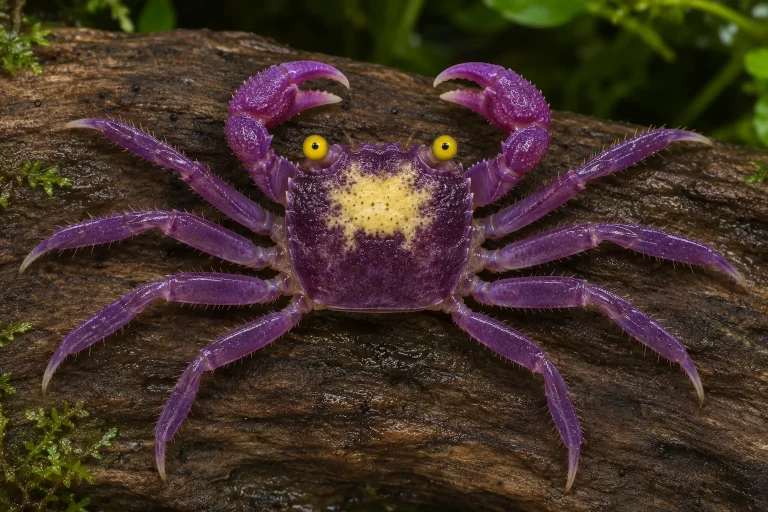
Vampire Crab
Geosesarma dennerle
- Care level
- Intermediate
- Adult size
- 2–3 cm
- Minimum tank
- 45 litres
- Temperature
- 24–28 °C
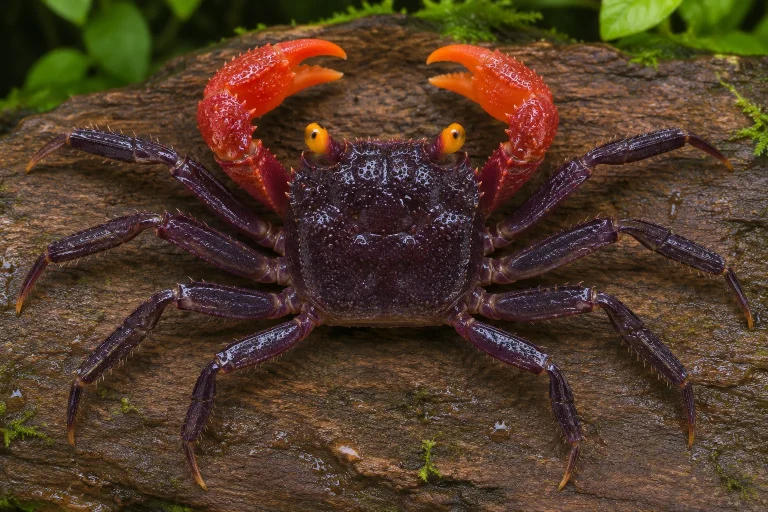
Red Devil Crab
Geosesarma hagen
- Care level
- Intermediate
- Adult size
- 2–3 cm
- Minimum tank
- 45 litres
- Temperature
- 24–28 °C