
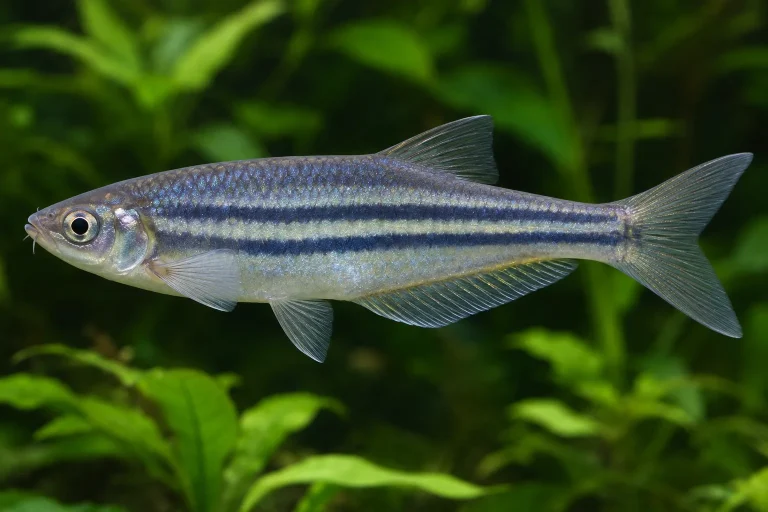
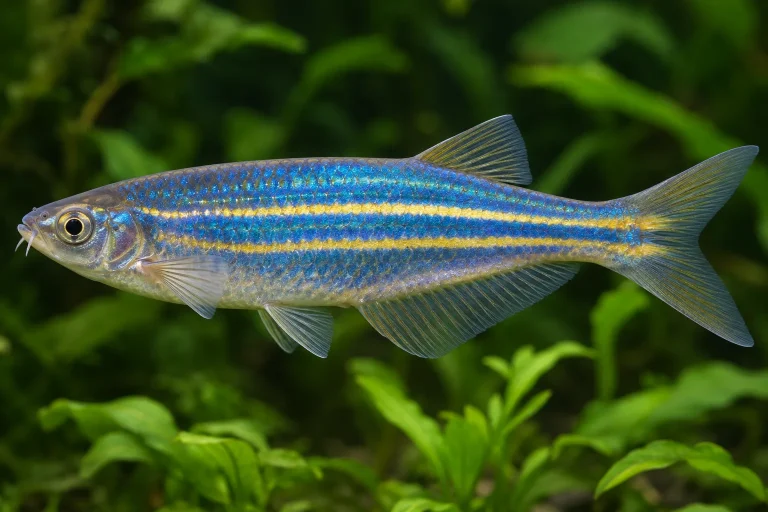
False Giant Danio
Devario affinis
- Care level
- Intermediate
- Adult size
- 6–8 cm
- Minimum tank
- 150 litres
- Temperature
- 20–26 °C
Species profile
Danio erythromicron
Common names: Emerald Dwarf Danio, Emerald Rasbora
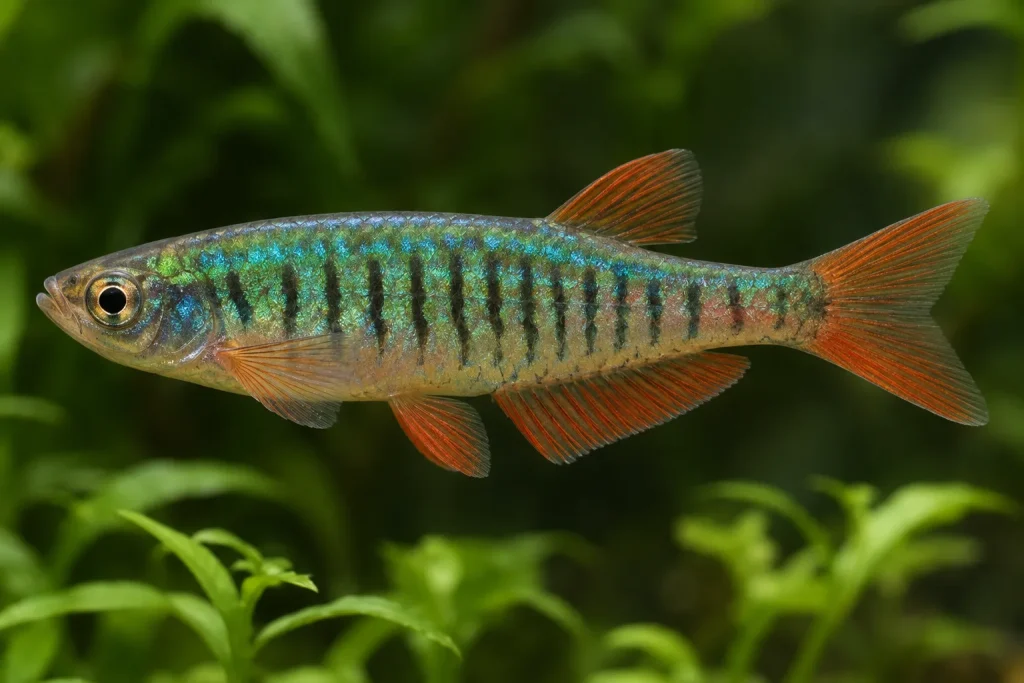
Up to 3 cm
Typical adult length 2.5–3 cm.


Emerald Dwarf Danio is a small to medium schooling danio requiring a group, a secure lid, clean oxygen-rich water, and at least 45 litres.
A tiny turquoise to emerald fish with narrow dark vertical bars and orange-red colour in the fins.
Often sold under the older name Microrasbora erythromicron. It is deeper-bodied and vertically barred compared with Celestial Pearl Danio.
Males are generally slimmer and show stronger emerald colour with brighter red-orange fins. Females are fuller through the abdomen and often appear paler or more golden.
Keep a group of at least 8 in an aquarium at least 60 cm long. Provide open swimming space, secure cover, efficient filtration, and moderate water movement.
Use plants, wood, and rounded stone around the margins while preserving a clear central swimming area.
Dense planting, moss, fine-leaved cover, and shaded margins help these small fish feel secure, while a clear central area allows normal group movement.
Emerald Dwarf Danio is a social, active schooling fish that should be maintained with its own kind. Most chasing is part of normal group interaction, but cramped quarters or a group that is too small can concentrate aggression.
Maintain at least 8, preferably 12 or more. A larger group produces more natural schooling and spreads chasing. Not truly territorial, although males may spar or defend short-lived display positions within the group. These smaller species often look more confident in a well-planted aquarium and may spend less time in the open when kept with large or restless tankmates.
Best kept with small, peaceful fish that will not dominate feeding time or keep the group in hiding. Avoid large, predatory, highly territorial, or very boisterous tankmates. Adult dwarf shrimp may coexist in a mature planted tank, but eggs, larvae, and shrimplets remain potential food.
Use clean, oxygen-rich water with moderate mineral content. Avoid abrupt drops in hardness or pH.
Some links may earn us a commission on qualifying purchases, at no extra cost to you. Check suitability, price and availability with the seller. How affiliate links work
 Manual aquarium siphon and gravel cleaner
A manual siphon for routine aquarium water changes and accessible waste removal. The seller lists a hose approximately 1.6 m long.
Control the flow and keep the intake clear of fish and delicate planting. Clean the areas appropriate for your substrate and layout rather than disturbing the entire planted bed.
 Dr. Tank tap-water conditioner – 250 ml
A tap-water conditioner option for the moderately mineralised water described in this profile. The seller states that it treats chlorine/chloramine and contains added minerals.
Use the current label instructions for the water being treated. Check the formulation against your water and stocking; this mineral-containing product is not automatically recommended for very soft-water setups.
Use finely crushed flakes, micro-pellets, cyclops, small Daphnia, microworms, and newly hatched Artemia that can be swallowed easily. Offer modest portions that the school can finish promptly, and distribute food across the surface or current so subordinate fish have access. A varied diet supports colour, condition, and breeding readiness better than relying on one dry food. These small fish can be hesitant feeders in busy communities, so confirm that food reaches them.
Feed small portions once or twice daily. Active danios feed quickly, so check that slower tankmates receive food.
This species is an egg scatterer with no parental care. Well-conditioned adults may spawn among moss, fine-leaved plants, or a spawning mop, often over several days. Adults and older fry may eat eggs or newly hatched fry, so breeders should be removed or eggs collected into a separate rearing container. Begin the smallest fry on infusoria or another microscopic first food, then move to microworms and newly hatched Artemia as they grow.
You can write a note about what worked for you, or send a photograph. We check everything before it appears here.
Devario affinis
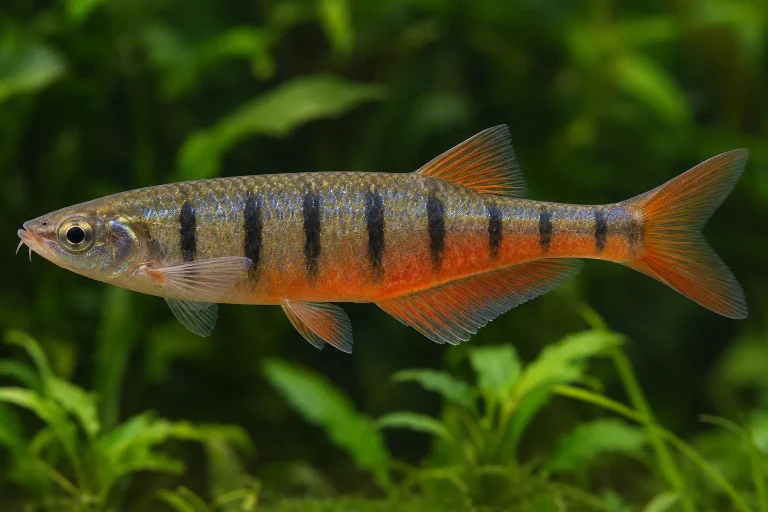
Inlecypris maetaengensis
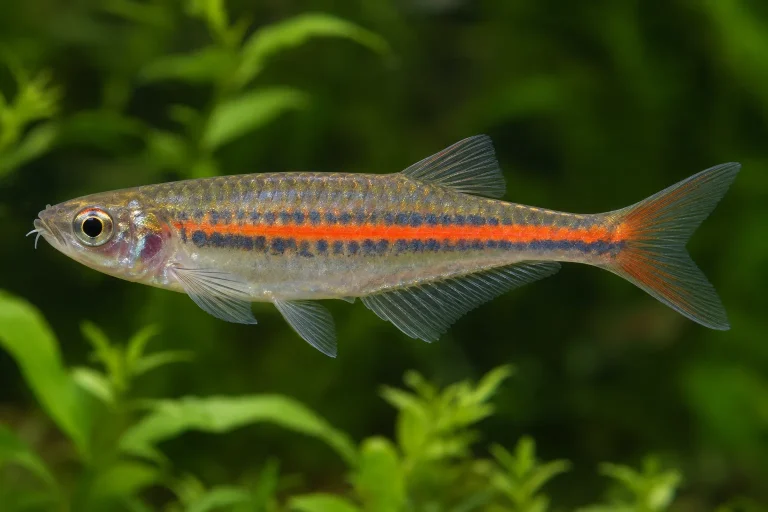
Devario sondhii
Devario aequipinnatus