Skip to content
Menu

Species profile

Dwarf Orange Crayfish

Cambarellus patzcuarensis

Common names: Dwarf Orange Crayfish, CPO Crayfish, Mexican Dwarf Orange Crayfish, Cambarellus patzcuarensis Orange
Colour varietyDwarf Crayfish
Dwarf Orange Crayfish (Cambarellus patzcuarensis)

Adult size

Up to 5 cm

Typical adult length 3–5 cm.
Up to 5 cm

Countries of origin

  • See all stock from Mexico

Good fit for your tank?

Good fit for

  • Mature planted aquarium setups
  • Intermediate shrimp keepers
  • Peaceful nano aquariums
  • Breeding colonies

Think carefully if

  • The aquarium contains shrimp-eating fish
  • The tank is newly cycled
  • You want to preserve another Cambarellus colour line
  • Water conditions change frequently

A selectively bred orange colour form of the small Mexican crayfish Cambarellus patzcuarensis.

Appearance and Identification

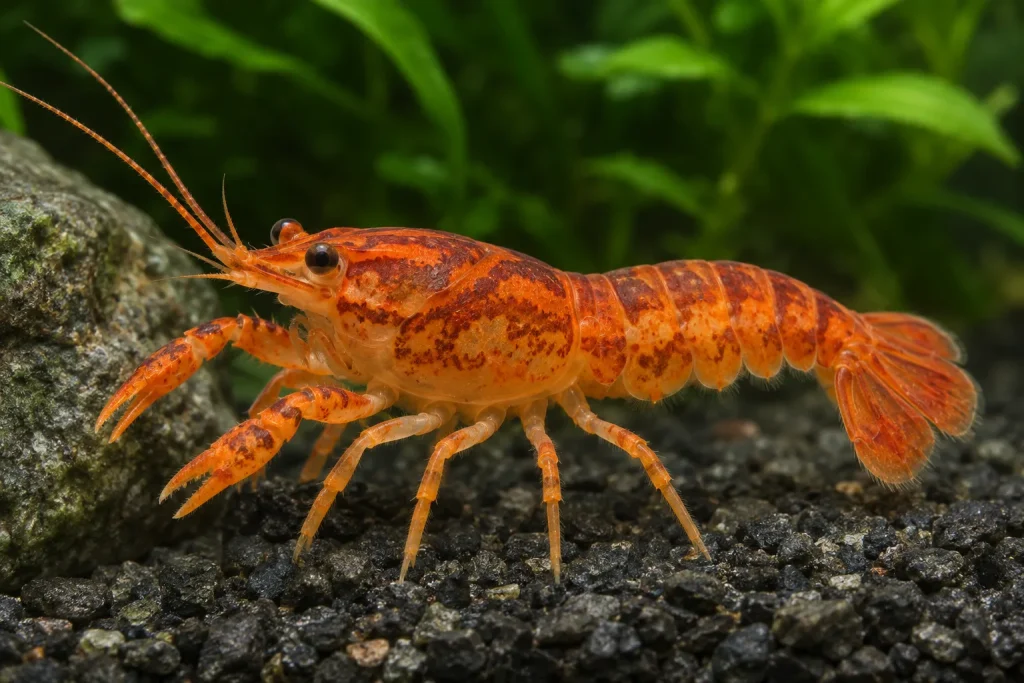
Bright orange to reddish-orange body colour, often with darker marbling, stripes, or mottling across the carapace and abdomen.

The accepted species is Cambarellus patzcuarensis. “Orange” or “var. Orange” is an aquarium-trade colour form and should not be included as a formal scientific variety name.

Mature males have modified first swimmerets used in mating; females have a broader abdomen for carrying eggs.

Tank Requirements

Suggested filter
About 120–150 litres an hour
Suggested heater
About 25–50 W for this tank
Minimum tank volume
30 litres
Minimum tank length
45 cm
Minimum group size
1
Recommended group size
3
Activity level
Moderate
Flow preference
Low to moderate
Planting preference
Heavily planted
Hiding places
Yes
Lid recommended
Yes
Jumping risk
Moderate

Provide many caves, leaf litter, plants, and visual barriers. Use a secure lid and sponge-protected filter intakes.

Behaviour and Tankmates

Active dwarf crayfish that explores plants, substrate, and hardscape and may defend small shelters.

Can sometimes be maintained in a group when the aquarium has many separated shelters, but aggression and limb loss remain possible.

Moderately territorial, especially during moulting and around caves.

More community-compatible than large crayfish, but small shrimp, slow fish, snails, eggs, and moulting animals remain at risk.

Check tankmates for this species

Water Parameters

Temperature
20–25 °C
pH
6.8–8
GH
6–15
KH
3–12
TDS
150–320
Stability importance
Very important

Provide mineralized, well-filtered water, multiple shelters, and a secure lid. Stable hardness is especially important during moulting.

Parameter caveat
Stability is more important than chasing an exact number.

Feeding

Diet types
Omnivore, Predator, Scavenger
Feeding frequency
Daily
Preferred foods
  • Complete dwarf-crayfish foodUse as the dietary base.
  • Leaf litter and vegetablesProvides fibre and grazing material.
  • Small animal-based foodOffer in moderate portions.

Omnivorous scavenger. Feed complete crustacean food, vegetables, leaf litter, and moderate animal protein.

Feed in several places when keeping a group, and provide mineral availability for moulting.

Breeding

Breeding type
Direct Developer, Egg Brooder
Breeding difficulty
Easy
Breeding temperature
22 °C
Breeding pH
7.4
Brood or egg count
Approximately 20–60 eggs
Incubation
28 days
Parental care
Maternal care
Baby foods
  • Fine complete crustacean food and biofilmProvide moss, leaf litter, and many small shelters.

Females carry eggs and hatchlings beneath the abdomen. Juveniles develop directly but require dense shelter to reduce predation and cannibalism.

Habitat and Origin

Geographic origin
Lake Pátzcuaro, Mexico
Natural habitat
Freshwater Wetland, Lake, Vegetated Shoreline
Aquarium contexts
Freshwater Community, Planted Aquarium, Species-Only Aquarium
Audience level
Intermediate

Classification

Profile type
Colour variety
Genus
Cambarellus
Family
Cambaridae
Species group
Dwarf Crayfish

Have you kept this species?

You can write a note about what worked for you, or send a photograph. We check everything before it appears here.

Share a note or photo

JPG, PNG, or WebP, up to 5 MB.