

Mendezi Dwarf Cichlid
Apistogramma mendezi
- Care level
- Intermediate
- Adult size
- 5 cm
- Minimum tank
- 40 litres
- Temperature
- 23–29 °C
Species profile
Apistogramma macmasteri
Common names: Macmaster's Apistogramma, Macmaster's Dwarf Cichlid, Macmasteri Apisto
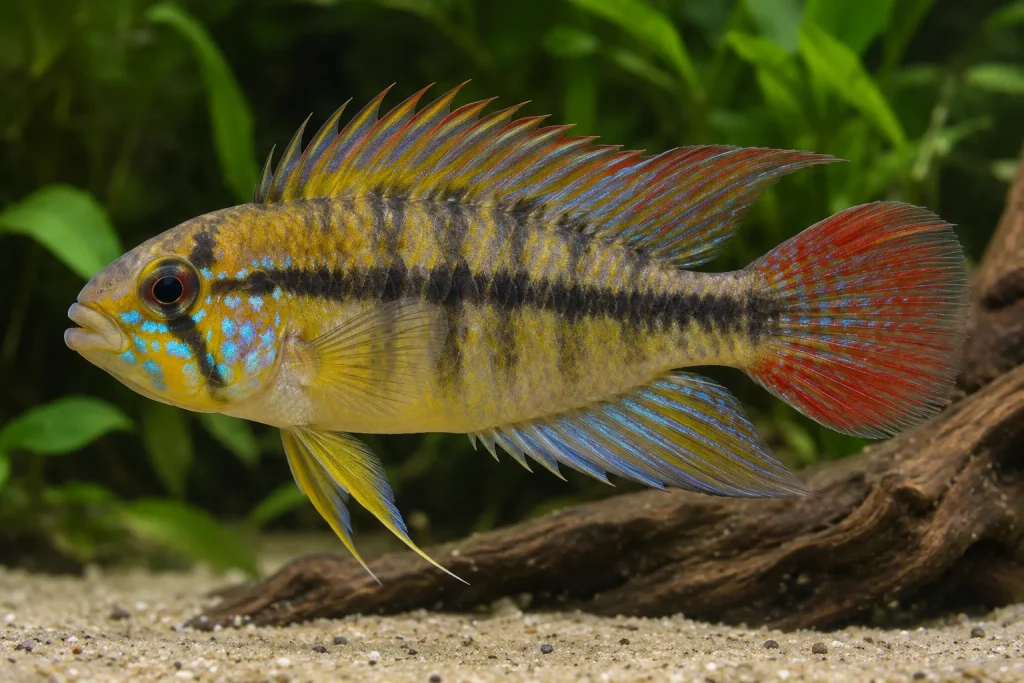
Up to 7 cm
Typical adult length 4–7 cm.


A Colombian dwarf cichlid that needs warm, soft water, leaf-litter cover, caves, and carefully managed territories.
A compact dwarf cichlid with dark vertical barring, a variable lateral stripe, and yellow, blue, red, or orange colour depending on sex, mood, and breeding line. Mature males are larger and often develop extended dorsal and caudal-fin rays.
Trade names and domestic colour strains can be confusing. Confirm the scientific name and breeder lineage; do not identify the species only from a red or gold colour pattern.
Males are normally larger, more elongated, and more brightly coloured, with longer fin extensions. Females are smaller and rounder and commonly become strongly yellow when breeding or guarding fry.
Prioritize floor space, visual barriers, caves, leaf litter, driftwood, and quiet lower-level territory. Keep one male with multiple females only where the aquarium provides several separated shelters; otherwise keep a compatible pair or a single specimen.
Usually reserved outside breeding, but territorial and much more defensive around caves and fry. Females can be particularly assertive near a brood.
A pair may be kept in a suitably structured aquarium. In larger layouts, one male may be kept with several females when each female has a separate refuge and line-of-sight breaks.
Territorial, especially during breeding. Do not assume a peaceful community setting will remain peaceful once a female has eggs or fry.
Use calm fish that do not crowd caves or dominate food. Avoid large cichlids, aggressive bottom dwellers, active fin-nippers, and small shrimp colonies where shrimplet survival is important.
Published species-level information describes warm, soft, acidic freshwater. Maintain low nitrate and stable conditions rather than making abrupt changes to reach one target number.
Some links may earn us a commission on qualifying purchases, at no extra cost to you. Check suitability, price and availability with the seller. How affiliate links work
 Manual aquarium siphon and gravel cleaner
A manual siphon for routine aquarium water changes and accessible waste removal. The seller lists a hose approximately 1.6 m long.
Control the flow and keep the intake clear of fish and delicate planting. Clean the areas appropriate for your substrate and layout rather than disturbing the entire planted bed.
An omnivorous micropredator that accepts fine prepared foods but benefits from regular small live or frozen invertebrate foods.
Do not rely only on floating foods. Feed near cover and monitor subordinate females during territorial periods.
A cave spawner. The female attaches a clutch inside a cave and provides maternal egg, larval, and fry care; the male may defend the wider territory. FishBase reports roughly 60–120 eggs and female care of eggs and larvae. A separate breeding aquarium is recommended when fry survival matters.
You can write a note about what worked for you, or send a photograph. We check everything before it appears here.
Apistogramma mendezi
Apistogramma nijsseni
Apistogramma hongsloi
Apistogramma eremnopyge