

Ghost Discus
Symphysodon aequifasciatus var. "Ghost"
- Care level
- Advanced
- Adult size
- 15–18 cm
- Minimum tank
- 350 litres
- Temperature
- 27–31 °C
Species profile
Symphysodon
Common names: Discus, Discus Fish
Up to 20 cm
Typical adult length 14–20 cm.




A genus-level profile for wild and captive discus, warm-water shoaling cichlids requiring stable conditions, excellent water quality, and careful social management.
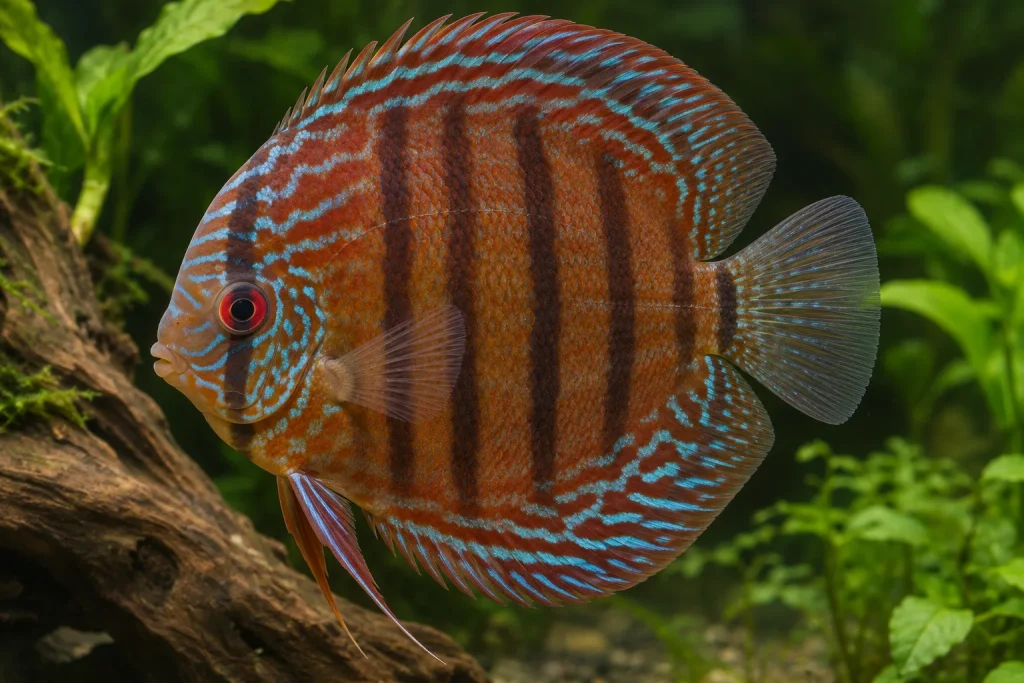
Discus are strongly compressed, nearly circular cichlids with vertical bars and extensive blue, green, red, brown, or patterned colour. Domestic strains vary greatly.
This is a genus-level husbandry profile. Wild locality forms and captive strains should be labelled more specifically when their species or breeding line is known.
Sexes are difficult to separate visually. Mature males may be larger with a broader head, but the breeding tubes and spawning behaviour are more reliable.
Keep a group of at least five or six in a tall, mature aquarium with excellent filtration, calm flow, open feeding space, vertical cover, and warm stable water. Quarantine all additions.
A calm, hierarchical shoaling cichlid that can become shy, bullied, or food-deprived when kept in too small a group.
Groups form a pecking order. Pairs separate to spawn and may need their own breeding aquarium.
Breeding pairs defend a vertical surface and surrounding area; outside breeding, aggression is mainly social ranking.
Use calm warm-water tank mates that do not nip fins, dominate food, or require cooler water. Small fish and shrimp may be eaten.
Wild fish generally need softer, more acidic water than long-established domestic strains. Temperature and water cleanliness must remain consistently high.
Some links may earn us a commission on qualifying purchases, at no extra cost to you. Check suitability, price and availability with the seller. How affiliate links work
 Manual aquarium siphon and gravel cleaner
A manual siphon for routine aquarium water changes and accessible waste removal. The seller lists a hose approximately 1.6 m long.
Control the flow and keep the intake clear of fish and delicate planting. Clean the areas appropriate for your substrate and layout rather than disturbing the entire planted bed.
An omnivorous micropredator that benefits from varied pellets, frozen invertebrates, and clean live foods.
Feed several small meals daily. Avoid mammal heart mixtures as a staple and remove uneaten food quickly in warm water.
Discus form pairs and lay eggs on vertical surfaces. Both parents guard the clutch and produce epidermal mucus that feeds newly free-swimming fry.
You can write a note about what worked for you, or send a photograph. We check everything before it appears here.
Symphysodon aequifasciatus var. "Ghost"
Symphysodon aequifasciatus var. "Golden"
Symphysodon aequifasciatus var. "Golden Snakeskin"
Symphysodon tarzoo