Skip to content
Menu

Species profile

Peaceful Betta

Betta imbellis

Common names: Peaceful Betta, Crescent Betta, Betta imbellis
Recognized speciesBettas
Peaceful Betta (Betta imbellis)

Adult size

Up to 6 cm

Typical adult length 5–6 cm.

Up to 6 cm

Countries of origin

  • See all stock from Indonesia
  • See all stock from Malaysia
  • See all stock from Thailand

Good fit for your tank?

Good fit for

  • A quiet, species-focused planted tank
  • A keeper interested in natural, wild-type bettas
  • Breeding projects with a confirmed line

Think carefully if

  • You want a busy community aquarium
  • You keep the water hard and cannot soften it
  • You cannot separate fish if conflict develops

A wild-type betta from southern Thailand, Malaysia, and Sumatra. It is calmer than the Siamese Fighting Fish, but it is still best kept in a quiet, species-focused aquarium.

Appearance and Identification

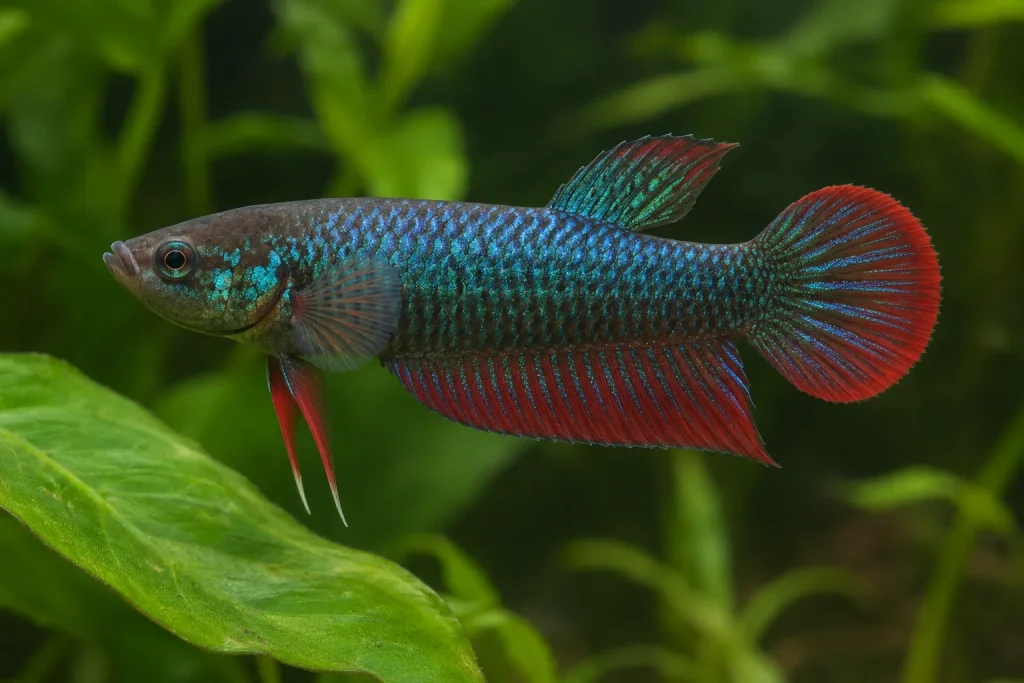
A slim blue-green iridescent fish with a red crescent or edge on the tail and red in the fins. Colour is strongest in settled, mature males.

Wild-type bettas are easily confused. This species readily hybridises with Betta splendens, so buy from a seller who can confirm the origin of the fish.

Males are more colourful and develop extended fins as they mature. Females are duller and shorter-finned.

Tank Requirements

Suggested filter
About 80–120 litres an hour
Suggested heater
About 50–75 W for this tank
Minimum tank volume
40 litres
Minimum tank length
45 cm
Minimum group size
1
Recommended group size
2
Activity level
Low
Flow preference
Very low
Planting preference
Heavily planted
Hiding places
Yes
Lid recommended
Yes
Jumping risk
Moderate

Use dense planting, leaf litter, floating plants, and caves or tubes to break sightlines. Keep a tight lid so the air above the water stays warm and humid.

Behaviour and Tankmates

Calm and rather shy compared with domestic bettas. Males display to each other, usually with less intensity.

Best kept alone or with very peaceful species. More than one male can share a tank when there is enough cover.

Males are mildly territorial, and pairs need separate space when breeding.

Not recommended for standard community tanks. If you do add tankmates, choose very peaceful, small fish that will not nip. Shrimp may be eaten.

Check tankmates for this species

Water Parameters

Temperature
20–28 °C
pH
5–7.5
GH
1–10
Stability importance
Important

Soft, slightly acidic water suits this species. Change water gently, and avoid sudden swings.

Parameter caveat
Calmer does not mean harmless. Watch for persistent chasing, and be ready to separate fish.

Feeding

Diet types
Carnivore, Insectivore
Feeding frequency
Once or twice daily
Preferred foods
  • Small granules or betta pelletsWild-type fish may take time to accept these, so offer them alongside other food.
  • Frozen or live daphnia and brine shrimpGood everyday variety and useful for conditioning.
  • Mosquito larvaeClose to natural prey, and strongly encourages breeding condition.

A micropredator that takes small live and frozen foods, and usually accepts prepared foods too.

Feed small amounts and remove leftovers, particularly in a small tank.

Breeding

Breeding type
Bubble Nest
Breeding difficulty
Moderate
Brood or egg count
Typically dozens to a few hundred eggs
Incubation
2 days
Parental care
Bubble-nest care
Baby foods
  • Infusoria or parameciumEssential for the first days, because labyrinth fry are tiny and cannot yet take larger food.
  • Vinegar eels or microwormsIntroduce as the fry grow, and offer in small amounts to protect water quality.
  • Newly hatched brine shrimpIntroduce once the fry can swallow it, usually after one to two weeks.

A bubble nester. The male builds the nest, often in a tube, canister, or under a broad leaf, and spawns with the female in an embrace beneath it. The female catches the eggs, and the male moves them to the nest and guards them. Eggs hatch in 24 to 48 hours, and fry need humid air and infusoria-grade food for their first few days.

Habitat and Origin

Geographic origin
Indonesia, Malaya, Malaysia, Southeast Asia, Sumatra, Thailand
Natural habitat
Blackwater, Rice Field, Swamp, Vegetated Shoreline
Aquarium contexts
Breeding Aquarium, Nano Aquarium, Planted Aquarium, Species-Only Aquarium
Audience level
Intermediate

Classification

Profile type
Recognized species
Genus
Betta
Family
Osphronemidae
Species group
Bettas, Fish, Wild Bettas

Have you kept this species?

You can write a note about what worked for you, or send a photograph. We check everything before it appears here.

Share a note or photo

JPG, PNG, or WebP, up to 5 MB.