Skip to content
Menu

Species profile

Lambchop Rasbora

Trigonostigma espei

Common names: Lambchop Rasbora, Espe's Rasbora
Recognized speciesRasboras
Lambchop Rasbora (Trigonostigma espei)

Adult size

Up to 3 cm

Typical adult length 2.5–3 cm.

Up to 3 cm

Countries of origin

  • See all stock from Cambodia
  • See all stock from Laos
  • See all stock from Thailand
  • See all stock from Vietnam

Good fit for your tank?

Good fit for

  • A small planted community aquarium
  • A calm tank with soft water
  • Fish that will not bother dwarf shrimp adults

Think carefully if

  • You keep large or boisterous fish
  • Your water is very hard
  • The tank is new or unstable

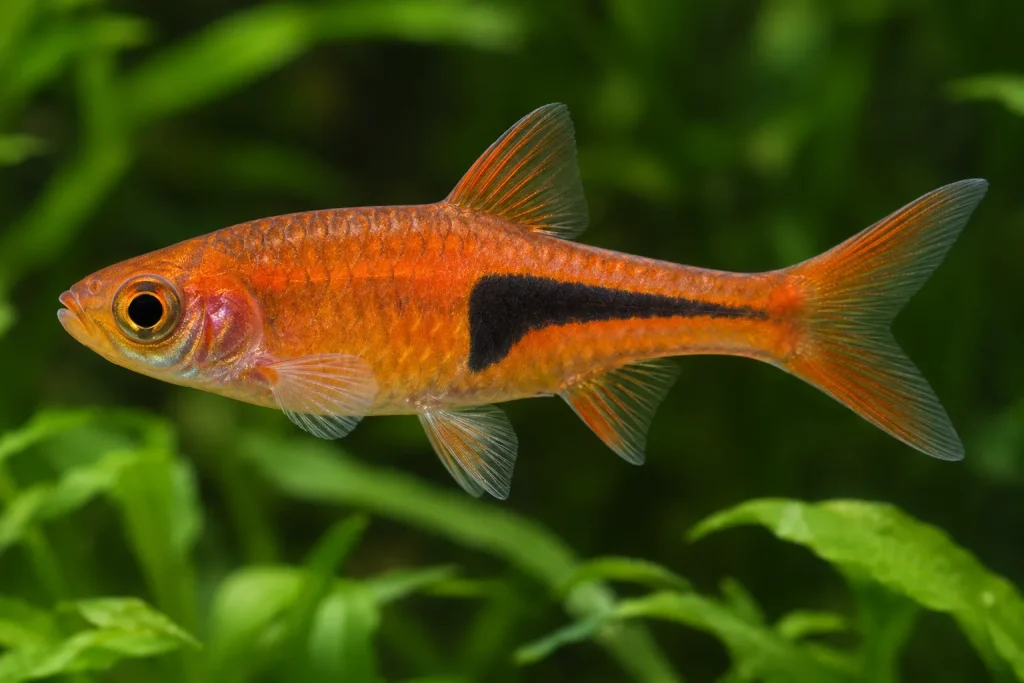
A small orange rasbora with a slim black marking shaped like a lamb chop. It is a very peaceful fish that suits small planted aquariums.

Appearance and Identification

A slim, bright orange to copper fish with a narrow black marking on the rear flank, which widens toward the front.

The narrow lamb-chop marking separates this fish from the Harlequin Rasbora. The similar Trigonostigma hengeli is also sold, and care is much the same.

Females are rounder-bellied and often slightly larger, with a more rounded marking. Males are slimmer and more colourful, with a sharper-edged marking.

Tank Requirements

Suggested filter
About 110–170 litres an hour
Suggested heater
About 50–75 W for this tank
Minimum tank volume
55 litres
Minimum tank length
60 cm
Minimum group size
8
Recommended group size
10
Activity level
Moderate
Flow preference
Low
Planting preference
Heavily planted
Hiding places
Yes
Lid recommended
Yes
Jumping risk
Low

Provide dense planting with broad leaves, along with soft light and low flow. Dark backgrounds help bring out the colour.

Behaviour and Tankmates

A very peaceful, schooling fish that moves in a tight group when it feels alarmed.

Keep at least 8 to 10.

Not territorial.

Good with small peaceful fish such as ember tetras, chili rasboras, small corydoras, and otocinclus. Avoid large or fast fish. Shrimplets may be eaten.

Check tankmates for this species

Water Parameters

Temperature
23–28 °C
pH
5.5–7.5
GH
1–10
Stability importance
Important

Soft, slightly acidic water is best. Change water gently and keep nitrate low.

Parameter caveat
Acclimate slowly. Wild-caught fish are sometimes sold and are less adaptable than farm-bred fish.

Feeding

Diet types
Insectivore, Omnivore
Feeding frequency
Once or twice daily
Preferred foods
  • Fine micro granules or crushed flakeUse a particle size the fish can swallow whole, and feed only what is eaten within a couple of minutes.
  • Frozen or live daphnia and cyclopsSmall crustaceans add variety and help bring adults into breeding condition.
  • Frozen or newly hatched brine shrimpA good small meat food a few times a week rather than the only food.

An omnivore that needs small foods because of its small mouth.

Crush food finely if needed, and feed where the group gathers.

Breeding

Breeding type
Egg Layer
Breeding difficulty
Moderate
Brood or egg count
Typically dozens of small eggs
Incubation
2 days
Parental care
None
Baby foods
  • Infusoria or parameciumNeeded for the first days after fry become free-swimming, because the fry are very small.
  • Fine powdered fry foodUse sparingly as a supplement, and siphon out anything left uneaten.
  • Newly hatched brine shrimpIntroduce once the fry are large enough to swallow it, usually after several days.
  • MicrowormsA useful next step for fry that are still too small for brine shrimp.

No parental care. Eggs are laid on the underside of broad leaves, and adults eat eggs, so remove them after spawning. Eggs hatch in about 24 to 48 hours, and fry are free-swimming in about a week.

Habitat and Origin

Geographic origin
Cambodia, Laos, Southeast Asia, Thailand, Vietnam
Natural habitat
Freshwater Stream, Slow River, Swamp
Aquarium contexts
Breeding Aquarium, Planted Aquarium
Audience level
Beginner

Classification

Profile type
Recognized species
Genus
Trigonostigma
Family
Danionidae
Species group
Fish, Rasboras

Have you kept this species?

You can write a note about what worked for you, or send a photograph. We check everything before it appears here.

Share a note or photo

JPG, PNG, or WebP, up to 5 MB.