Skip to content
Menu

Species profile

Chili Rasbora

Boraras brigittae

Common names: Chili Rasbora, Mosquito Rasbora, Mosquito Fish
Recognized speciesRasboras
Chili Rasbora (Boraras brigittae)

Adult size

Up to 2 cm

Typical adult length 1.5–2 cm.

Up to 2 cm

Countries of origin

  • See all stock from Indonesia

Good fit for your tank?

Good fit for

  • A heavily planted nano aquarium
  • A shrimp tank where fish need to be very small
  • A soft-water blackwater-style setup

Think carefully if

  • Your water is hard or alkaline
  • Your tankmates have large mouths
  • You rely on an unguarded filter intake

A tiny red and black rasbora from Borneo that reaches only about 2 cm. It suits well-planted nano aquariums and is one of the safest fish to keep with dwarf shrimp.

Appearance and Identification

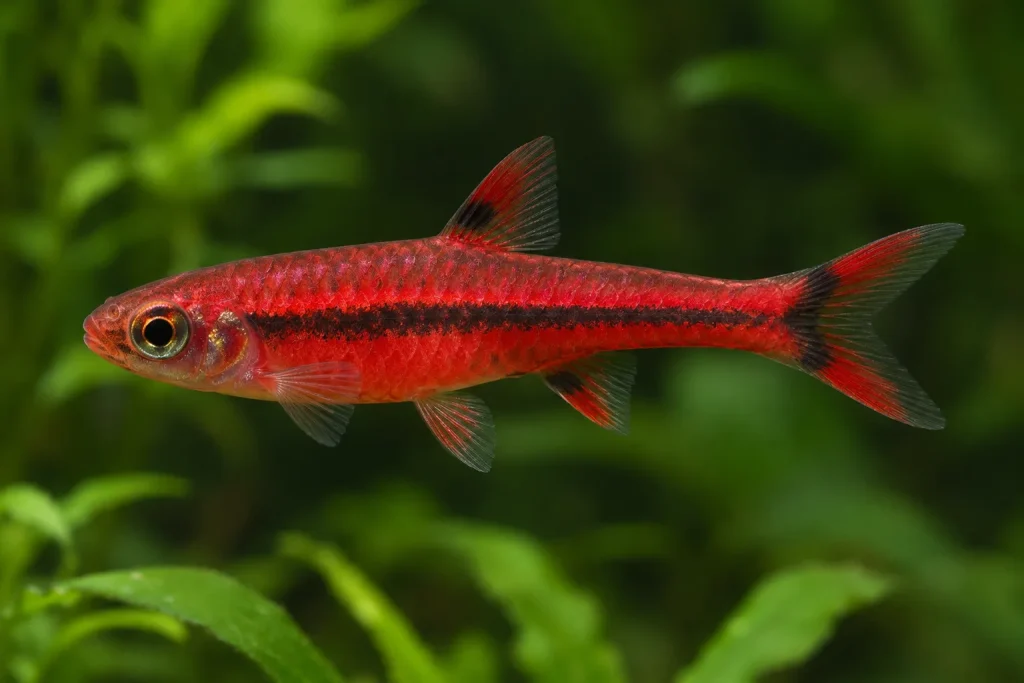
A tiny, slender fish with a deep red body and a dark lateral stripe, along with red and black marks on the fins. Dominant males show the most intense colour.

Several similar Boraras species are sold under this name or as Phoenix Rasbora. Care is much the same, and the differences are in the exact pattern.

Females are rounder-bellied and often slightly larger. Males are more colourful, and dominant males show intense colour.

Tank Requirements

Suggested filter
About 80–120 litres an hour
Suggested heater
About 50–75 W for this tank
Minimum tank volume
40 litres
Minimum tank length
45 cm
Minimum group size
8
Recommended group size
10
Activity level
Moderate
Flow preference
Very low
Planting preference
Heavily planted
Hiding places
Yes
Lid recommended
Yes
Jumping risk
Low

Use dense plants, leaf litter, and dim light with a gentle sponge filter. Open intakes and strong flow are a real danger to such a small fish.

Behaviour and Tankmates

A very peaceful fish that holds loose groups among plants. Males display to each other without harm.

Keep at least 8 to 10. Bigger groups show better colour and settle more quickly.

Dominant males may display, but this is harmless.

Best alone or with very small, peaceful fish and dwarf shrimp. Adult shrimp are safe, though the smallest shrimplets may occasionally be taken. Do not keep with larger fish.

Check tankmates for this species

Water Parameters

Temperature
20–28 °C
pH
4–7
GH
1–10
Stability importance
Important

Soft, acidic water is best. Peat or leaf litter can help, but avoid pushing the pH down quickly.

Parameter caveat
Small tanks change quickly. Dose carefully, change water gently, and keep ammonia and nitrite at zero.

Feeding

Diet types
Insectivore, Omnivore
Feeding frequency
Once or twice daily
Preferred foods
  • Crushed micro granulesUse the smallest size available, because standard granules are too large.
  • Newly hatched brine shrimpAn excellent food, and well worth the effort for conditioning.
  • Frozen cyclops or micro daphniaChoose very small items and thaw them before feeding.

A micropredator that eats tiny invertebrates and needs very small food.

Feed small amounts because leftovers quickly affect water quality in a small tank.

Breeding

Breeding type
Egg Scatterer
Breeding difficulty
Moderate
Breeding pH
6
Brood or egg count
A few eggs per day
Incubation
2 days
Parental care
None
Baby foods
  • Infusoria or parameciumNeeded for the first days after fry become free-swimming, because the fry are very small.
  • Fine powdered fry foodUse sparingly as a supplement, and siphon out anything left uneaten.
  • Newly hatched brine shrimpIntroduce once the fry are large enough to swallow it, usually after several days.
  • MicrowormsA useful next step for fry that are still too small for brine shrimp.

An egg-scattering continuous spawner with no parental care. Breeders use separate containers at pH 5 to 6.5 with very soft water. Fry hatch about two days after spawning and need the smallest live foods.

Habitat and Origin

Geographic origin
Borneo, Indonesia, Southeast Asia
Natural habitat
Blackwater, Freshwater Stream, Swamp
Aquarium contexts
Breeding Aquarium, Nano Aquarium, Planted Aquarium, Shrimp Tank
Audience level
Intermediate

Classification

Profile type
Recognized species
Genus
Boraras
Family
Danionidae
Species group
Fish, Rasboras

Have you kept this species?

You can write a note about what worked for you, or send a photograph. We check everything before it appears here.

Share a note or photo

JPG, PNG, or WebP, up to 5 MB.