Skip to content
Menu

Species profile

Scissortail Rasbora

Rasbora trilineata

Common names: Scissortail Rasbora, Three-Lined Rasbora
Recognized speciesRasboras
Scissortail Rasbora (Rasbora trilineata)

Adult size

Up to 15 cm

Typical adult length 10–15 cm.

Up to 15 cm

Countries of origin

  • See all stock from Cambodia
  • See all stock from Indonesia
  • See all stock from Laos
  • See all stock from Malaysia
  • See all stock from Thailand

Good fit for your tank?

Good fit for

  • A large, long community aquarium
  • A keeper who wants an active upper-level shoal
  • A robust community with medium-sized fish

Think carefully if

  • You have bought it as a small fish for a small tank
  • The aquarium has no lid
  • You keep very small fish or shrimp

A silver Southeast Asian rasbora that grows much larger than its shop size. Named for its flicking tail, it is hardy and active, and it needs a long aquarium with a lid.

Appearance and Identification

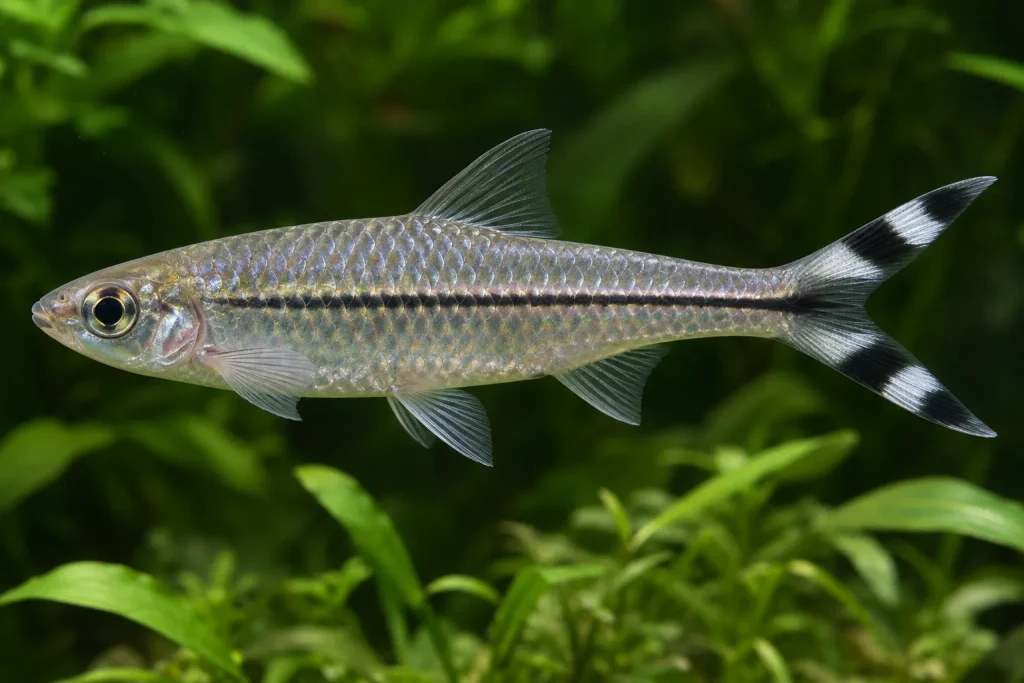
A long, silvery, torpedo-shaped body with a thin dark line along the flank and a deeply forked tail marked with black and white bars.

The black and white markings on the deeply forked tail, which flicks as the fish swims, are the best features to look for.

Mature females are rounder-bellied and often slightly larger than males.

Tank Requirements

Suggested filter
About 960–1,200 litres an hour
Suggested heater
About 250–350 W for this tank
Minimum tank volume
240 litres
Minimum tank length
120 cm
Minimum group size
6
Recommended group size
8
Activity level
Very active
Flow preference
Moderate
Planting preference
Moderately planted
Lid recommended
Yes
Jumping risk
High

Provide a long open swimming lane with plants or wood around the edges. Use a tight lid, as this fish jumps when startled.

Behaviour and Tankmates

An active, gregarious fish that uses the middle and upper water and shows better colour among its own kind.

Keep at least 6, and preferably more.

Not territorial.

Good with medium-sized peaceful fish, barbs, larger tetras, and loaches. Small tetras, small rasboras, and shrimp may become prey once this fish is adult.

Check tankmates for this species

Water Parameters

Temperature
22–25 °C
pH
5–8
GH
2–12
Stability importance
Normal

Acceptable pH depends on where the fish come from, with 6.5 to 7.5 usually ideal. Keep the water clean and well oxygenated.

Parameter caveat
Plan for the adult size, not the size in the shop. Acclimate slowly.

Feeding

Diet types
Insectivore, Omnivore
Feeding frequency
Once or twice daily
Preferred foods
  • Quality flake or small granulesUse as the daily staple, choosing a size every fish in the group can manage.
  • Frozen bloodworm, daphnia, or brine shrimpRotate these a few times a week to improve condition and colour.
  • Spirulina or vegetable flakeAdds plant matter that a meat-heavy diet lacks.

An omnivore that takes insects from the surface and readily accepts prepared foods.

Floating and slowly sinking foods suit its upper-level feeding.

Breeding

Breeding type
Egg Scatterer
Breeding difficulty
Easy
Brood or egg count
Often several hundred eggs
Incubation
1 days
Parental care
None
Baby foods
  • Infusoria or parameciumNeeded for the first days after fry become free-swimming, because the fry are very small.
  • Fine powdered fry foodUse sparingly as a supplement, and siphon out anything left uneaten.
  • Newly hatched brine shrimpIntroduce once the fry are large enough to swallow it, usually after several days.
  • MicrowormsA useful next step for fry that are still too small for brine shrimp.

An egg-scattering continuous spawner with no parental care, and comparatively easy to breed. For more fry, use a separate, dimly lit container with a mesh base to protect eggs from adults. Eggs hatch in about 18 to 48 hours.

Habitat and Origin

Geographic origin
Borneo, Cambodia, Indonesia, Laos, Malaya, Malaysia, Southeast Asia, Sumatra, Thailand
Natural habitat
Freshwater River, Lake, Slow River
Aquarium contexts
Breeding Aquarium, Large Aquarium
Audience level
Intermediate

Classification

Profile type
Recognized species
Genus
Rasbora
Family
Danionidae
Species group
Fish, Rasboras

Have you kept this species?

You can write a note about what worked for you, or send a photograph. We check everything before it appears here.

Share a note or photo

JPG, PNG, or WebP, up to 5 MB.