Skip to content
Menu

Species profile

Freshwater Angelfish

Pterophyllum scalare

Common names: Freshwater Angelfish, Angelfish, Scalare
Recognized speciesCichlids
Freshwater Angelfish (Pterophyllum scalare)

Adult size

Up to 15 cm

Typical adult length 12–15 cm.

Up to 15 cm

Countries of origin

  • See all stock from Brazil
  • See all stock from Colombia
  • See all stock from French Guiana
  • See all stock from Guyana
  • See all stock from Peru

Good fit for your tank?

Good fit for

  • A large, tall community aquarium
  • A group of medium-sized, peaceful fish
  • A keeper who enjoys watching pairs raise fry

Think carefully if

  • Your community is built around neon tetras or other small fish
  • Your tank is short or under about 200 litres
  • You keep fin nippers such as Tiger Barbs or Serpae Tetras

A tall, elegant South American cichlid sold in many colour forms. It needs a tall, spacious aquarium, and adults will eat small fish such as neon tetras.

Appearance and Identification

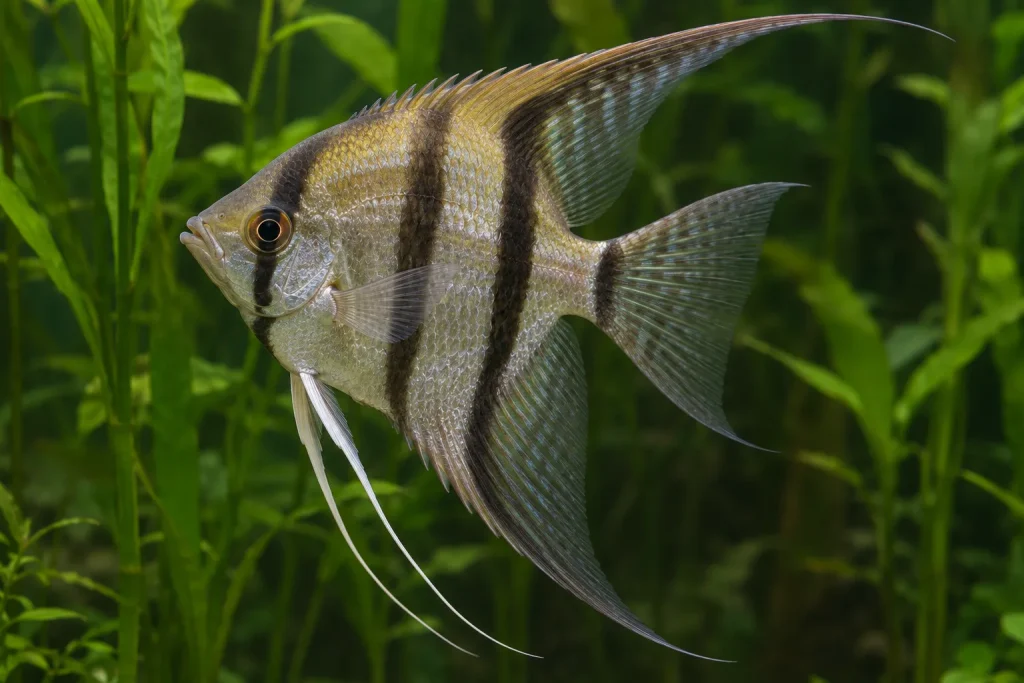
A tall, disc-shaped body with very long dorsal and anal fins and thread-like pelvic fins. Natural fish are silver with dark vertical bars, and domestic colour forms are common.

This is the common aquarium angelfish. Altum and Leopold's Angelfish are separate species with different needs, so check the species when buying.

Quite difficult to sex. Males have smaller, pointed genital papillae, usually visible only when spawning. Behaviour is a better indicator, with males being more territorial.

Tank Requirements

Suggested filter
About 800–1,000 litres an hour
Suggested heater
About 200–300 W for this tank
Minimum tank volume
200 litres
Minimum tank length
100 cm
Minimum group size
2
Recommended group size
5
Activity level
Moderate
Flow preference
Low to moderate
Planting preference
Heavily planted
Hiding places
Yes
Lid recommended
Yes
Jumping risk
Low

Height matters as much as volume, because adults are tall. Provide planted areas, upright wood, and gentle flow, leaving swimming space in the centre.

Behaviour and Tankmates

Calm in a suitable tank, but forms a pecking order in groups. Pairs become territorial and can drive others away when breeding.

Best kept in small groups, and a pair will separate from the group when ready to spawn. A very large tank gives other fish room to escape.

Males are more aggressive and territorial, especially around spawning sites.

Good with larger tetras, rainbowfish, corydoras, and peaceful medium-sized fish. Avoid small fish that fit in its mouth, and fin nippers that target its long fins.

Check tankmates for this species

Water Parameters

Temperature
24–30 °C
pH
6–7.4
GH
0–15
Stability importance
Important

Soft to moderately hard, slightly acidic to neutral water suits this species, and domestic fish adapt more readily than wild ones.

Parameter caveat
Domestic fish are much more adaptable than wild-caught fish. Acclimate slowly, and keep nitrate low with regular water changes.

Feeding

Diet types
Carnivore, Insectivore, Omnivore
Feeding frequency
Once or twice daily
Preferred foods
  • Cichlid pellets or quality flakeUse as a staple, with a size that suits the fish.
  • Frozen bloodworm, mysis, or brine shrimpOffer several times a week for condition and growth.
  • Spirulina or vegetable flakeAdds plant matter that a meat-heavy diet lacks.

An omnivore with a strong preference for meaty foods, feeding mostly in midwater.

Avoid live feeder fish, which bring a disease risk and are not needed for healthy growth.

Breeding

Breeding type
Substrate Spawner
Breeding difficulty
Moderate
Brood or egg count
Often several hundred eggs
Incubation
2 days
Parental care
Biparental care
Baby foods
  • Newly hatched brine shrimpThe main first food once fry are free-swimming, and it gives good growth.
  • MicrowormsUseful for fry that stay close to the floor of the tank.
  • Finely crushed flake or fry powderUse as a supplement, and siphon out leftovers to protect water quality.

Spawns on vertical surfaces such as slate, broad-leaved plants, or aquarium glass. Both parents guard the eggs and then the fry. Young or disturbed pairs may eat their first clutches, which is often not a lasting problem.

Habitat and Origin

Geographic origin
Amazon Basin, Brazil, Captive Bred, Colombia, French Guiana, Guyana, Peru, South America
Natural habitat
Floodplain, Freshwater River, Slow River, Vegetated Shoreline
Aquarium contexts
Breeding Aquarium, Large Aquarium, Planted Aquarium
Audience level
Intermediate

Classification

Profile type
Recognized species
Genus
Pterophyllum
Family
Cichlidae
Species group
Cichlids, Fish, South American Cichlids

Have you kept this species?

You can write a note about what worked for you, or send a photograph. We check everything before it appears here.

Share a note or photo

JPG, PNG, or WebP, up to 5 MB.