

Snow White Discus
Symphysodon aequifasciatus var. "Snow White"
- Care level
- Advanced
- Adult size
- 15–18 cm
- Minimum tank
- 350 litres
- Temperature
- 27–31 °C
Species profile
Symphysodon aequifasciatus var. "Snakeskin"
Common names: Snakeskin Discus, Snake Skin Discus, Red Snakeskin, Blue Snakeskin, Royal Blue Snakeskin, Fineline Snakeskin, Snake Skin Pigeon Blood
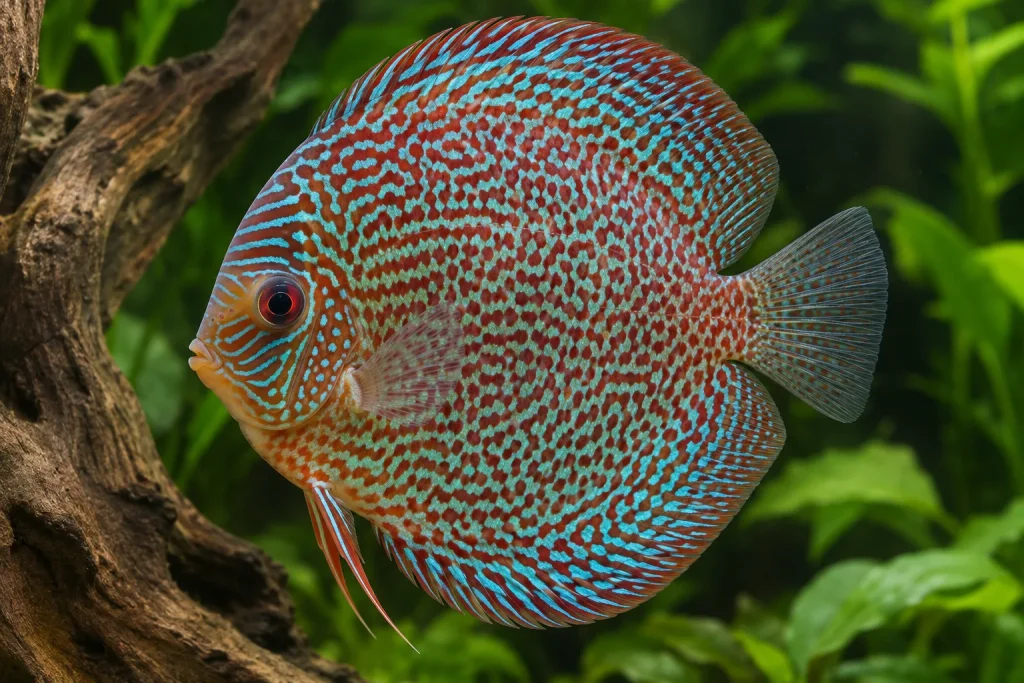
Up to 18 cm
Typical adult length 15–18 cm.




Very fine stripes cover the body and join into a net across the flanks and fins, with fine lines and dots on the gill covers. It is a captive-bred form of Discus, with the same care needs: a warm, stable, very clean tank and a group of at least five.
Very fine stripes cover the body and join into a net across the flanks and fins, with fine lines and dots on the gill covers. It was fixed on Thai farms in the early 1990s.
Count the bars: most Snakeskins show 14 or more when stressed, where wild fish have nine. The base colour gives the rest of the name, such as Red or Blue Snakeskin. Discus with very similar genes are sold under different names, and one seller's name may not match another's, so judge a fish by its pattern, body colour, pepper (fine black speckling) and eye colour.
Sexes are hard to tell apart by eye. Mature males may be larger with a broader head, but the breeding tubes and spawning behaviour are more reliable.
Keep a group of at least five or six in a tall, mature tank with excellent filtration, calm flow, open feeding space and vertical cover. Quarantine all new fish.
A calm, shoaling cichlid that can become shy, bullied or underfed in too small a group.
Groups form a pecking order. Pairs separate to spawn and may need their own breeding tank.
Breeding pairs defend a vertical surface and the area around it. Outside breeding, aggression is mainly social ranking.
Use calm, warm-water tankmates that do not nip fins or take all the food. Small fish and shrimp may be eaten.
Captive-bred discus are usually kept at pH 6 to 7, and can take up to 7.5 if it stays stable. Temperature and water cleanliness must stay consistently high.
An omnivore that does well on varied pellets and frozen foods.
Feed several small meals a day, and remove uneaten food quickly in warm water.
Pairs lay on vertical surfaces. Both parents guard the eggs and produce a skin mucus that feeds the fry for about their first four weeks.
You can write a note about what worked for you, or send a photograph. We check everything before it appears here.
Symphysodon aequifasciatus var. "Snow White"
Symphysodon aequifasciatus var. "Spider Leopard"
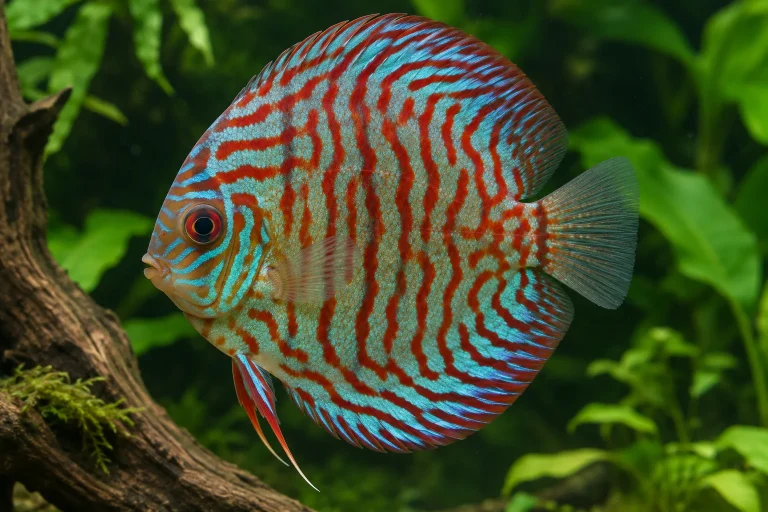
Symphysodon aequifasciatus var. "Tiger"
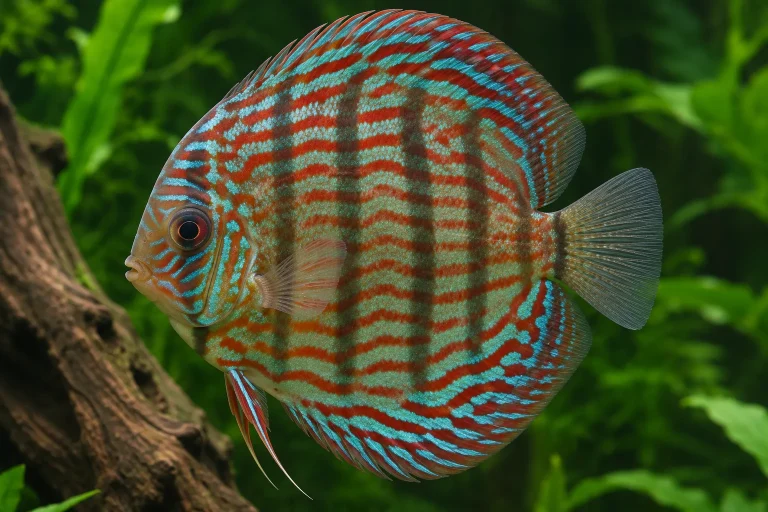
Symphysodon aequifasciatus var. "Turquoise"