
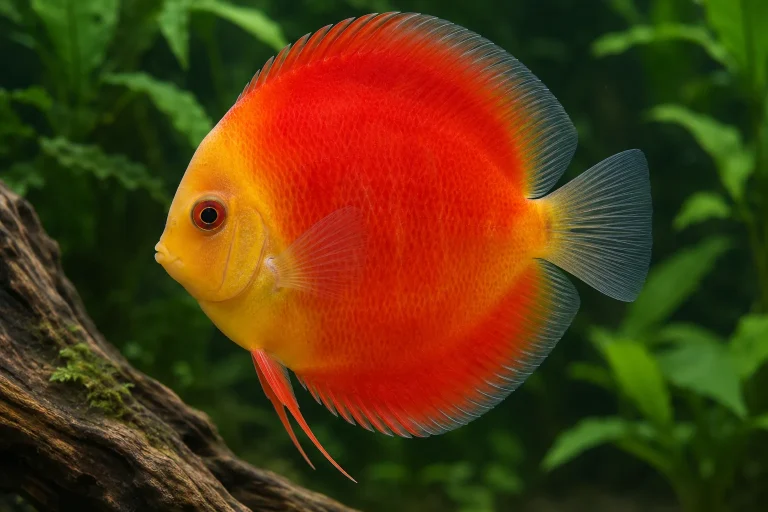
Red Sun Discus
Symphysodon aequifasciatus var. "Red Sun"
- Care level
- Advanced
- Adult size
- 15–18 cm
- Minimum tank
- 350 litres
- Temperature
- 27–31 °C
Species profile
Symphysodon tarzoo var. "Red Spotted Green"
Common names: Red Spotted Green Discus, RSG Discus
Up to 16 cm
Typical adult length 12–16 cm.


A green discus with red spots on an olive-green base. Wild discus need warm, soft, acidic water and more care than domestic strains.
A green discus with red spots on an olive-green base. Collectors prize fish with spots across much of the body. It is found both wild and captive-bred.
Count the spots, because price follows how far they spread. Domestic fish need domestic care, and wild fish need softer water. Discus with very similar genes are sold under different names, and one seller's name may not match another's, so judge a fish by its pattern, body colour, pepper (fine black speckling) and eye colour.
Sexes are hard to tell apart by eye. Mature males may be larger with a broader head, but the breeding tubes and spawning behaviour are more reliable.
Keep a group of at least five or six in a tall, mature tank with excellent filtration, calm flow, open feeding space and vertical cover. Quarantine all new fish.
A calm, shoaling cichlid that can become shy, bullied or underfed in too small a group.
Groups form a pecking order. Pairs separate to spawn and may need their own breeding tank.
Breeding pairs defend a vertical surface and the area around it. Outside breeding, aggression is mainly social ranking.
Use calm, warm-water tankmates that do not nip fins or take all the food. Small fish and shrimp may be eaten.
Wild fish need softer, more acidic water than domestic strains.
An omnivore that does well on varied pellets and frozen foods.
Feed several small meals a day, and remove uneaten food quickly in warm water.
Pairs lay on vertical surfaces. Both parents guard the eggs and produce a skin mucus that feeds the fry for about their first four weeks.
You can write a note about what worked for you, or send a photograph. We check everything before it appears here.
Symphysodon aequifasciatus var. "Red Sun"
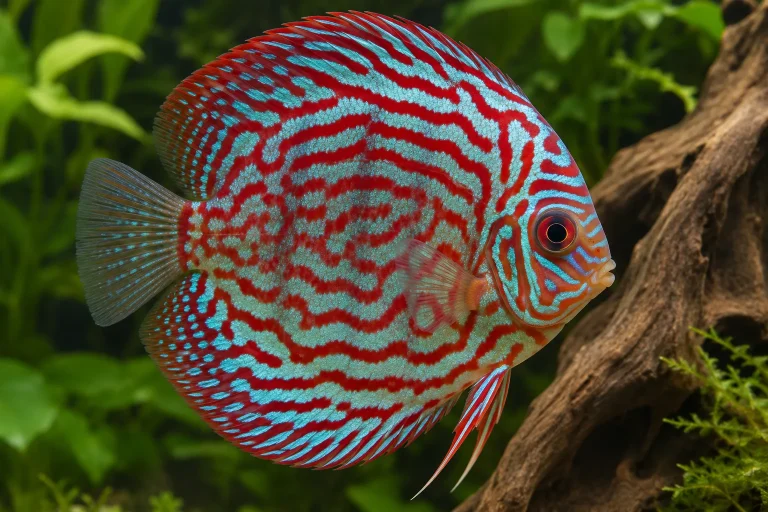
Symphysodon aequifasciatus var. "Red Turquoise"

Symphysodon aequifasciatus var. "Red White"
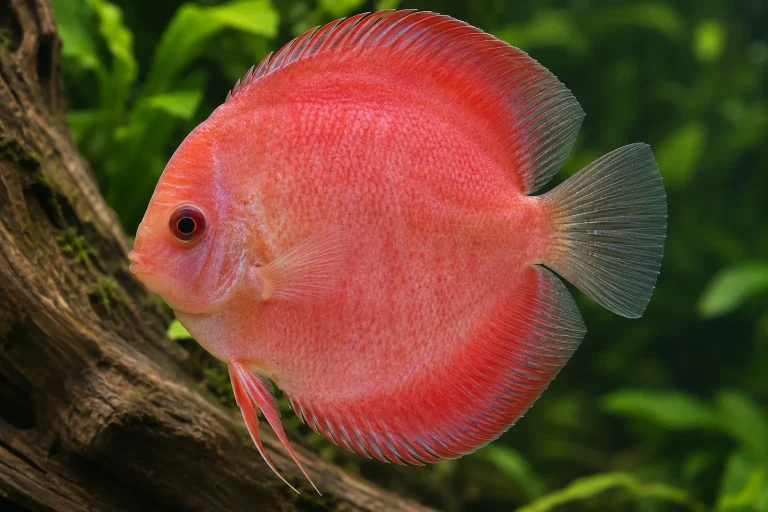
Symphysodon aequifasciatus var. "Rose Red"