

L222 Hypostomus Plecostomus
Hypostomus sp. (L222)
- Care level
- Intermediate
- Minimum tank
- 300 litres
- Temperature
- 22–29 °C
Species profile
Peckoltia sp. (L218)
Common names: L218 Peckoltia Plecostomus, L218

L218 Peckoltia Plecostomus is a South American loricariid represented by L218. It requires stable oxygen-rich water, suitable caves, and deliberate species-appropriate feeding.
L218 is an unidentified Peckoltia with dark bands, saddles or intricate head markings over a tan to brown body. Similar coded Peckoltia often overlap in appearance, so provenance should be retained.
Use the L-number identification L218 together with the current assignment Peckoltia sp. (L218). Do not merge it with visually similar forms without matching collection locality and diagnostic features. The L-number remains the principal stable identifier because the form is undescribed or not conclusively assigned.
Mature males tend to develop a broader head and stronger odontodes on the cheeks, pectoral region and sometimes the rear body. Females become fuller through the abdomen.
Provide a mature, well-oxygenated aquarium with driftwood, rock cover and several tight caves. Break sight lines and leave clean open areas where sinking food can be distributed.
Generally peaceful toward free-swimming fish but territorial around caves and food. Adult males may chase one another when shelters are too close or too few.
Can be kept singly. A pair or group requires several appropriately sized caves and enough floor area for every adult to feed without being trapped.
Mature males commonly defend caves and favoured feeding areas from similarly shaped loricariids.
Suitable for calm communities when each bottom fish has a separate cave and feeding area. Avoid mixing similar coded Peckoltia if preserving identity matters.
Some links may earn us a commission on qualifying purchases, at no extra cost to you. Check suitability, price and availability with the seller. How affiliate links work
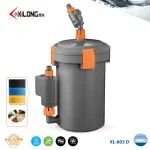 Xilong XL-803D canister filter – up to 100 L
An external-filter option for the moderate-flow setup described above. The seller lists a 400 L/h pump and an aquarium capacity of up to 100 litres.
Check the volume of your actual aquarium and the needs of its complete stocking. Use the flow control or spray bar to avoid a concentrated current. A larger tank or a species requiring strong river flow needs a different filter selection.
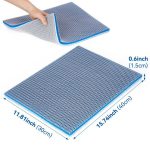 Cut-to-fit aquarium filter media pad
A cut-to-fit pad for compatible filter compartments. The listing describes a sheet approximately 16 by 12 inches; check the offered variant and the space inside your filter.
The seller description varies between five and eight layers, so confirm the actual sheet before ordering. Keep the filter manufacturer’s media arrangement and avoid obstructing the flow.
 Xinyou ceramic filter rings – 300 g
A biological-media option for a filter with a suitable media basket. This listing is a 300 g pack of ceramic rings.
Check the ring size and available basket space. Installing new media does not make a new aquarium instantly cycled, and these rings do not replace routine water-quality checks.
Maintain stable clean water with strong oxygenation. Warm water, protein-rich food, wood waste, and crowded hardscape can rapidly reduce oxygen and degrade water quality.
Some links may earn us a commission on qualifying purchases, at no extra cost to you. Check suitability, price and availability with the seller. How affiliate links work
 Manual aquarium siphon and gravel cleaner
A manual siphon for routine aquarium water changes and accessible waste removal. The seller lists a hose approximately 1.6 m long.
Control the flow and keep the intake clear of fish and delicate planting. Clean the areas appropriate for your substrate and layout rather than disturbing the entire planted bed.
Offer a varied omnivorous diet of quality sinking pellets, vegetable matter, biofilm and frozen or live invertebrate foods. It should not be expected to survive on algae alone.
Feed after lights dim and distribute food near every occupied shelter. Confirm that subordinate fish eat and remove rich leftovers before they affect water quality.
A male-guarded cave spawning method is expected for Peckoltia, but details for this coded form may be limited. Keep accurate parentage records if breeding occurs.
You can write a note about what worked for you, or send a photograph. We check everything before it appears here.
Hypostomus sp. (L222)
Hypostomus sp. (L224)
Hypostomus sp. (L227)
Lasiancistrus sp. (L228)