Skip to content
Menu

Species profile

Black Skirt Tetra

Gymnocorymbus ternetzi

Common names: Black Skirt Tetra, Black Widow Tetra, Petticoat Tetra
Recognized speciesTetras
Black Skirt Tetra (Gymnocorymbus ternetzi)

Adult size

Up to 6 cm

Typical adult length 5–6 cm.
Up to 6 cm

Countries of origin

  • See all stock from Argentina
  • See all stock from Bolivia
  • See all stock from Brazil

Good fit for your tank?

Good fit for

  • A hardy starter tank with a large group
  • A community of robust, short-finned fish
  • Cooler or moderately hard water than neons prefer

Think carefully if

  • You keep long-finned fish or other slow, fancy species
  • You can only keep a small group
  • You want a very small nano fish

A deep-bodied, hardy tetra from South America with a dark, flowing rear body. It is easy to keep, but needs a large group to keep fin nipping under control.

Appearance and Identification

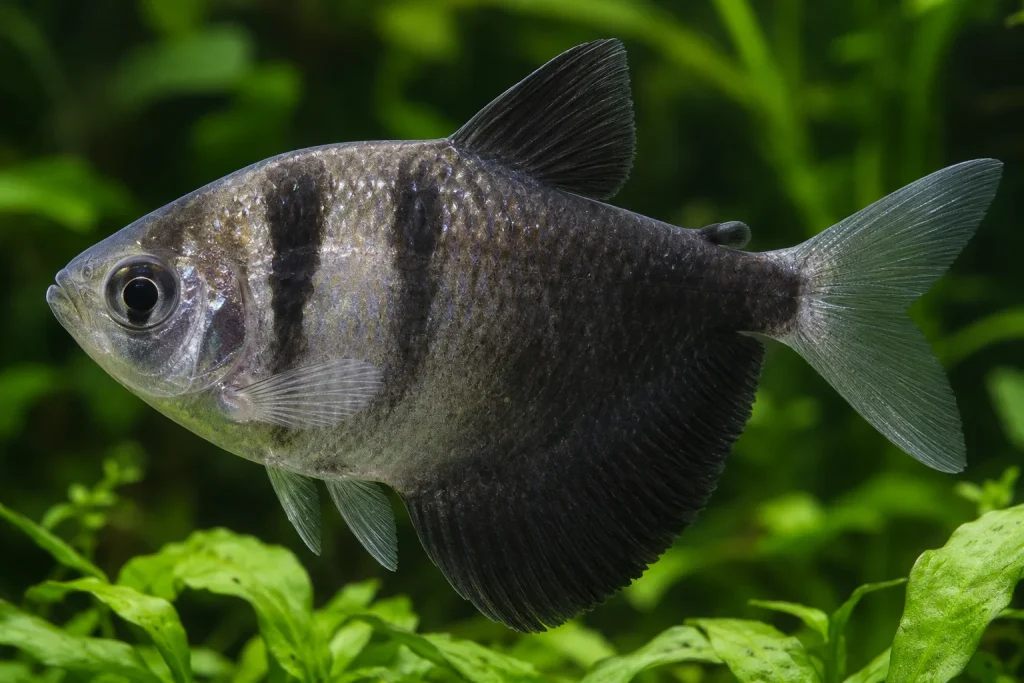
A deep, laterally flattened body with two dark vertical bars behind the head, and a dark rear body with fan-like fins. Colour fades to grey in older fish.

The tall body shape and dark rear are distinctive. Long-finned, white, and artificially coloured forms are sold under related names, and dyed fish should be avoided.

Males are slimmer and smaller, with more pointed dorsal and anal fins. Females have deeper, rounder bodies.

Tank Requirements

Suggested filter
About 280–350 litres an hour
Suggested heater
About 75–100 W for this tank
Minimum tank volume
70 litres
Minimum tank length
75 cm
Minimum group size
12
Recommended group size
12
Activity level
Active
Flow preference
Moderate
Planting preference
Moderately planted
Lid recommended
Yes
Jumping risk
Low

Provide open swimming space with some planting and robust filtration. A larger group needs more length than a typical small tetra setup.

Behaviour and Tankmates

Active and generally peaceful in a large group, though individuals can chase or nip when numbers are low.

Keep at least 12. A larger group is the best way to reduce fin nipping.

Not territorial, but pecking orders form in the group.

Suitable with similar-sized barbs, tetras, danios, loaches, and corydoras. Avoid bettas, fancy guppies, and angelfish, whose long fins attract nipping.

Check tankmates for this species

Water Parameters

Temperature
20–26 °C
pH
6–7
GH
5–20
Stability importance
Normal

Very adaptable. Avoid sudden changes, and keep nitrate low with regular water changes.

Parameter caveat
Tolerance is not a reason to skip maintenance. Acclimate slowly and keep ammonia and nitrite at zero.

Feeding

Diet types
Insectivore, Omnivore
Feeding frequency
Once or twice daily
Preferred foods
  • Quality flake or small granulesUse as the daily staple, choosing a size every fish in the group can manage.
  • Frozen bloodworm, daphnia, or brine shrimpRotate these a few times a week to improve condition and colour.
  • Spirulina or vegetable flakeAdds plant matter that a meat-heavy diet lacks.

An unfussy omnivore that eats most flakes, granules, and frozen foods.

Regular feeding of varied foods helps keep the group settled.

Breeding

Breeding type
Egg Scatterer
Breeding difficulty
Easy
Brood or egg count
Often several hundred small eggs
Incubation
1 days
Parental care
None
Baby foods
  • Infusoria or parameciumNeeded for the first days after fry become free-swimming, because the fry are very small.
  • Fine powdered fry foodUse sparingly as a supplement, and siphon out anything left uneaten.
  • Newly hatched brine shrimpIntroduce once the fry are large enough to swallow it, usually after several days.
  • MicrowormsA useful next step for fry that are still too small for brine shrimp.

Adhesive eggs are spawned in a group or in pairs in a separate, dim tank. Remove adults once eggs appear, because they eat them. Eggs hatch in 18 to 36 hours.

Habitat and Origin

Geographic origin
Argentina, Bolivia, Brazil, South America
Natural habitat
Freshwater River, Slow River, Vegetated Shoreline
Aquarium contexts
Breeding Aquarium
Audience level
Beginner

Classification

Profile type
Recognized species
Genus
Gymnocorymbus
Family
Characidae
Species group
Fish, Tetras

Have you kept this species?

You can write a note about what worked for you, or send a photograph. We check everything before it appears here.

Share a note or photo

JPG, PNG, or WebP, up to 5 MB.