Skip to content
Menu

Species profile

Cherry Barb

Puntius titteya

Common names: Cherry Barb
Recognized speciesBarbs
Cherry Barb (Puntius titteya)

Adult size

Up to 5 cm

Typical adult length 4–5 cm.
Up to 5 cm

Countries of origin

  • See all stock from Sri Lanka

Good fit for your tank?

Good fit for

  • A 55 L tank with a group of 10, which gives the males the confidence to colour up
  • A densely planted tank with dark substrate, subdued light and plenty of cover
  • A peaceful community with small tetras, rasboras and corydoras

Think carefully if

  • Your group is small: males become more aggressive and colour dulls
  • You keep very big or boisterous fish that will pester it
  • You keep shrimp you want to protect: shrimplets will be eaten

A small, peaceful barb from Sri Lanka whose males turn deep red in spawning colour. It is a calm alternative to the livelier barbs, and a good fit for planted community tanks.

Appearance and Identification

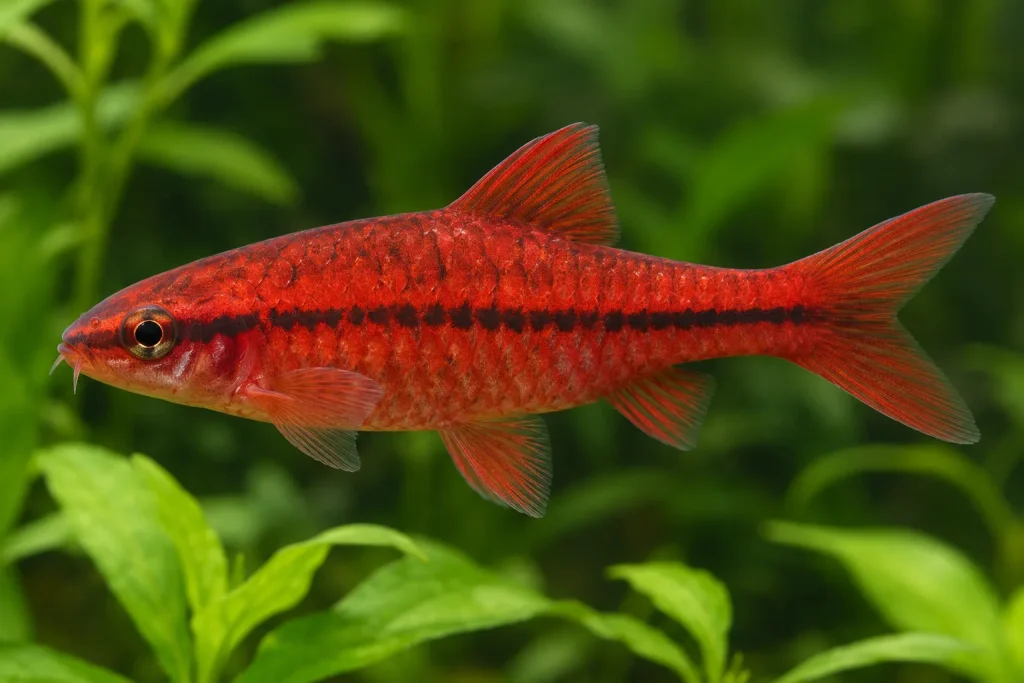
A slim body with a dark line from the snout to the tail. Males turn from reddish brown to deep cherry red in breeding condition, and females are tan with the same line.

A dark line along the flank plus a slim body separates this fish from other small red fish.

Males are smaller, slimmer, and more colourful than females, especially in spawning condition.

Tank Requirements

Suggested filter
About 220–280 litres an hour
Suggested heater
About 50–75 W for this tank
Minimum tank volume
55 litres
Minimum tank length
60 cm
Minimum group size
6
Recommended group size
10
Activity level
Moderate
Flow preference
Low to moderate
Planting preference
Heavily planted
Hiding places
Yes
Lid recommended
Yes
Jumping risk
Low

Provide dense planting with soft light and a dark substrate. Males show more colour when the fish feel secure.

Behaviour and Tankmates

A peaceful fish that holds loose groups. Males display to females and to each other without causing damage.

Keep at least 6 to 10, with more females than males where possible.

Not territorial. Males display but rarely harm each other.

Good with small tetras, rasboras, corydoras, and small gouramis. Larger fish may eat it. Adult shrimp are usually fine, but shrimplets may be eaten.

Check tankmates for this species

Water Parameters

Temperature
20–27 °C
pH
6–8
GH
2–20
Stability importance
Normal

Adapts to a broad range of water. Keep nitrate low and change water regularly.

Parameter caveat
Acclimate slowly and avoid sudden changes.

Feeding

Diet types
Insectivore, Omnivore
Feeding frequency
Once or twice daily
Preferred foods
  • Quality flake or small granulesUse as the daily staple and scatter it so every fish in the group can reach food.
  • Frozen or live bloodworm, daphnia, and brine shrimpOffer a few times a week to improve condition and colour.
  • Spirulina flake or blanched vegetablesBarbs graze as well as hunt, so include some plant matter each week.

An omnivore that eats small invertebrates and plant matter.

Use small foods. Frozen or live foods help bring males into their best colour.

Breeding

Breeding type
Egg Scatterer
Breeding difficulty
Easy
Brood or egg count
Typically dozens to a few hundred eggs
Incubation
2 days
Parental care
None
Baby foods
  • Infusoria or parameciumNeeded for the first days after fry become free-swimming, because the fry are very small.
  • Fine powdered fry foodUse sparingly as a supplement, and siphon out anything left uneaten.
  • Newly hatched brine shrimpIntroduce once the fry are large enough to swallow it, usually after several days.
  • MicrowormsA useful next step for fry that are still too small for brine shrimp.

An egg-scattering free spawner with no parental care. Adults may eat their eggs, so remove them once eggs are seen. Eggs hatch in about 24 to 48 hours, and fine-leaved plants or spawning mops help protect them.

Habitat and Origin

Geographic origin
South Asia, Sri Lanka
Natural habitat
Freshwater Stream, Slow River, Vegetated Shoreline
Aquarium contexts
Breeding Aquarium, Planted Aquarium
Audience level
Beginner

Classification

Profile type
Recognized species
Genus
Puntius
Family
Cyprinidae
Species group
Barbs, Fish

Have you kept this species?

You can write a note about what worked for you, or send a photograph. We check everything before it appears here.

Share a note or photo

JPG, PNG, or WebP, up to 5 MB.