



Species profile
Cobalt Blue Discus
Symphysodon aequifasciatus var. "Cobalt Blue"
Common names: Cobalt Blue Discus, Cobalt Discus, Solid Blue Discus
Colour varietyCichlids
Adult size
Up to 18 cm
Typical adult length 15–18 cm.

Up to 18 cm
Countries of origin
Good fit for your tank?
Good fit for
- You can keep a group of five or more in a tall, mature tank
- You can do large, regular water changes
- You want a calm, warm-water showpiece
Think carefully if
- You are new to fishkeeping
- You keep cool-water fish, or shrimp you want to protect
- You cannot hold the water warm and stable
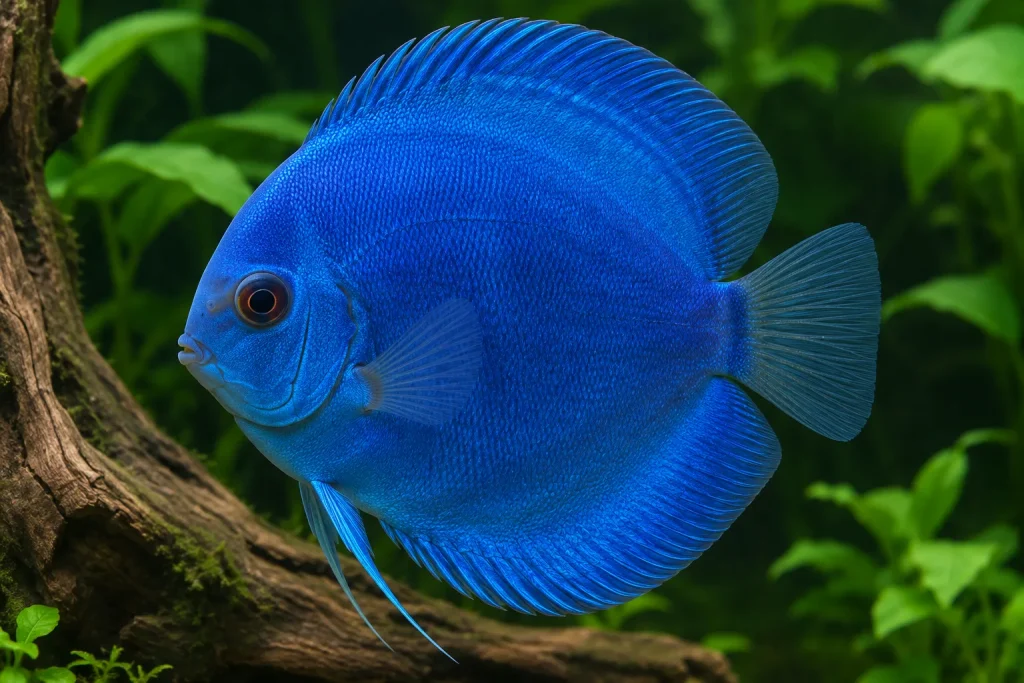
A solid or nearly solid blue fish. It is a captive-bred form of Discus, with the same care needs: a warm, stable, very clean tank and a group of at least five.
Appearance and Identification
A solid or nearly solid blue fish. American breeders developed it from Turquoise stock by selecting for fuller blue striping.
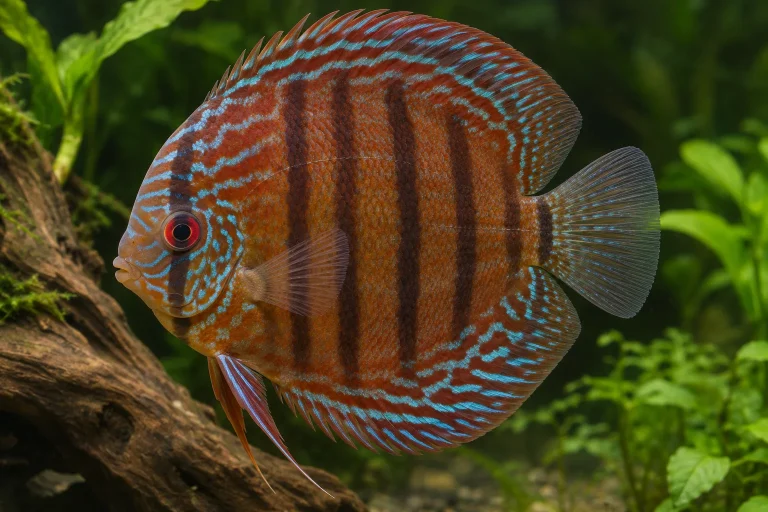
Discus shows class it with Blue Diamond as a solid blue. Look for an even colour across the body and few bars. Discus with very similar genes are sold under different names, and one seller's name may not match another's, so judge a fish by its pattern, body colour, pepper (fine black speckling) and eye colour.
Sexes are hard to tell apart by eye. Mature males may be larger with a broader head, but the breeding tubes and spawning behaviour are more reliable.
Tank Requirements
- Suggested filter
- About 700–1,050 litres an hour
- Suggested heater
- About 350–525 W for this tank
- Minimum tank volume
- 350 litres
- Minimum tank length
- 150 cm
- Minimum group size
- 5
- Recommended group size
- 6
- Activity level
- Moderate
- Flow preference
- Low
- Planting preference
- Moderately planted
- Hiding places
- Yes
- Lid recommended
- Yes
- Jumping risk
- Low
Keep a group of at least five or six in a tall, mature tank with excellent filtration, calm flow, open feeding space and vertical cover. Quarantine all new fish.
Behaviour and Tankmates
A calm, shoaling cichlid that can become shy, bullied or underfed in too small a group.
Groups form a pecking order. Pairs separate to spawn and may need their own breeding tank.
Breeding pairs defend a vertical surface and the area around it. Outside breeding, aggression is mainly social ranking.
Use calm, warm-water tankmates that do not nip fins or take all the food. Small fish and shrimp may be eaten.
Water Parameters
Captive-bred discus are usually kept at pH 6 to 7, and can take up to 7.5 if it stays stable. Temperature and water cleanliness must stay consistently high.
Parameter caveat
Stable water matters more than an exact number. Do not mix fish from very different water without slow acclimation.
Feeding
- Diet types
- Insectivore, Omnivore
- Feeding frequency
- Daily
- Preferred foods
- Quality discus pellets or granulesA good daily staple. Feed small amounts and remove what is not eaten, because leftovers foul warm water quickly.
- Frozen bloodworm and brine shrimpOffer often for variety and condition.
An omnivore that does well on varied pellets and frozen foods.
Feed several small meals a day, and remove uneaten food quickly in warm water.
Breeding
- Breeding type
- Egg Layer, Substrate Spawner
- Breeding difficulty
- Difficult
- Brood or egg count
- Commonly 100 to 400 eggs
- Incubation
- 3 days
- Parental care
- Biparental care
- Baby foods
- Skin mucus from the parentsFry feed on this for about their first four weeks. Parent-raised fry survive better than fry raised without it.
- Newly hatched brine shrimpAdd as the fry grow and start to swim away from the parents.
Pairs lay on vertical surfaces. Both parents guard the eggs and produce a skin mucus that feeds the fry for about their first four weeks.
Habitat and Origin
- Geographic origin
- Amazon Basin, Brazil, Captive Bred, Colombia, Peru, South America
- Natural habitat
- Blackwater, Clearwater, Floodplain, Slow River
- Aquarium contexts
- Breeding Aquarium, Large Freshwater Aquarium, Planted Aquarium
- Audience level
- Advanced
Classification
- Profile type
- Colour variety
- Genus
- Symphysodon
- Family
- Cichlidae
- Species group
- Cichlids, Discus, Fish, South American Cichlids
Have you kept this species?
You can write a note about what worked for you, or send a photograph. We check everything before it appears here.
Share a note or photo

Ghost Discus
Symphysodon aequifasciatus var. "Ghost"
- Care level
- Advanced
- Adult size
- 15–18 cm
- Minimum tank
- 350 litres
- Temperature
- 27–31 °C
Golden Discus
Symphysodon aequifasciatus var. "Golden"
- Care level
- Advanced
- Adult size
- 15–18 cm
- Minimum tank
- 350 litres
- Temperature
- 27–31 °C
Golden Snakeskin Discus
Symphysodon aequifasciatus var. "Golden Snakeskin"
- Care level
- Advanced
- Adult size
- 15–18 cm
- Minimum tank
- 350 litres
- Temperature
- 27–31 °C