Skip to content
Menu

Species profile

Dwarf Gourami

Trichogaster lalius

Common names: Dwarf Gourami, Powder Blue Gourami, Flame Gourami
Recognized speciesGouramis
Dwarf Gourami (Trichogaster lalius)

Adult size

Up to 8.8 cm

Typical adult length 6–8.8 cm.

Up to 8.8 cm

Countries of origin

  • See all stock from Bangladesh
  • See all stock from India
  • See all stock from Pakistan

Good fit for your tank?

Good fit for

  • A planted community with calm small fish
  • A single colourful centrepiece for a medium tank
  • A keeper able to quarantine new fish

Think carefully if

  • You plan to keep two males in an ordinary tank
  • You cannot quarantine or check the health of new stock
  • Your tank has fin nippers such as tiger barbs

A colourful small gourami from South Asia, popular for planted tanks. It is calm with most fish, but males are territorial and shop fish have a serious problem with viral disease.

Appearance and Identification

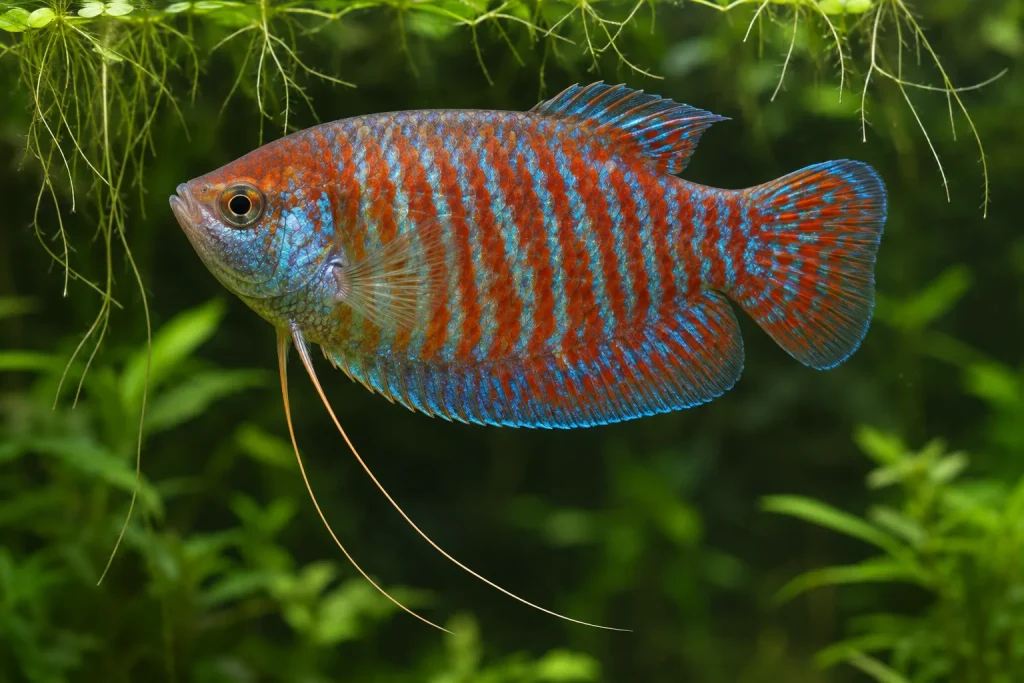
A deep, oval body. Males show alternating red-orange and blue bars, while line-bred fish can be solid blue or red. Females are plainer and silvery. The pelvic fins are long and thread-like.

Line-bred colour forms are all the same species. Honey Gouramis are smaller, plainer, and slimmer. Sellers sometimes sell mostly males, so check when you want a pair.

Males are slightly larger and more colourful, with extended dorsal and anal fins. Females are plainer and silvery.

Tank Requirements

Suggested filter
About 110–170 litres an hour
Suggested heater
About 50–75 W for this tank
Minimum tank volume
55 litres
Minimum tank length
60 cm
Minimum group size
1
Recommended group size
2
Activity level
Low
Flow preference
Low
Planting preference
Heavily planted
Hiding places
Yes
Lid recommended
Yes
Jumping risk
Low

Use dense planting with floating cover to give the fish security and give the male nest sites. Keep flow low, because strong flow stresses gouramis and disrupts nests.

Behaviour and Tankmates

Calm and rather shy, spending time near plants and the surface and using its long pelvic fins to feel its way around.

Not suited to groups. A male and female pair is the usual choice, although males can harass females, so plenty of cover is needed.

Males are territorial toward each other, and also toward similar-looking gouramis.

Suits small peaceful fish such as tetras, rasboras, and corydoras. Avoid fin nippers, large cichlids, and other gouramis in smaller tanks. Shrimp may be eaten.

Check tankmates for this species

Water Parameters

Temperature
22–27 °C
pH
6–7.5
GH
2–18
Stability importance
Important

Tank-bred fish adapt to a broad range, while wild fish prefer soft, acidic water.

Parameter caveat
Gouramis breathe air from the surface, so keep the surface accessible and the air above it warm with a lid.

Feeding

Diet types
Insectivore, Omnivore
Feeding frequency
Once or twice daily
Preferred foods
  • Small floating pellets or quality flakeThese fish feed readily from the surface. Choose a small size and feed sparingly.
  • Frozen or live daphnia and brine shrimpOffer a few times a week for variety and condition.
  • Frozen bloodworm or mosquito larvaeUse as an occasional rich treat rather than a daily food.

An omnivore that eats small invertebrates and algae, and takes food from the surface.

Add some plant matter, and feed small meals to avoid bloating.

Breeding

Breeding type
Bubble Nest
Breeding difficulty
Moderate
Brood or egg count
Often several hundred small eggs
Incubation
1 days
Parental care
Bubble-nest care
Baby foods
  • Infusoria or parameciumEssential for the first days, because labyrinth fry are tiny and cannot yet take larger food.
  • Vinegar eels or microwormsIntroduce as the fry grow, and offer in small amounts to protect water quality.
  • Newly hatched brine shrimpIntroduce once the fry can swallow it, usually after one to two weeks.

A bubble-nest builder. The male builds the nest, often using plant pieces, and the pair spawns beneath it in an embrace. The male then guards the eggs and fry, while the female should be moved away.

Habitat and Origin

Geographic origin
Bangladesh, Captive Bred, India, Pakistan, South Asia
Natural habitat
Pond, Slow River, Swamp, Vegetated Shoreline
Aquarium contexts
Breeding Aquarium, Planted Aquarium
Audience level
Intermediate

Classification

Profile type
Recognized species
Genus
Trichogaster
Family
Osphronemidae
Species group
Fish, Gouramis

Have you kept this species?

You can write a note about what worked for you, or send a photograph. We check everything before it appears here.

Share a note or photo

JPG, PNG, or WebP, up to 5 MB.