Skip to content
Menu

Species profile

Gold Barb

Barbodes semifasciolatus

Common names: Gold Barb, Chinese Barb, Green Barb, Schubert's Barb
Recognized speciesBarbs
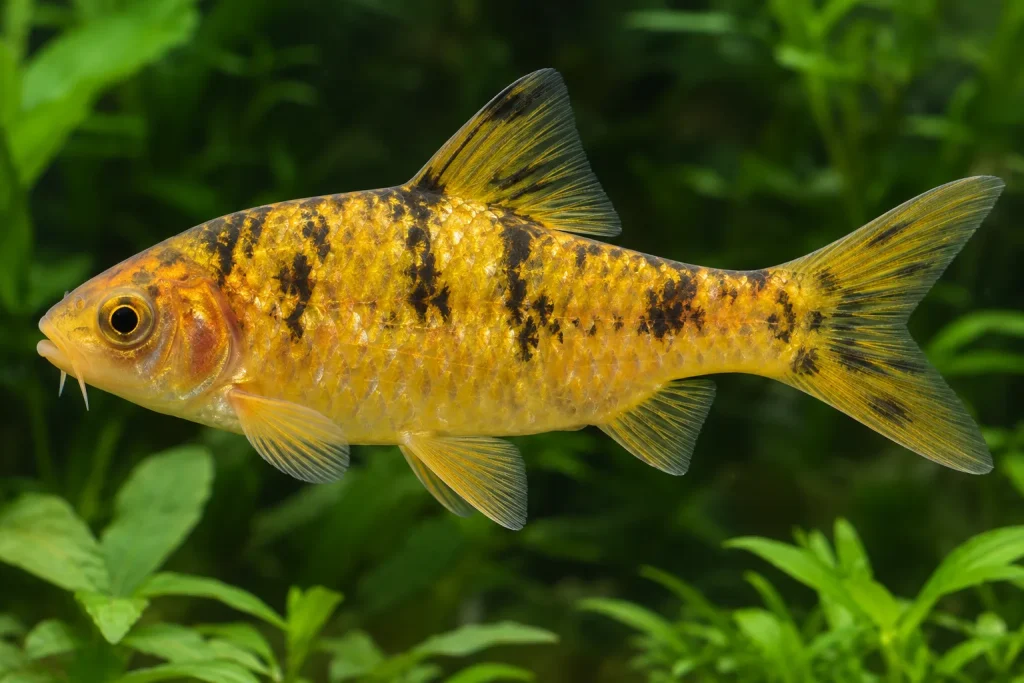
Gold Barb (Barbodes semifasciolatus)

Adult size

Up to 7.5 cm

Typical adult length 6–7.5 cm.
Up to 7.5 cm

Countries of origin

  • See all stock from China
  • See all stock from Laos
  • See all stock from Taiwan
  • See all stock from Vietnam

Good fit for your tank?

Good fit for

  • An unheated community aquarium
  • A group with other cool-tolerant, active fish
  • A hardy shoal for a medium-sized tank

Think carefully if

  • You keep warm-water tropical fish
  • You have delicate soft-leaved plants
  • You keep long-finned or very small fish

A cool-tolerant barb from East and Southeast Asia, usually sold in a bright gold colour form. It is hardy and sociable, and fits well in unheated community tanks.

Appearance and Identification

The gold form is bright yellow-gold with irregular dark marks. Natural fish are greener with dark vertical bars.

Gold and natural green fish are the same species. The name Schubert's Barb is often used for gold fish in the trade.

Females are rounder-bellied and slightly larger. Mature males in the natural colour form develop red pigmentation on the lower body.

Tank Requirements

Suggested filter
About 320–400 litres an hour
Minimum tank volume
80 litres
Minimum tank length
90 cm
Minimum group size
8
Recommended group size
10
Activity level
Active
Flow preference
Moderate
Planting preference
Moderately planted
Lid recommended
Yes
Jumping risk
Low

Provide swimming space with hardy plants, because soft growth may be nibbled. A heater is often unnecessary in a room within its range.

Behaviour and Tankmates

Active and sociable, with some playful chasing inside the group.

Keep a mixed-sex group of at least 8 to 10, with other schooling fish for added security.

Not territorial.

Good with other cool-tolerant, active fish such as rosy barbs, odessa barbs, and danios. Avoid long-finned fish and shrimp.

Check tankmates for this species

Water Parameters

Temperature
16–24 °C
pH
6–8
GH
2–20
Stability importance
Normal

Adapts to a broad range of water. Cooler temperatures suit this fish better than warm tropical setups.

Parameter caveat
Acclimate slowly and keep the water clean and well oxygenated.

Feeding

Diet types
Insectivore, Omnivore
Feeding frequency
Once or twice daily
Preferred foods
  • Quality flake or small granulesUse as the daily staple and scatter it so every fish in the group can reach food.
  • Frozen or live bloodworm, daphnia, and brine shrimpOffer a few times a week to improve condition and colour.
  • Spirulina flake or blanched vegetablesBarbs graze as well as hunt, so include some plant matter each week.

An omnivore that takes most prepared foods, small invertebrates, and plant matter.

Include plant matter each week, which may also reduce nibbling on plants.

Breeding

Breeding type
Egg Scatterer
Breeding difficulty
Easy
Brood or egg count
Often several hundred eggs
Incubation
2 days
Parental care
None
Baby foods
  • Infusoria or parameciumNeeded for the first days after fry become free-swimming, because the fry are very small.
  • Fine powdered fry foodUse sparingly as a supplement, and siphon out anything left uneaten.
  • Newly hatched brine shrimpIntroduce once the fry are large enough to swallow it, usually after several days.
  • MicrowormsA useful next step for fry that are still too small for brine shrimp.

An egg-scattering free spawner with no parental care. Adults may eat their eggs, so remove them after spawning. Eggs hatch in 24 to 48 hours.

Habitat and Origin

Geographic origin
Asia, Captive Bred, China, Laos, Southeast Asia, Taiwan, Vietnam
Natural habitat
Freshwater River, Freshwater Stream, Pond
Aquarium contexts
Breeding Aquarium, Temperate Aquarium
Audience level
Beginner

Classification

Profile type
Recognized species
Genus
Barbodes
Family
Cyprinidae
Species group
Barbs, Fish
Previous scientific names
Puntius semifasciolatus, An older name still widely used in shops and books.

Have you kept this species?

You can write a note about what worked for you, or send a photograph. We check everything before it appears here.

Share a note or photo

JPG, PNG, or WebP, up to 5 MB.