Skip to content
Menu

Species profile

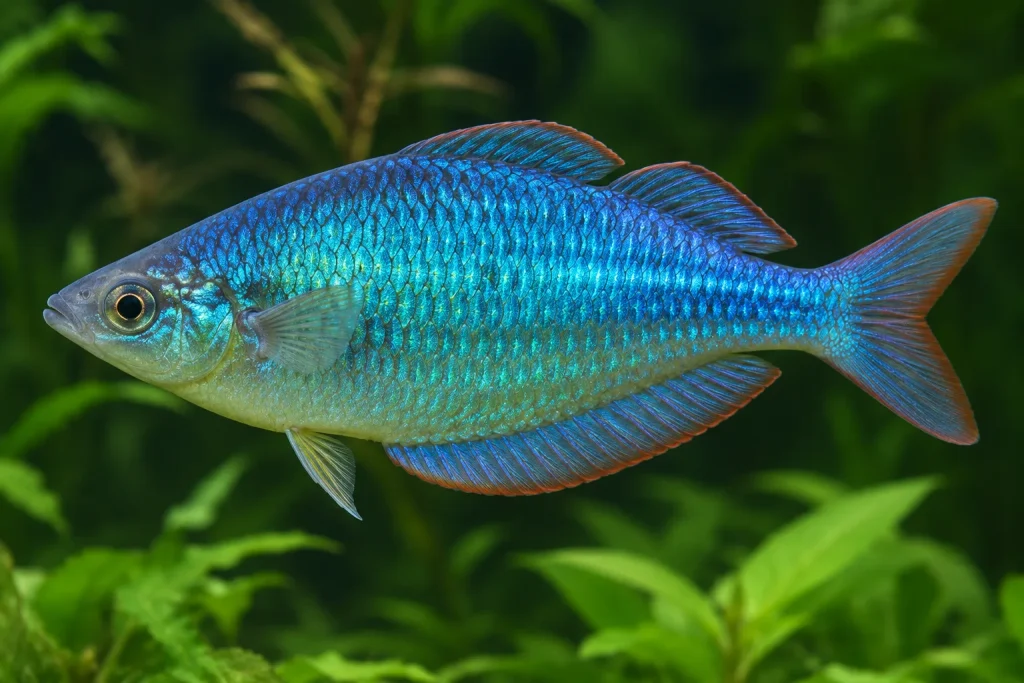
Lake Kutubu Rainbowfish

Melanotaenia lacustris

Common names: Lake Kutubu Rainbowfish, Turquoise Rainbowfish, Blue Rainbowfish
Recognized speciesRainbowfish
Lake Kutubu Rainbowfish (Melanotaenia lacustris)

Adult size

Up to 12 cm

Typical adult length 10–12 cm.

Up to 12 cm

Countries of origin

  • See all stock from Papua New Guinea

Good fit for your tank?

Good fit for

  • A long aquarium with cooler, hard water
  • A keeper with alkaline tap water
  • A shoal of active, medium-sized fish

Think carefully if

  • You keep warm tropical fish
  • Your water is soft and acidic
  • Your aquarium is short

A bright turquoise rainbowfish from a single lake in Papua New Guinea. It prefers cooler, hard, alkaline water and needs a long aquarium.

Appearance and Identification

A deep-bodied, bright turquoise to blue fish. Colour shifts with light and mood, and young fish are silvery and plain.

The turquoise colour is distinctive, but it takes time to develop. Check the seller's information, because many rainbowfish look similar when young.

Mature males are larger, more brightly coloured, and develop deeper bodies than females.

Tank Requirements

Suggested filter
About 440–550 litres an hour
Suggested heater
About 100–175 W for this tank
Minimum tank volume
110 litres
Minimum tank length
120 cm
Minimum group size
6
Recommended group size
8
Activity level
Very active
Flow preference
Moderate
Planting preference
Moderately planted
Lid recommended
Yes
Jumping risk
Moderate

Provide long swimming lanes, good oxygenation, and planted edges. A lid helps, because this fish may jump when startled.

Behaviour and Tankmates

Active and social, with males displaying to each other and to females.

Keep at least 6 to 8, and preferably more, with females included.

Not strongly territorial, although males display and may chase each other.

Good with robust fish that like the same cooler, hard water. Avoid very small fish, shrimp, and slow, long-finned fish.

Check tankmates for this species

Water Parameters

Temperature
20–25 °C
pH
7–9
GH
10–20
Stability importance
Important

Hard, alkaline water suits this fish. Keep it cooler than most tropical community tanks, and keep oxygen levels high.

Parameter caveat
Long periods in warm water are not ideal. Acclimate slowly.

Feeding

Diet types
Insectivore, Omnivore
Feeding frequency
Once or twice daily
Preferred foods
  • Quality flake or small granulesUse as the staple, and feed small amounts because these fish rarely chase food to the bottom.
  • Frozen or live daphnia, brine shrimp, and bloodwormOffer a few times a week for colour and condition.
  • Spirulina or vegetable flakeAdds plant matter that a meat-heavy diet lacks.

An omnivore that takes small foods mainly from the upper and middle water.

A varied diet helps bring out the turquoise colour.

Breeding

Breeding type
Egg Scatterer
Breeding difficulty
Moderate
Brood or egg count
A small number of eggs each day over several days
Incubation
9 days
Parental care
None
Baby foods
  • Infusoria or parameciumNeeded for the first days after fry become free-swimming, because the fry are very small.
  • Fine powdered fry foodUse sparingly as a supplement, and siphon out anything left uneaten.
  • Newly hatched brine shrimpIntroduce once the fry are large enough to swallow it, usually after several days.
  • MicrowormsA useful next step for fry that are still too small for brine shrimp.

An egg scatterer that attaches adhesive eggs to plants or spawning mops. Eggs hatch in 7 to 12 days. Fry need infusoria first, then brine shrimp.

Habitat and Origin

Geographic origin
Oceania, Papua New Guinea
Natural habitat
Clearwater, Freshwater River, Lake
Aquarium contexts
Breeding Aquarium, Large Aquarium, Temperate Aquarium
Audience level
Intermediate

Classification

Profile type
Recognized species
Genus
Melanotaenia
Family
Melanotaeniidae
Species group
Fish, Rainbowfish

Have you kept this species?

You can write a note about what worked for you, or send a photograph. We check everything before it appears here.

Share a note or photo

JPG, PNG, or WebP, up to 5 MB.