Skip to content
Menu

Species profile

Lyretail Killifish

Aphyosemion australe

Common names: Lyretail Killifish, Golden Lyretail, Cape Lopez Lyretail
Recognized speciesKillifish
Lyretail Killifish (Aphyosemion australe)

Adult size

Up to 6 cm

Typical adult length 5–6 cm.

Up to 6 cm

Countries of origin

  • See all stock from Angola
  • See all stock from Cameroon
  • See all stock from Gabon
  • See all stock from Republic of the Congo

Good fit for your tank?

Good fit for

  • A small planted tank for a pair or trio
  • A keeper with soft water
  • A quiet tank with small, calm fish

Think carefully if

  • You keep boisterous or fast-feeding fish
  • Your water is hard and alkaline
  • Your lid has gaps

A peaceful, shy killifish from coastal Central Africa with a striking lyre-shaped tail. A small planted tank with soft water and a tight lid suits a pair or trio.

Appearance and Identification

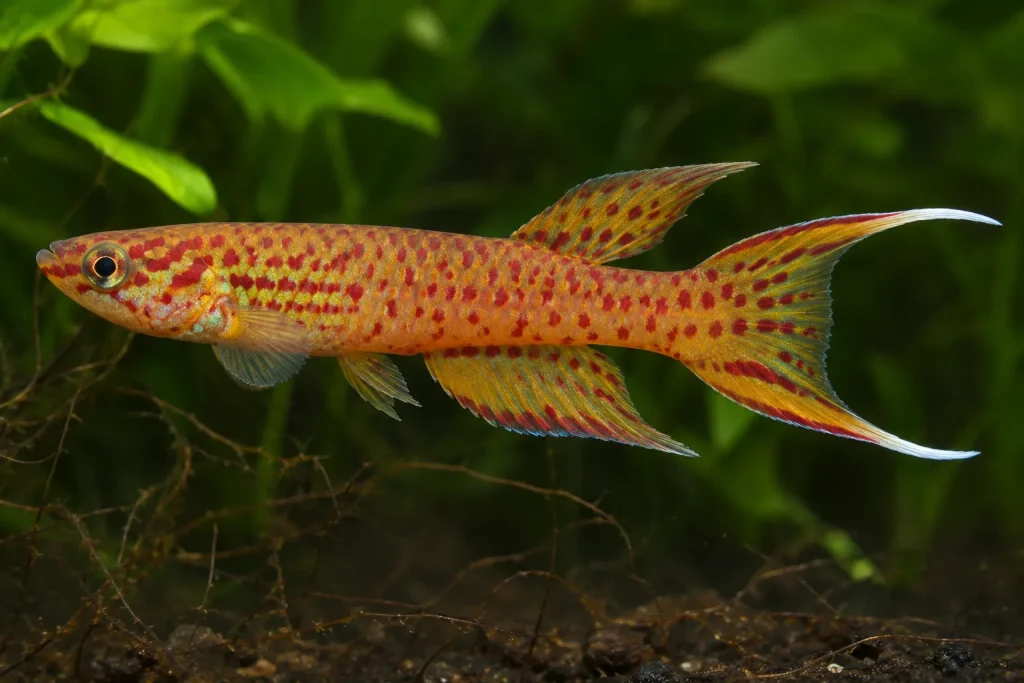
Males have an orange-brown to golden body with red spots and a long lyre-shaped tail with white-tipped extensions. Females are smaller, plainer, and rounder.

The lyre-shaped tail on males is the clearest feature. Females of different Aphyosemion species are very hard to tell apart, so keep lines separate.

Males are larger and more brightly coloured, with extended caudal, dorsal, and anal fins. Females are smaller, plainer, and rounder-bellied.

Tank Requirements

Suggested filter
About 60–90 litres an hour
Suggested heater
About 25–50 W for this tank
Minimum tank volume
30 litres
Minimum tank length
45 cm
Minimum group size
1
Recommended group size
3
Activity level
Low
Flow preference
Low
Planting preference
Heavily planted
Hiding places
Yes
Lid recommended
Yes
Jumping risk
High

Use dense plants, floating cover, and dim light with a gentle sponge filter. A tight-fitting lid is essential, because this fish jumps.

Behaviour and Tankmates

Peaceful and shy, spending much of its time among plants.

Keep as a pair or trio. Tankmates need to be small and peaceful.

Males display at each other but are mild compared with many killifish.

Suitable with small characins, rasboras, dwarf cichlids, corydoras, small loricariids, and some anabantoids. Avoid fish that will outcompete it for food.

Check tankmates for this species

Water Parameters

Temperature
21–32 °C
pH
5.5–7
GH
1–10
Stability importance
Important

Soft, slightly acidic water suits this fish. The reference gives a wide temperature range, and most keepers stay in the low to mid 20s °C.

Parameter caveat
Small tanks change quickly, so keep up with gentle water changes and acclimate slowly.

Feeding

Diet types
Carnivore, Insectivore
Feeding frequency
Once or twice daily
Preferred foods
  • Frozen or live bloodworm, daphnia, and brine shrimpShould form most of the diet, because these fish prefer meaty foods.
  • Small granulesSome fish learn to accept these, but they should not be the only food.
  • Mosquito larvaeClose to natural prey, and helpful for bringing fish into breeding condition.

A carnivore that prefers small live and frozen foods and may slowly accept prepared food.

Make sure this shy fish actually gets a share in a mixed tank.

Breeding

Breeding type
Egg Layer
Breeding difficulty
Easy
Brood or egg count
A small number of eggs each day
Incubation
15 days
Parental care
None
Baby foods
  • Newly hatched brine shrimpKillifish fry are usually large enough for this as their first food.
  • MicrowormsUseful for the smallest fry and for a varied diet.
  • InfusoriaKeep some ready in case very small fry cannot yet take larger food.

Spawns in pairs or trios on mops or plants, with eggs that are picked out daily. Incubate them in water treated with methylene blue or on damp peat, with hatching in 10 to 20 days depending on temperature. Breeders recommend soft, acidic water and a dim tank.

Habitat and Origin

Geographic origin
Africa, Angola, Cameroon, Gabon, Republic of the Congo
Natural habitat
Blackwater, Freshwater Stream, Swamp
Aquarium contexts
Breeding Aquarium, Nano Aquarium, Planted Aquarium
Audience level
Intermediate

Classification

Profile type
Recognized species
Genus
Aphyosemion
Family
Nothobranchiidae
Species group
Fish, Killifish

Have you kept this species?

You can write a note about what worked for you, or send a photograph. We check everything before it appears here.

Share a note or photo

JPG, PNG, or WebP, up to 5 MB.