Skip to content
Menu

Species profile

Medaka (Japanese Ricefish)

Oryzias latipes

Common names: Medaka, Japanese Ricefish, Ricefish
Recognized speciesRicefish
Medaka (Japanese Ricefish) (Oryzias latipes)

Adult size

Up to 3.6 cm

Typical adult length 3–3.6 cm.

Up to 3.6 cm

Countries of origin

  • See all stock from China
  • See all stock from Japan
  • See all stock from Laos
  • See all stock from Myanmar
  • See all stock from South Korea
  • See all stock from Taiwan
  • See all stock from Vietnam

Good fit for your tank?

Good fit for

  • An unheated aquarium or small pond in a suitable climate
  • A keeper who wants easy breeding
  • A calm planted tank

Think carefully if

  • You keep warm tropical fish
  • You keep other Oryzias species
  • You want a long-lived fish

A small, hardy cool-water fish from East Asia, kept for centuries in Japan and now bred in many colours. It breeds easily and suits unheated aquariums and small ponds.

Appearance and Identification

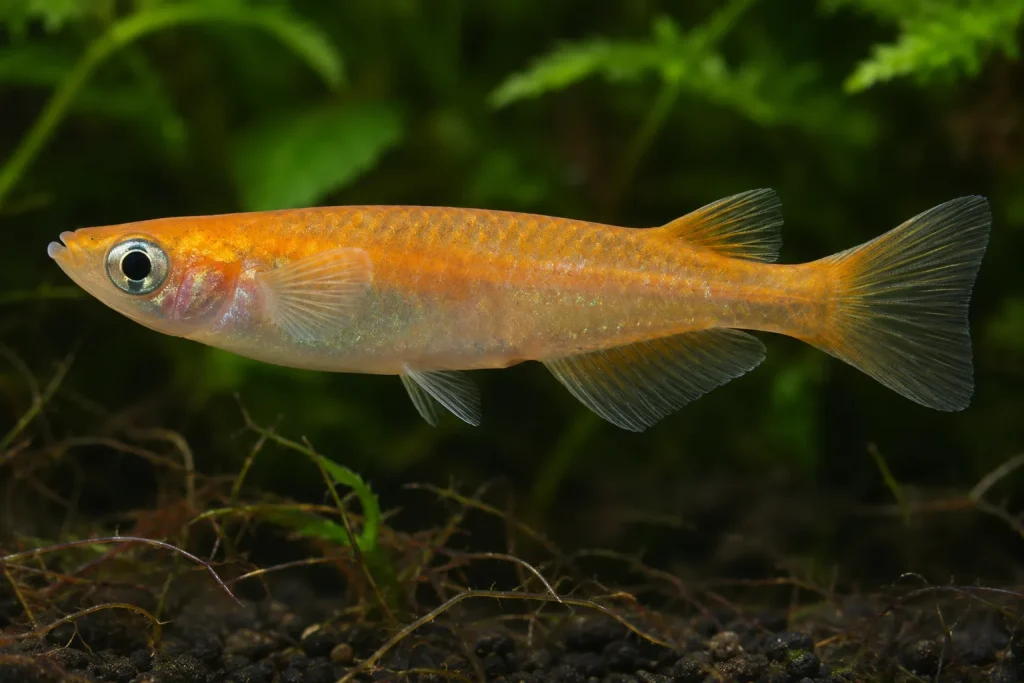
A small, slim fish with large eyes and a flat upper head, in natural silver-grey or line-bred orange, white, blue, and metallic forms.

Many Oryzias species look similar, and they can interbreed. Check the name if you keep more than one type.

Males have elongated dorsal and anal fin rays and a slimmer body. Females have a rounder body and often carry eggs near the vent.

Tank Requirements

Suggested filter
About 80–120 litres an hour
Minimum tank volume
40 litres
Minimum tank length
45 cm
Minimum group size
8
Recommended group size
10
Activity level
Moderate
Flow preference
Low
Planting preference
Heavily planted
Hiding places
Yes
Lid recommended
Yes
Jumping risk
Moderate

Provide fine-leaved plants or floating roots for eggs, plus open water near the surface and gentle flow. A heater is often unnecessary, as long as the room stays within range.

Behaviour and Tankmates

Generally peaceful and active near the surface. Males display to females.

Needs to be kept in a group, ideally 8 or more.

Mostly non-aggressive toward its own kind.

Best alone for breeding. Otherwise suits small, peaceful, cool-water fish. Avoid other Oryzias species because of the risk of hybridising.

Check tankmates for this species

Water Parameters

Temperature
16–22 °C
pH
6.5–8.5
GH
5–25
Stability importance
Normal

Adaptable to a broad range of neutral to alkaline water. Cool conditions suit it better than warm tropical setups.

Parameter caveat
Hot rooms may need cooling measures in the warmest months. Acclimate slowly.

Feeding

Diet types
Insectivore, Omnivore
Feeding frequency
Once or twice daily
Preferred foods
  • Fine micro granules or crushed flakeUse a particle size the fish can swallow whole, and feed only what is eaten within a couple of minutes.
  • Frozen or live daphnia and cyclopsSmall crustaceans add variety and help bring adults into breeding condition.
  • Frozen or newly hatched brine shrimpA good small meat food a few times a week rather than the only food.

An omnivore that eats small invertebrates, algae, and small prepared foods, mainly near the surface.

Reduce feeding if the water cools in winter, because the fish become less active.

Breeding

Breeding type
Egg Layer
Breeding difficulty
Very easy
Brood or egg count
A small batch every few days
Incubation
14 days
Parental care
None
Baby foods
  • Infusoria or parameciumNeeded for the first days after fry become free-swimming, because the fry are very small.
  • Fine powdered fry foodUse sparingly as a supplement, and siphon out anything left uneaten.
  • Newly hatched brine shrimpIntroduce once the fry are large enough to swallow it, usually after several days.
  • MicrowormsA useful next step for fry that are still too small for brine shrimp.

Easy and prolific. Females produce batches of adhesive eggs every few days or even daily, usually in the early morning. Eggs hang from the female before being scattered among fine-leaved plants, and they take about 1 to 3 weeks to hatch. Adults may eat fry, so dense plants or a separate container help.

Habitat and Origin

Geographic origin
Asia, Captive Bred, China, Japan, Laos, Myanmar, South Korea, Southeast Asia, Taiwan, Vietnam
Natural habitat
Ditch, Pond, Rice Field, Slow River
Aquarium contexts
Breeding Aquarium, Coldwater Aquarium, Nano Aquarium, Planted Aquarium, Pond, Temperate Aquarium
Audience level
Beginner

Classification

Profile type
Recognized species
Genus
Oryzias
Family
Adrianichthyidae
Species group
Fish, Ricefish

Have you kept this species?

You can write a note about what worked for you, or send a photograph. We check everything before it appears here.

Share a note or photo

JPG, PNG, or WebP, up to 5 MB.