Skip to content
Menu

Species profile

Paradise Fish

Macropodus opercularis

Common names: Paradise Fish, Paradise Gourami
Recognized speciesGouramis
Paradise Fish (Macropodus opercularis)

Adult size

Up to 8 cm

Typical adult length 6–8 cm.

Up to 8 cm

Countries of origin

  • See all stock from China
  • See all stock from Taiwan
  • See all stock from Vietnam

Good fit for your tank?

Good fit for

  • An unheated or cool-water aquarium
  • A species-focused tank with one male and several females
  • A keeper who wants a bold, characterful fish

Think carefully if

  • You keep a warm tropical community
  • You plan to keep two males together
  • You keep small fish, shrimp, or long-finned gouramis

A bold, striped labyrinth fish from East Asia that prefers cool water and does not need a heater in many homes. Males are aggressive, so tankmates need careful selection.

Appearance and Identification

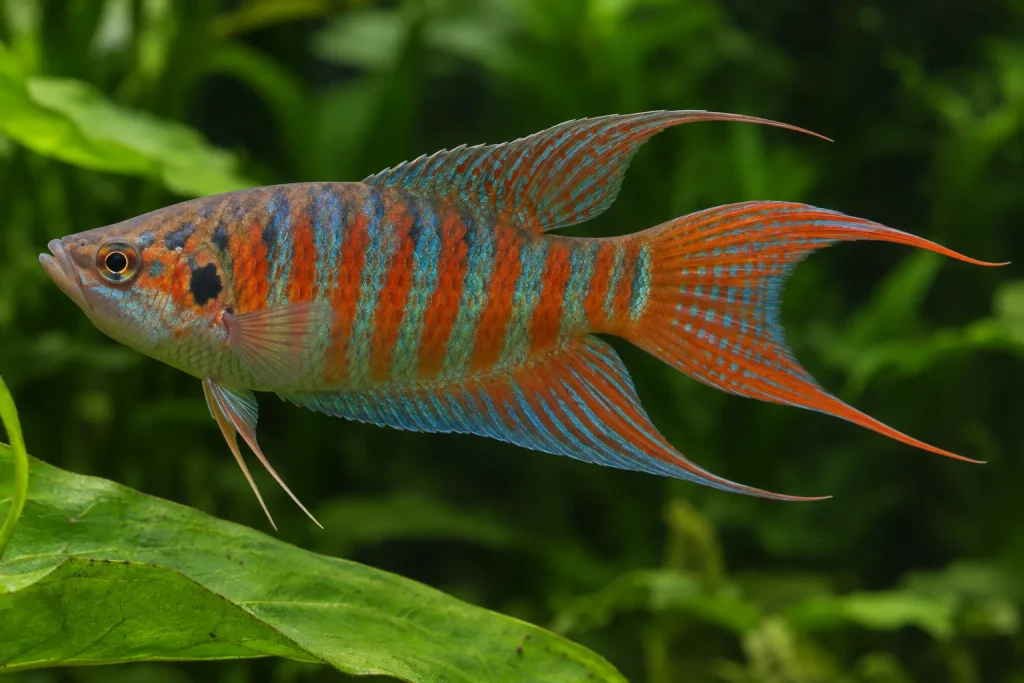
A long body with alternating red-orange and blue-green bars and a dark spot on the gill cover. Males have extended dorsal, anal, and tail fins. Albino and dark forms are also sold.

The barred body and deeply forked tail are distinctive. Do not confuse it with tropical gouramis, because its temperature needs are very different.

Males are larger and have extended soft rays in the dorsal, anal, and caudal fins. Females are plainer and shorter-finned.

Tank Requirements

Suggested filter
About 140–210 litres an hour
Minimum tank volume
70 litres
Minimum tank length
80 cm
Minimum group size
1
Recommended group size
3
Activity level
Moderate
Flow preference
Low
Planting preference
Heavily planted
Hiding places
Yes
Lid recommended
Yes
Jumping risk
Moderate

Provide dense plants, floating cover, and hiding places for females. A heater is often unnecessary, though the room temperature should stay within the fish’s range. Use a lid to stop it jumping.

Behaviour and Tankmates

Bold and inquisitive. Males are territorial, display strongly, and can be aggressive.

Keep one male with two or more females. Do not keep two males together in a normal aquarium.

Males are territorially aggressive, especially toward other males and similarly shaped fish.

Peaceful schooling fish with similar temperature needs, such as White Cloud Mountain Minnows of a good size, can work. Avoid other labyrinth fish, long-finned fish, and shrimp.

Check tankmates for this species

Water Parameters

Temperature
10–22 °C
pH
6–8
GH
5–20
Stability importance
Normal

A cool-water fish, so long periods in warm tropical water are not ideal. Allow for a natural seasonal change if your room temperature varies.

Parameter caveat
Check your room temperature through the year, because hot rooms may need cooling measures in the warmest months.

Feeding

Diet types
Carnivore, Insectivore, Omnivore
Feeding frequency
Once or twice daily
Preferred foods
  • Small floating pellets or quality flakeThese fish feed readily from the surface. Choose a small size and feed sparingly.
  • Frozen or live daphnia and brine shrimpOffer a few times a week for variety and condition.
  • Frozen bloodworm or mosquito larvaeUse as an occasional rich treat rather than a daily food.

An unfussy omnivore that also hunts small invertebrates and may eat small fish.

Reduce feeding if the water cools in winter, because the fish becomes less active.

Breeding

Breeding type
Bubble Nest
Breeding difficulty
Easy
Brood or egg count
Often several hundred eggs
Incubation
3 days
Parental care
Bubble-nest care
Baby foods
  • Infusoria or parameciumEssential for the first days, because labyrinth fry are tiny and cannot yet take larger food.
  • Vinegar eels or microwormsIntroduce as the fry grow, and offer in small amounts to protect water quality.
  • Newly hatched brine shrimpIntroduce once the fry can swallow it, usually after one to two weeks.

A bubble nester. Soft water with a slightly raised temperature is said to trigger breeding. Eggs float up to the nest, which the male guards, and fry hatch in about 3 to 4 days. Move the female away after spawning, because the male can become aggressive.

Habitat and Origin

Geographic origin
Asia, China, Southeast Asia, Taiwan, Vietnam
Natural habitat
Ditch, Pond, Rice Field, Slow River
Aquarium contexts
Breeding Aquarium, Coldwater Aquarium, Planted Aquarium, Species-Only Aquarium, Temperate Aquarium
Audience level
Intermediate

Classification

Profile type
Recognized species
Genus
Macropodus
Family
Osphronemidae
Species group
Fish, Gouramis

Have you kept this species?

You can write a note about what worked for you, or send a photograph. We check everything before it appears here.

Share a note or photo

JPG, PNG, or WebP, up to 5 MB.