

Threadfin Rainbowfish
Iriatherina werneri
- Care level
- Intermediate
- Adult size
- 4 cm
- Minimum tank
- 54 litres
- Temperature
- 22–30 °C
Species profile
Pseudomugil gertrudae
Common names: Spotted Blue Eye Rainbowfish, Spotted Blue-eye, Northern Blue-Eye, Spotted Blue Eye
Up to 3.8 cm


A tiny, spotted blue-eye from northern Australia and New Guinea, at about 3.8 cm, with white fins on the male. Keep a group of at least 6 in 40 litres or more.
A tiny, spotted blue-eye from northern Australia and New Guinea, at about 3.8 cm, with white fins on the male. It suits a planted nano tank.
Check the scientific name when buying, as common names vary between sellers and countries.
Mature females are usually rounder in the belly, and males are usually slimmer and often brighter.
A long tank with open swimming water, plants around the edges and steady filtration suits this fish. A darker substrate and some floating plants usually bring out its colour.
Active and social, and most settled when kept with its own kind.
Keep a group of at least 6, and more if you can. Larger groups are calmer and show better colour and behaviour.
Not territorial, although males may spar and display.
Suits a community of similar-sized, peaceful fish that like the same water. Avoid large predators, which will treat it as food. It may eat baby shrimp.
Fairly tolerant of different water, if it is clean and stable.
A tiny blue-eye that needs very small foods such as fine flake and baby brine shrimp.
Feed small amounts, and remove anything left after a few minutes.
An egg scatterer with no parental care. Adults eat eggs and fry, so use a separate tank with fine plants, moss or mesh on the bottom, and remove the adults after spawning. The fry need very small foods at first.
You can write a note about what worked for you, or send a photograph. We check everything before it appears here.
Iriatherina werneri
Melanotaenia australis
Melanotaenia trifasciata
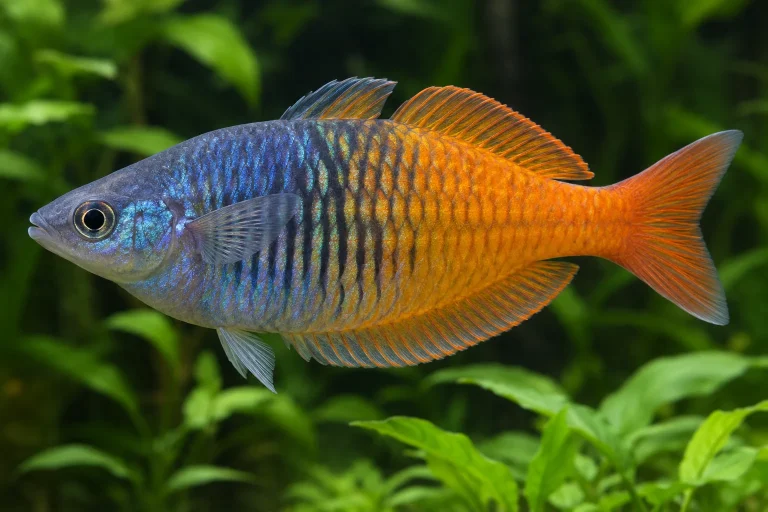
Melanotaenia boesemani