Skip to content
Menu

Species profile

Swordtail

Xiphophorus hellerii

Common names: Swordtail, Green Swordtail, Red Swordtail
Recognized speciesLivebearers
Swordtail (Xiphophorus hellerii)

Adult size

Up to 14 cm

Typical adult length 10–14 cm.

Up to 14 cm

Countries of origin

  • See all stock from Belize
  • See all stock from Guatemala
  • See all stock from Honduras
  • See all stock from Mexico

Good fit for your tank?

Good fit for

  • A long, hard-water community aquarium
  • A keeper with an active group of fish in mind
  • A tank with robust, similarly sized tankmates

Think carefully if

  • Your tank is short or has no lid
  • Your water is soft or acidic
  • You plan to keep several males in a small tank

A lively livebearer from Central America whose males grow a long sword from the tail. It grows larger than most people expect, so it needs a long aquarium and a tight lid.

Appearance and Identification

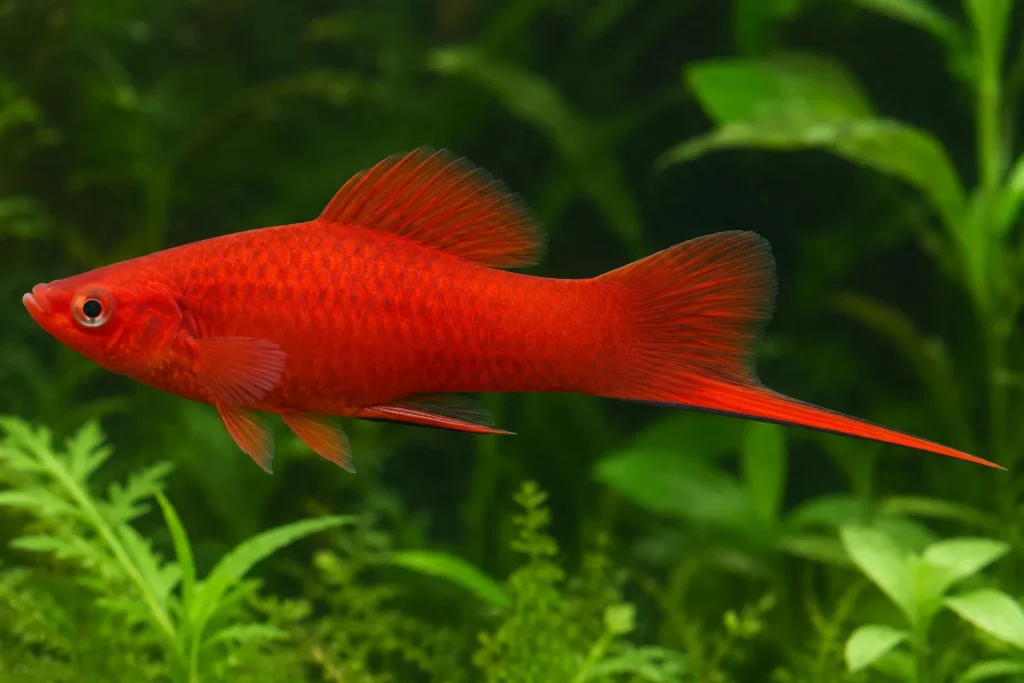
A long, torpedo-shaped body. Males have a long, narrow sword from the lower tail. Colours include red, green, black, wagtail, and pineapple.

The male's sword is the clearest feature. Females look more like large, slender platies, and the two species can hybridise.

Males are smaller than females and have a gonopodium and an extended lower tail lobe, which forms the sword.

Tank Requirements

Suggested filter
About 600–750 litres an hour
Minimum tank volume
150 litres
Minimum tank length
120 cm
Minimum group size
3
Recommended group size
6
Activity level
Very active
Flow preference
Moderate
Planting preference
Moderately planted
Hiding places
Yes
Lid recommended
Yes
Jumping risk
High

Length matters because this fish is a fast swimmer. Provide moderate flow, open swimming lanes, and planted edges. A tight lid is essential, as swordtails jump.

Behaviour and Tankmates

A fast, active fish. Dominant males can be aggressive toward other males and may bully smaller fish.

Keep in a group with more females than males. A single male with several females often works best in smaller setups.

Dominant males can bully other males, sometimes badly. More females and more space reduce the problem.

Suits robust, active fish that like hard water, including other livebearers and larger barbs. Very small fish and shrimp are at risk. Avoid slow, long-finned fish.

Check tankmates for this species

Water Parameters

Temperature
16–28 °C
pH
7–8
GH
10–25
Stability importance
Normal

Moderately hard to hard, alkaline water is best. It tolerates cooler water than many tropical fish.

Parameter caveat
Keep the water hard and alkaline. Soft, acidic water is a common cause of poor health in livebearers.

Feeding

Diet types
Algae Grazer, Insectivore, Omnivore
Feeding frequency
Once or twice daily
Preferred foods
  • Spirulina or vegetable flakeThese fish graze naturally, so plant matter should be a regular part of the diet.
  • Small granules or quality flakeUse as the daily staple and keep portions small, because they will overeat.
  • Frozen or live daphnia and brine shrimpOffer a few times a week. Daphnia also helps prevent constipation.

An omnivore that eats insects, small invertebrates, and algae in the wild.

Feed a mix of plant-based and meaty foods, and do not rely on leftovers from other fish.

Breeding

Breeding type
Livebearer
Breeding difficulty
Easy
Brood or egg count
Often 20 to over 100 live young per brood
Parental care
None
Baby foods
  • Newly hatched brine shrimpLivebearer fry are born large enough to take this straight away, and it gives the fastest growth.
  • Finely crushed flakeEasy and widely accepted. Feed small amounts several times a day.
  • MicrowormsUseful for the smallest fry and for those feeding near the floor of the tank.

A livebearer in which males fertilise females internally using the gonopodium, and females can store viable sperm for months. Fry are large at birth and can take small food straight away. Dense plants or a separate tank protect them from adults.

Habitat and Origin

Geographic origin
Belize, Captive Bred, Central America, Guatemala, Honduras, Mexico
Natural habitat
Freshwater River, Freshwater Stream, Vegetated Shoreline
Aquarium contexts
Breeding Aquarium, Large Aquarium, Planted Aquarium
Audience level
Beginner

Classification

Profile type
Recognized species
Genus
Xiphophorus
Family
Poeciliidae
Species group
Fish, Livebearers

Have you kept this species?

You can write a note about what worked for you, or send a photograph. We check everything before it appears here.

Share a note or photo

JPG, PNG, or WebP, up to 5 MB.