

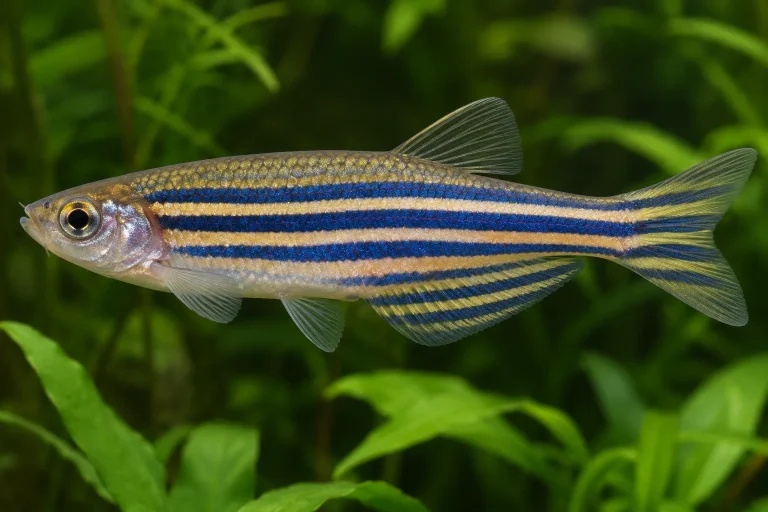
Species profile
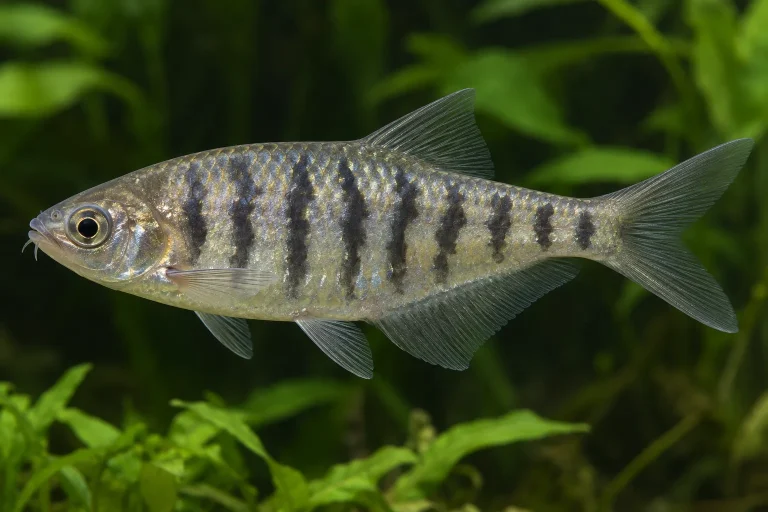
Yoma Danio
Danio feegradei
Common names: Yoma Danio
Recognized speciesDanios
Adult size
Up to 6.8 cm
Typical adult length 5–6.8 cm.

Up to 6.8 cm
Countries of origin
Good fit for your tank?
Good fit for
- Keepers able to maintain an active school of at least 10 fish.
- Mature freshwater aquariums with open swimming room, good oxygenation, and regular maintenance.
Think carefully if
- The aquarium is shorter than 90 cm or cannot hold at least 8 fish.
- Tankmates are slow, long-finned, very timid, or small enough to be intimidated or eaten.
- You need a species with extensive, well-established aquarium husbandry records; information for this fish remains limited.
Yoma Danio is a small to medium schooling danio requiring a group, a secure lid, clean oxygen-rich water, and at least 100 litres.
Appearance and Identification
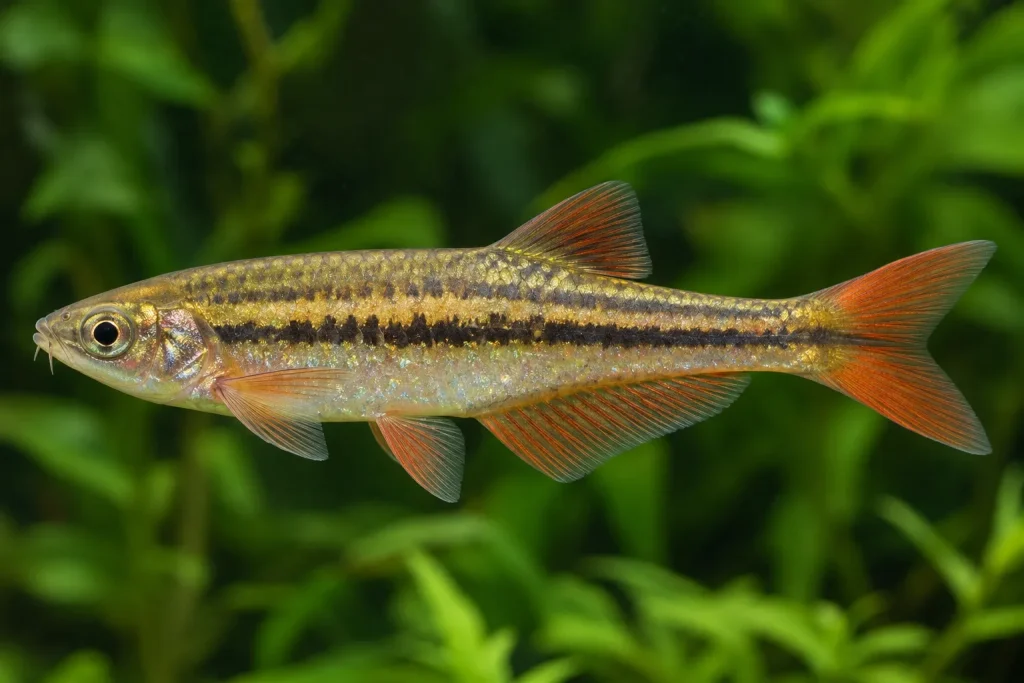
A silvery-gold danio with dark horizontal markings and orange-red colour in the fins.
The accepted placement is Danio feegradei. Devario feegradei and Brachydanio feegradei are older combinations.
Adult females are generally fuller-bodied and slightly larger. Mature males are usually slimmer and show stronger colour, especially during courtship.
Tank Requirements
- Suggested filter
- About 400–500 litres an hour
- Suggested heater
- About 100–150 W for this tank
- Minimum tank volume
- 100 litres
- Minimum tank length
- 90 cm
- Minimum group size
- 8
- Recommended group size
- 10
- Activity level
- High
- Flow preference
- Moderate
- Planting preference
- Moderately planted
- Hiding places
- Yes
- Lid recommended
- Yes
- Jumping risk
- High
Aquarium information for this uncommon species is limited, so conservative husbandry and careful observation are advised. Keep a group of at least 8 in an aquarium at least 90 cm long.
Provide open swimming space, secure cover, efficient filtration, and moderate water movement. Use plants, wood, and rounded stone around the margins while preserving a clear central swimming area.
Keep planting and hardscape around the margins so the school has cover without losing the open midwater space it uses most.
Behaviour and Tankmates
Yoma Danio is a social, active schooling fish that should be maintained with its own kind. Most chasing is part of normal group interaction, but cramped quarters or a group that is too small can concentrate aggression.
Maintain at least 8, preferably 10 or more. A larger group produces more natural schooling and spreads chasing. Not truly territorial, although males may spar or defend short-lived display positions within the group.
Choose peaceful, similarly active fish that share the same temperature and water requirements. Very slow, timid, or long-finned tankmates may be stressed by constant movement or persistent feeding competition. Small shrimp and shrimplets may be eaten.
Some links may earn us a commission on qualifying purchases, at no extra cost to you. Check suitability, price and availability with the seller. How affiliate links work
 Xilong XL-803D canister filter – up to 100 L
An external-filter option for the moderate-flow setup described above. The seller lists a 400 L/h pump and an aquarium capacity of up to 100 litres.
Check the volume of your actual aquarium and the needs of its complete stocking. Use the flow control or spray bar to avoid a concentrated current. A larger tank or a species requiring strong river flow needs a different filter selection.
Daraz NepalCheck availability on Daraz
 Cut-to-fit aquarium filter media pad
A cut-to-fit pad for compatible filter compartments. The listing describes a sheet approximately 16 by 12 inches; check the offered variant and the space inside your filter.
The seller description varies between five and eight layers, so confirm the actual sheet before ordering. Keep the filter manufacturer’s media arrangement and avoid obstructing the flow.
Daraz NepalCheck availability on Daraz
 Xinyou ceramic filter rings – 300 g
A biological-media option for a filter with a suitable media basket. This listing is a 300 g pack of ceramic rings.
Check the ring size and available basket space. Installing new media does not make a new aquarium instantly cycled, and these rings do not replace routine water-quality checks.
Daraz NepalCheck availability on Daraz
Water Parameters
Maintain stable, clean freshwater with good oxygenation and gradual acclimation.
Parameter caveat
Do not chase a precise number at the expense of stability. Acclimate slowly, match the supplier's water where practical, and change mineral content gradually.
Some links may earn us a commission on qualifying purchases, at no extra cost to you. Check suitability, price and availability with the seller. How affiliate links work
 Manual aquarium siphon and gravel cleaner
A manual siphon for routine aquarium water changes and accessible waste removal. The seller lists a hose approximately 1.6 m long.
Control the flow and keep the intake clear of fish and delicate planting. Clean the areas appropriate for your substrate and layout rather than disturbing the entire planted bed.
Daraz NepalCheck availability on Daraz
Feeding
- Diet types
- Insectivore, Omnivore
- Feeding frequency
- Daily
- Preferred foods
- Quality micro pellets or flakesUse as the staple and choose a size that can be swallowed easily.
- Artemia and DaphniaOffer regularly for conditioning, colour, and natural feeding behaviour.
- Small frozen invertebrate foodsUse suitable portions and avoid large, tough pieces for small species.
A small omnivore that takes fine flake and frozen foods.
Feed small portions once or twice daily. Active danios feed quickly, so check that slower tankmates receive food.
Breeding
- Breeding type
- Egg Scatterer
- Breeding difficulty
- Difficult
- Breeding temperature
- 24 °C
- Breeding pH
- 6.9
- Brood or egg count
- Usually several dozen to low hundreds of eggs, depending on adult size and condition.
- Incubation
- 2 days
- Parental care
- None
- Baby foods
- Infusoria or very fine fry foodUse for the smallest newly free-swimming fry.
- MicrowormsIntroduce once fry can take moving foods.
- Newly hatched Artemia naupliiUse after the fry are large enough to swallow nauplii.
An egg-scattering spawner with no parental care. Condition adults well, then use fine-leaved plants, spawning mops, mesh, or marbles to protect eggs from the adults. Remove the breeders after spawning and raise the fry on infusoria or very fine prepared food before moving to microworms and Artemia nauplii. For uncommon species, keep detailed notes on temperature, timing, adult condition, and fry growth because dependable species-specific aquarium reports may be limited.
Habitat and Origin
- Geographic origin
- Asia, Myanmar, Southeast Asia
- Natural habitat
- Ditch, Freshwater Stream
- Aquarium contexts
- Freshwater Aquarium, Freshwater Community, Planted Aquarium, Species-Only Aquarium
- Audience level
- Specialist
Classification
- Profile type
- Recognized species
- Genus
- Danio
- Family
- Danionidae
- Species group
- Danios, Fish
- Previous scientific names
- Brachydanio feegradei, Former generic placement., Devario feegradei, Former generic placement.
Have you kept this species?
You can write a note about what worked for you, or send a photograph. We check everything before it appears here.
Share a note or photo
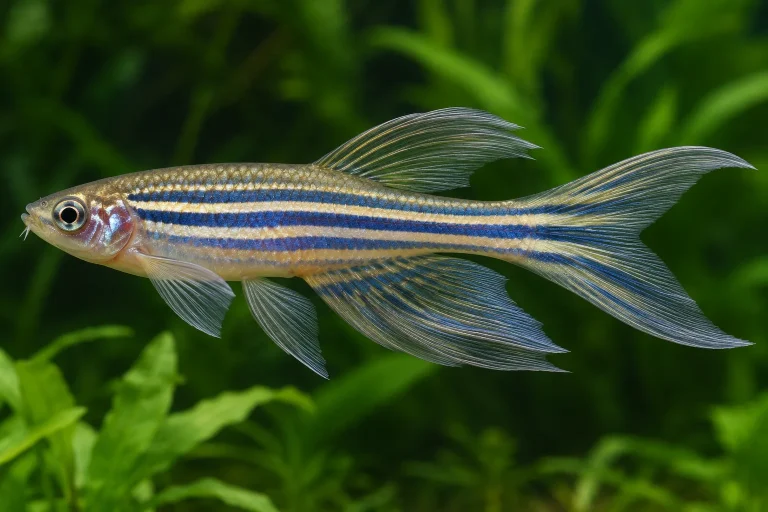
Zebra Danio – Longfin
Danio rerio
- Care level
- Beginner
- Adult size
- 4–5.5 cm
- Minimum tank
- 72 litres
- Temperature
- 18–26 °C
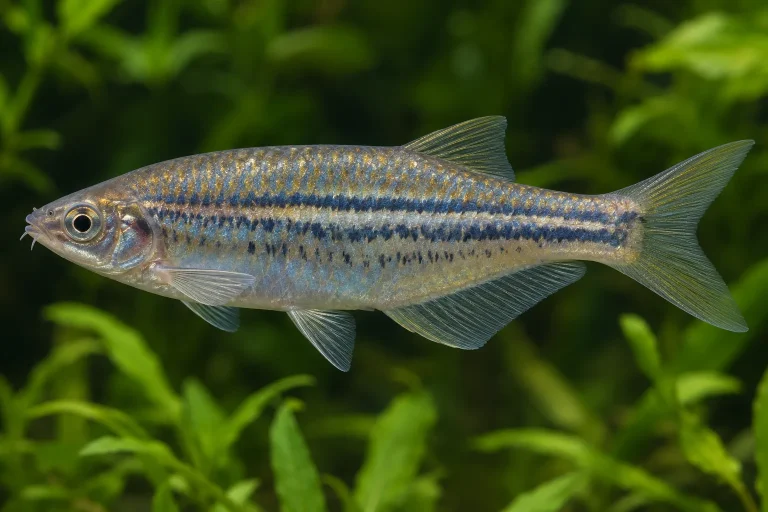
Assam Danio
Devario assamensis
- Care level
- Specialist
- Adult size
- 7–9 cm
- Minimum tank
- 180 litres
- Temperature
- 18–26 °C
Barred Danio
Devario pathirana
- Care level
- Specialist
- Adult size
- 5–6 cm
- Minimum tank
- 100 litres
- Temperature
- 18–26 °C