
Care Guide
Vampire Shrimp Care Guide
Vampire shrimp look intimidating because of their size and heavy front legs, but their feeding behavior is almost the opposite of a predator. Atya gabonensis is a specialized filter-feeding freshwater shrimp that uses fan-like structures to collect tiny suspended food particles from moving water.
That specialization is the key to proper care. A tank can have excellent water quality and still be a poor home for a vampire shrimp if the animal has nowhere to sit in steady current or there is too little suspended food to filter. The best setup combines mature freshwater conditions, strong but usable flow, secure retreats, and feeding methods that put fine food into the current rather than simply dropping large pellets onto the substrate.

What Is a Vampire Shrimp?
The vampire shrimp is Atya gabonensis, a large freshwater atyid shrimp also known as the African fan shrimp, African filter shrimp, or Gabon shrimp. GBIF recognizes A. gabonensis as the species associated with these common names.
Unlike Neocaridina and many familiar dwarf shrimp, a vampire shrimp is adapted for filter feeding. Peer-reviewed research on its feeding apparatus shows specialized elongated setae adapted to filtering particles in flowing water. That anatomy explains many of its aquarium requirements.
Adults are much larger and bulkier than cherry shrimp, but they are generally peaceful toward fish and other shrimp that do not threaten them. Their large body size should not be mistaken for predatory behavior.
Aquarium Setup: Space, Flow, and Hiding Places
A vampire shrimp needs enough aquarium volume for stable water quality and enough space to create distinct high-flow feeding positions without turning the entire tank into a torrent. Larger aquariums are usually easier because they provide room for a strong filter return, rocks or wood in the current, and quieter retreats.
Provide caves, wood, rock overhangs, or other secure hiding places. Vampire shrimp can be shy, especially when newly introduced or after molting, and often spend daylight hours partly hidden until they become comfortable.
Make sure hardscape is stable. A large shrimp pushing into a narrow crevice should not be able to dislodge a rock. Avoid sharp gaps that could trap the body during a molt.
Why Water Flow Is Essential
Flow is not simply an aesthetic preference for this species. In nature and in aquarium behavior, Atya gabonensis uses its filtering fans in moving water. A comfortable animal often chooses a perch facing the current and repeatedly opens its fans to capture suspended particles.
Create at least one reliable feeding station in the filter output or another steady current. Wood or rock positioned downstream from the return can give the shrimp a secure foothold. The flow should carry fine particles past the fans without blasting the shrimp off its perch.
If the shrimp spends much of its time scraping the substrate with closed fans rather than filtering in the current, that can be a sign that suspended food is inadequate or the available flow is not useful. Occasional picking is not automatically abnormal, but persistent floor-sweeping deserves a review of the feeding setup.
How to Feed Vampire Shrimp
Feeding is the part of vampire shrimp care that beginners most often underestimate. Large sinking pellets may be eaten indirectly if they break apart, but they do not reproduce the shrimp’s normal filtering behavior. The animal is designed to capture very fine suspended particles.
Suitable foods can include finely powdered invertebrate foods, crushed quality fish foods, fine natural suspended material from a mature aquarium, and other nutritionally appropriate particles small enough to remain in the water column. Variety is useful because no single powder should be assumed to provide every nutrient indefinitely.
Instead of dumping powder throughout the aquarium, use a small amount and release it upstream of the shrimp’s feeding perch so the current carries particles toward the fans. A pipette or small container of aquarium water mixed with food can help distribute a controlled amount.
Watch the response. A feeding shrimp should be able to remain on its perch and repeatedly move food from the fans to the mouth. If a visible cloud of food remains long after feeding, reduce the next portion. Excess fine food is especially easy to overuse because it disappears into the system instead of sitting visibly as one pellet.
Water Quality and Aquarium Maturity
Vampire shrimp should be added to an established freshwater aquarium with functioning biological filtration. Ammonia and nitrite should not be allowed to accumulate. Stable temperature and species-appropriate freshwater chemistry are more useful than repeatedly chasing a narrow number.
A mature aquarium is helpful for another reason: biofilm, microorganisms, detrital particles, and other fine natural material contribute to the suspended food web. That does not mean you should maintain dirty water. It means a sterile-looking brand-new tank may provide fewer natural feeding opportunities than a mature, well-maintained system.
Regular partial water changes and filter maintenance remain important. Do not confuse the shrimp’s need for suspended food with a need for accumulated waste.
Tank Mates for Vampire Shrimp
Vampire shrimp are peaceful filter feeders, so the main compatibility question is whether the other animals will stress, injure, or outcompete them. Avoid large predatory fish, aggressive bottom dwellers, and fish likely to pick at antennae or vulnerable freshly molted shrimp.
Peaceful community fish and other nonaggressive invertebrates can be compatible when their water requirements overlap. Remember that a vampire shrimp needs access to its feeding current; tank mates that constantly occupy or harass that perch can interfere with feeding even without direct aggression.
Do not use the shrimp as a “cleaner” for leftover food. It needs deliberate access to fine suspended nutrition.
Molting and Hiding
Like other shrimp, vampire shrimp grow by shedding the old exoskeleton. Because the animal is large, the empty molt can look surprisingly complete. Check whether what you found is a hollow translucent shell before assuming the shrimp died.
Freshly molted shrimp are vulnerable and may remain hidden while the new exoskeleton hardens. Provide secure caves and avoid moving hardscape to force the shrimp into view.
Appropriate mineral conditions and nutrition matter to crustacean growth, but do not automatically add calcium or hardness products whenever a shrimp molts. Test the water and understand what the aquarium already contains before altering chemistry.
How to Tell When a Vampire Shrimp May Not Be Feeding Well
Body condition and behavior are more useful than whether the shrimp accepts one particular food. A healthy animal should have regular opportunities to sit in the current and filter. Constantly roaming the bottom while scraping with the fans can suggest that it is trying to find food by less efficient means.
Other warning signs include prolonged inactivity combined with loss of condition, repeated failed molts, or a shrimp that cannot hold a feeding position because of unsuitable flow or harassment. Check the entire environment rather than immediately increasing food.
If the aquarium is heavily polished by mechanical filtration and receives only large pellets, consider whether there are enough fine suspended particles reaching the shrimp. Feed targeted small portions while continuing to protect water quality.
Common Vampire Shrimp Care Mistakes
Keeping the shrimp in weak, stagnant flow
The species is adapted for filter feeding in moving water and needs a useful current.
Feeding only large sinking pellets
Provide fine particles that can be captured by the fans.
Adding too much powdered food
Fine food can degrade water quality even when you cannot see it sitting on the substrate.
Providing no secure retreat
Large caves and shaded hiding places are important, particularly after molting.
Assuming a large shrimp is aggressive
Atya gabonensis is a specialized filter feeder, not a shrimp-hunting predator.
Frequently Asked Questions
What Do Vampire Shrimp Eat?
They filter very fine suspended particles from moving water. In aquariums, offer nutritionally appropriate powdered or finely crushed foods into the current along with natural fine material available in a mature tank.
Do Vampire Shrimp Need Strong Flow?
They need a reliable current where they can perch and filter feed. The current should move food past the fans without physically blasting the shrimp away.
Why Is My Vampire Shrimp Scraping the Ground?
Occasional scraping can occur, but persistent sweeping of the substrate may indicate that the shrimp is not receiving enough suspended food or does not have a useful feeding current.
Are Vampire Shrimp Aggressive?
Despite their size and appearance, they are filter feeders and are generally peaceful. Compatibility problems are more likely to come from fish harassing or preying on the shrimp.
Why Is My Vampire Shrimp Hiding?
Hiding is common after introduction and around molting. Provide secure caves and allow the shrimp to emerge when it feels safe.
Can Vampire Shrimp Live With Neocaridina or Snails?
They can coexist behaviorally with many peaceful invertebrates when water requirements are compatible and everyone has access to appropriate food.
Conclusion
Vampire shrimp care makes sense once you build the aquarium around the animal’s filter-feeding biology. Give Atya gabonensis stable freshwater, secure hiding places, and—most importantly—a feeding perch in steady current where fine food particles actually reach its fans.
Do not judge care by how much food you drop into the tank. Judge it by whether the shrimp can perform its normal feeding behavior while maintaining good body condition and clean water. A mature, well-filtered aquarium with targeted fine feeding is far more suitable than a tank full of large pellets and weak flow.
Sources
Atya gabonensis Giebel, 1875 — GBIF: Provides taxonomic information for Atya gabonensis, the species commonly sold as the vampire shrimp, African fan shrimp, or African filter shrimp.
High Stability in Filtration Apparatus of African Shrimp — Scientific Reports / PMC, 2023: Peer-reviewed research describes the specialized filtering setae of Atya gabonensis and their adaptation to feeding in flowing water, supporting the guide’s emphasis on current and suspended fine foods.
Aspects of the Biology of the Gabon Shrimp Atya gabonensis in the Cross River, Nigeria — Journal of Fisheries International: Reports biological and feeding information for wild Atya gabonensis and provides natural-history context for this filter-feeding freshwater shrimp.
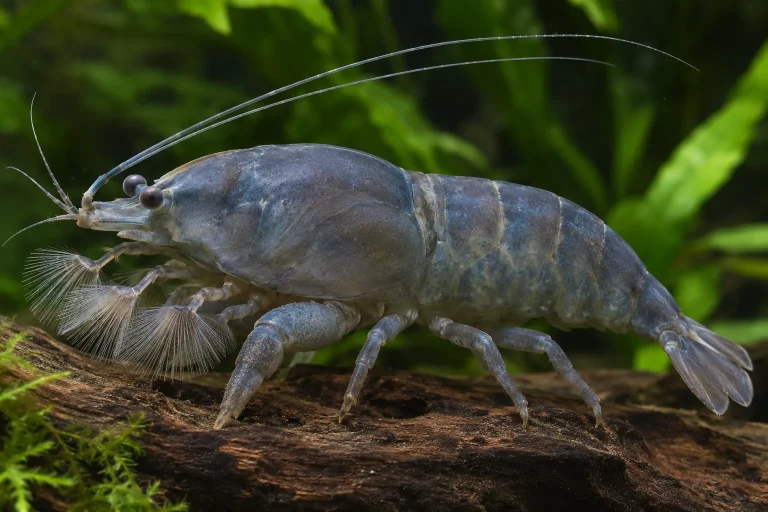
Vampire Shrimp
Atya gabonensis
- Care level
- Advanced
- Adult size
- 8–15 cm
- Minimum tank
- 100 litres
- Temperature
- 23–28 °C