
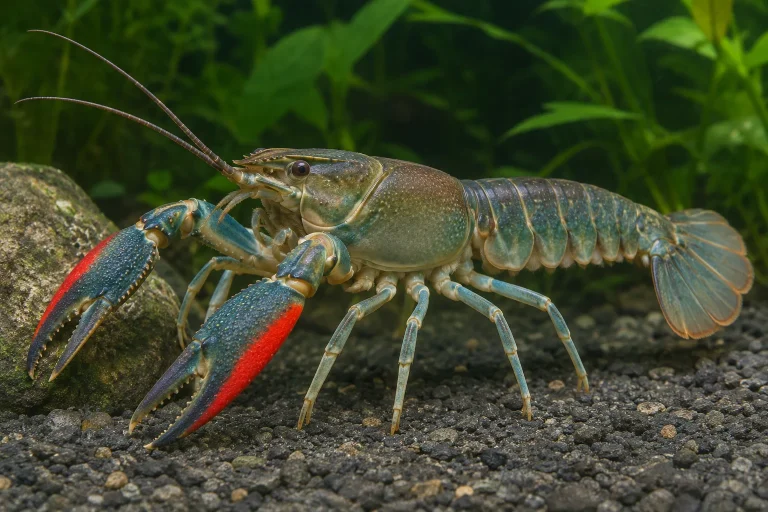
Red Claw Crayfish
Cherax quadricarinatus
- Care level
- Advanced
- Adult size
- 15–25 cm
- Minimum tank
- 200 litres
- Temperature
- 22–28 °C
Species profile
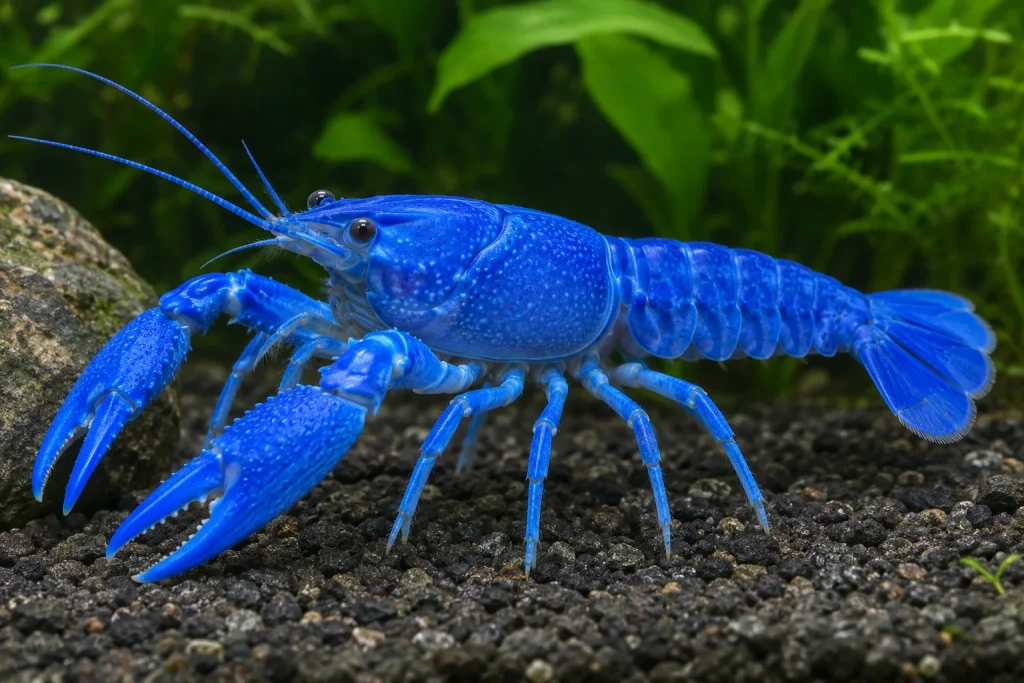
Procambarus alleni
Common names: Blue Crayfish, Electric Blue Crayfish, Florida Blue Crayfish
Up to 15 cm
Typical adult length 10–15 cm.

A robust Florida crayfish commonly sold in vivid blue captive colour forms and requiring a secure, spacious aquarium.
Wild individuals are variable brown to blue-grey, while captive aquarium lines are often selected for bright electric-blue coloration.
Procambarus alleni is the Florida crayfish commonly sold as Blue or Electric Blue Crayfish. Blue colour alone is not enough to distinguish it from other blue crayfish species.
Mature males and females can be distinguished by the position of reproductive openings and abdominal appendages; colour is not a sex indicator.
Provide a heavy escape-proof lid, multiple caves, stable hard water, protected equipment, and décor that cannot collapse when excavated.
Strong, opportunistic bottom-dweller that digs, rearranges décor, explores the aquarium, and may capture tankmates.
Usually safest kept singly. Cohabitation requires a very large enclosure and still carries injury and cannibalism risk.
Highly territorial around shelters, especially during and after moulting.
Best kept alone or in a carefully planned species aquarium. Fish, shrimp, snails, and other crayfish may be injured or eaten.
Provide hard, well-buffered water, strong filtration, a secure cover, and shelters. Avoid soft acidic water and sudden mineral changes during moulting.
Opportunistic omnivore and predator. Feed a complete crustacean diet with plant material, sinking foods, and controlled animal protein.
Remove uneaten food and provide calcium-rich mineral availability for healthy moulting.
Females carry eggs and newly hatched juveniles beneath the abdomen. Adults may eat juveniles unless they are separated and heavily sheltered.
You can write a note about what worked for you, or send a photograph. We check everything before it appears here.
Cherax quadricarinatus
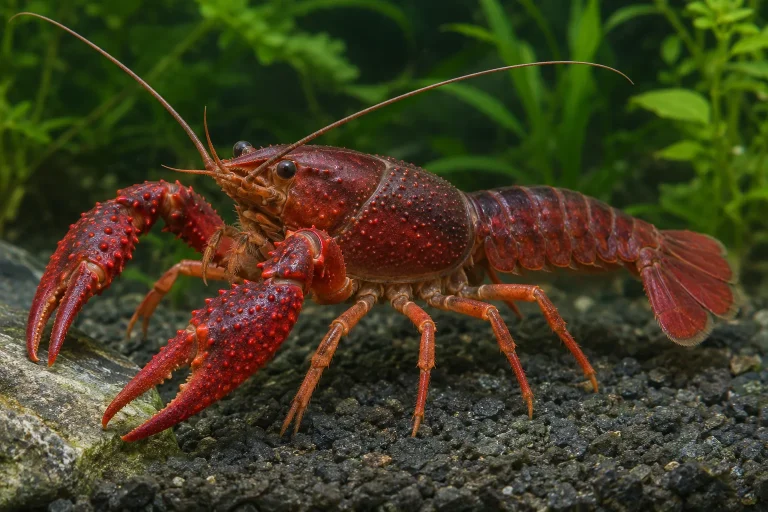
Procambarus clarkii