
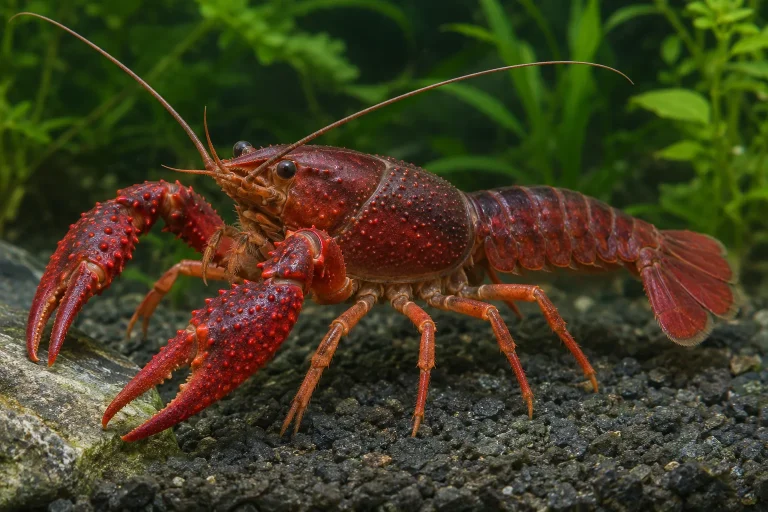
Red Swamp Crayfish
Procambarus clarkii
- Care level
- Advanced
- Adult size
- 8–12 cm
- Minimum tank
- 100 litres
- Temperature
- 18–28 °C
Species profile
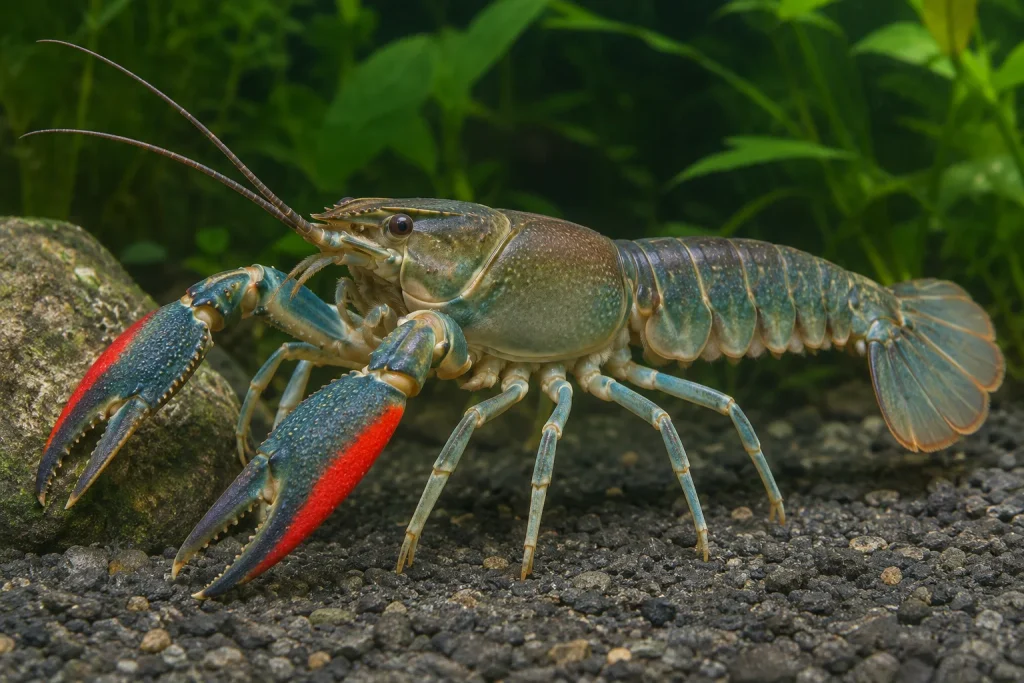
Cherax quadricarinatus
Common names: Red Claw Crayfish, Australian Redclaw Crayfish, Queensland Red Claw
Up to 25 cm
Typical adult length 15–25 cm.
A large tropical Australian crayfish that requires a very spacious, secure aquarium and can injure or consume tankmates.
Large blue-green to brown crayfish; mature males develop a distinctive red patch on the outer margin of each major claw.
Cherax quadricarinatus is the Australian Red Claw Crayfish. The red claw patch is most developed in mature males and should not be expected in juveniles or females.
Mature males develop a red patch on the outer edge of the major claws; females lack this prominent red patch and have different reproductive openings.
Use a very large escape-proof aquarium with heavy filtration, protected equipment, stable hard water, and shelters large enough for moulting adults.
Large, powerful bottom-dweller that excavates, rearranges décor, climbs equipment, and captures vulnerable animals.
Usually safest kept singly. Multiple adults need commercial-scale space and abundant shelters.
Strongly territorial around shelters and during moulting.
Not suitable for ordinary community aquariums. Most fish, shrimp, snails, plants, and other crayfish may be damaged or eaten.
Provide hard, alkaline water, strong filtration, spacious floor area, shelters, and a secure cover. Adults are territorial and produce substantial waste.
Large opportunistic omnivore. Feed complete crayfish food, vegetables, plant material, and controlled animal protein.
Monitor water quality closely because large crayfish produce substantial waste.
Females carry large broods beneath the abdomen. Juveniles require separation, shelter, and frequent feeding to reduce cannibalism.
You can write a note about what worked for you, or send a photograph. We check everything before it appears here.
Procambarus clarkii
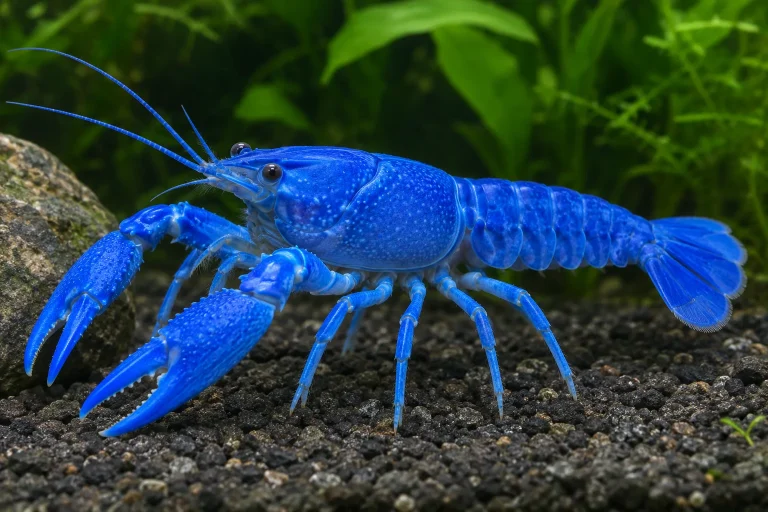
Procambarus alleni