Skip to content
Menu

Species profile

Mbu Puffer

Tetraodon mbu

Common names: Mbu Puffer, Giant Puffer, Giant Freshwater Puffer
Recognized speciesPufferfish
Mbu Puffer (Tetraodon mbu)

Adult size

Up to 75 cm

Up to 75 cm

Countries of origin

  • See all stock from Burundi
  • See all stock from Cameroon
  • See all stock from Democratic Republic of the Congo
  • See all stock from Republic of the Congo
  • See all stock from Tanzania
  • See all stock from Zambia

Good fit for your tank?

Good fit for

  • A public aquarium or an extremely large private system

Think carefully if

  • You do not already have a tank of around 2,000 litres
  • You plan to keep it with other fish
  • You also keep shrimp or snails you want to protect, because this puffer will eat them

The largest freshwater puffer, at up to 75 cm. It needs close to 2,000 litres and is suitable only for a very small number of keepers.

Appearance and Identification

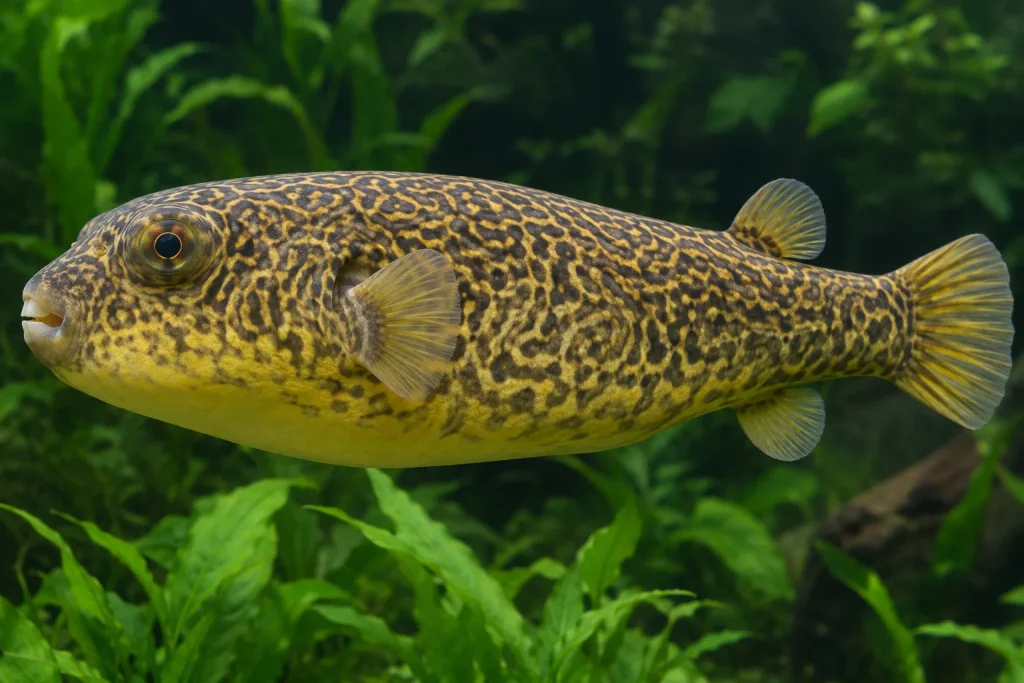
A huge puffer with a yellow to tan body covered in a maze of dark lines, and a large head.

Sources give its maximum size as 75 cm (Seriously Fish), nearly 70 cm (Aquarium Glaser), 67 cm (FishBase) or 60 cm (OATA). Young fish look harmless and are sometimes sold without warning.

No external differences.

Tank Requirements

Suggested filter
About 7,780–9,720 litres an hour
Suggested heater
About 1950–2925 W for this tank
Minimum tank volume
1944 litres
Minimum tank length
240 cm
Minimum group size
1
Recommended group size
1
Activity level
Active
Flow preference
Moderate
Planting preference
Open swimming space required
Hiding places
Yes
Lid recommended
Yes
Jumping risk
Low

Plan on a footprint of 240 × 90 cm or larger, with sand, smooth rock and very heavy filtration. Few home setups can meet this.

Behaviour and Tankmates

Slow-moving but intolerant. Some fish are calmer than others, but none are safe to trust.

Keep alone.

Generally aggressive towards other fish.

Keep alone. Its beak can tear pieces from tankmates. It will eat shrimp and snails.

Check tankmates for this species

Water Parameters

Temperature
24–26 °C
pH
7–8
GH
10–25
Stability importance
Very important

Prefers moderately hard, slightly alkaline water, in line with its range around Lake Tanganyika.

Parameter caveat
Puffers are messy feeders and sensitive to waste, so keep up regular water changes and use a filter rated for a larger tank.

Feeding

Diet types
Carnivore, Predator
Feeding frequency
Once or twice daily
Preferred foods
  • Snails and mussels in the shellEssential. Crushing shells wears down the beak, which never stops growing.
  • Crab legs, prawns and cocklesFeed unshelled where you can, for the same reason.
  • EarthwormsA useful meaty food, and many puffers take them readily.

Eats mostly snails and shellfish, plus worms and other meaty foods.

Check the beak regularly. If it overgrows, the fish can no longer eat and the teeth may need to be trimmed by someone experienced.

Breeding

Breeding difficulty
Not commonly bred
Parental care
Unknown

Has not been bred in aquariums. A vast volume of water would be needed for a serious attempt.

Habitat and Origin

Geographic origin
Africa, Burundi, Cameroon, Democratic Republic of the Congo, Republic of the Congo, Tanzania, Zambia
Natural habitat
Ancient Lake, Lake, River
Aquarium contexts
Large Freshwater Aquarium, Species-Only Aquarium
Audience level
Specialist

Classification

Profile type
Recognized species
Genus
Tetraodon
Family
Tetraodontidae
Species group
Fish, Pufferfish

Have you kept this species?

You can write a note about what worked for you, or send a photograph. We check everything before it appears here.

Share a note or photo

JPG, PNG, or WebP, up to 5 MB.