

Gabon Killifish
Aphyosemion gabunense
- Care level
- Beginner
- Adult size
- 5 cm
- Minimum tank
- 28 litres
- Temperature
- 22–28 °C
Species profile
Nothobranchius eggersi
Common names: Eggers Killifish
Up to 5 cm

A colourful annual killifish from Tanzania, with red and blue forms, usually labelled with a collection code. Keep alone or in a small group in 40 litres or more.
A colourful annual killifish from Tanzania, with red and blue forms, usually labelled with a collection code. It naturally lives for only months, and its eggs survive in dry mud.
Check the scientific name when buying, as common names vary between sellers and countries.
Males are far more colourful, with larger fins. Females are usually plain.
A small, dark, densely planted tank with a tight lid suits most killifish, as they are strong jumpers. Filtration should be gentle.
A jewel-like small fish, with males displaying to rivals and to females.
Often kept as one male with several females, because males can fight.
Males can be quarrelsome with each other.
Best in a species tank, or with small, peaceful fish. Avoid fin nippers. It is likely to eat shrimp. Choose its tankmates with care.
Fairly tolerant of different water, if it is clean and stable. Keep the temperature steady. This fish prefers cooler water than most tropical fish, and it may not need a heater in a warm room.
Prefers small live and frozen foods.
Feed small amounts, and remove anything left after a few minutes.
Lays eggs on plants or in the substrate, depending on the species, and many keepers collect the eggs to raise separately. Some species have eggs that survive long dry periods.
You can write a note about what worked for you, or send a photograph. We check everything before it appears here.
Aphyosemion gabunense
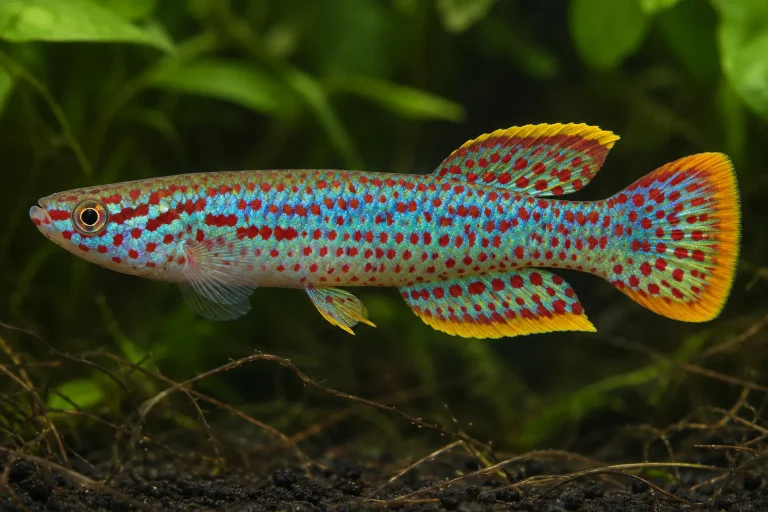
Fundulopanchax gardneri
Aplocheilus lineatus
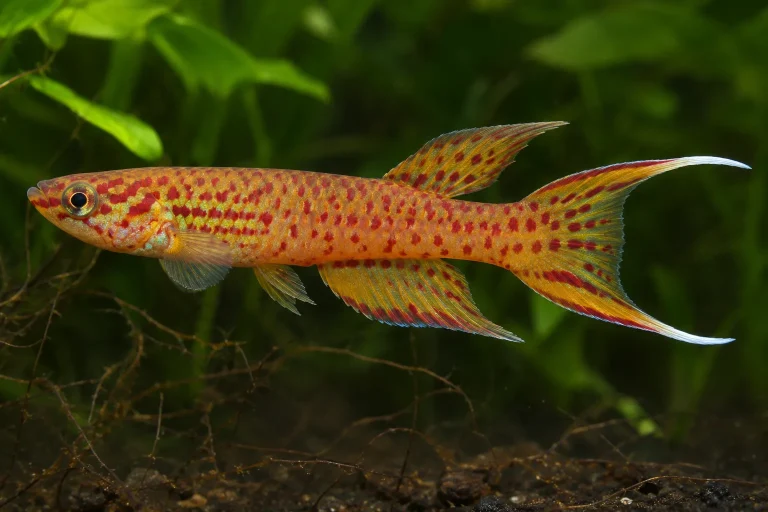
Aphyosemion australe