
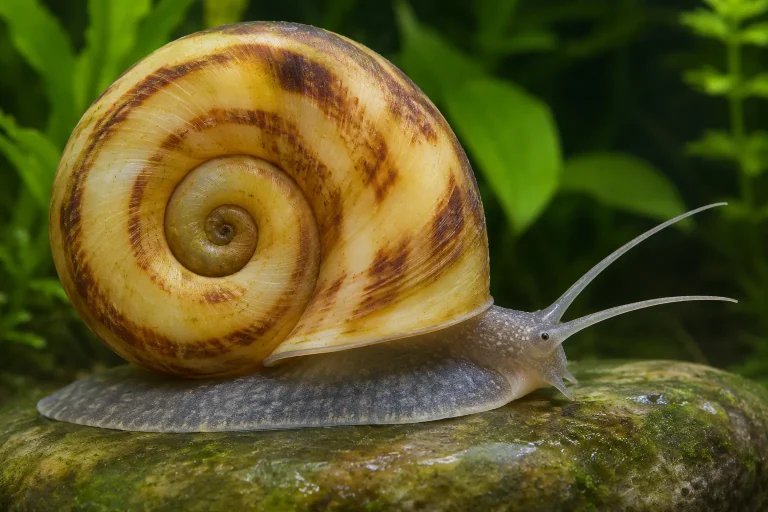
Giant Colombian Ramshorn Snail
Marisa cornuarietis
- Care level
- Advanced
- Adult size
- 4–6 cm
- Minimum tank
- 80 litres
- Temperature
- 22–28 °C
Species profile
Pomacea canaliculata
Common names: Apple Snail, Channeled Apple Snail, Golden Apple Snail
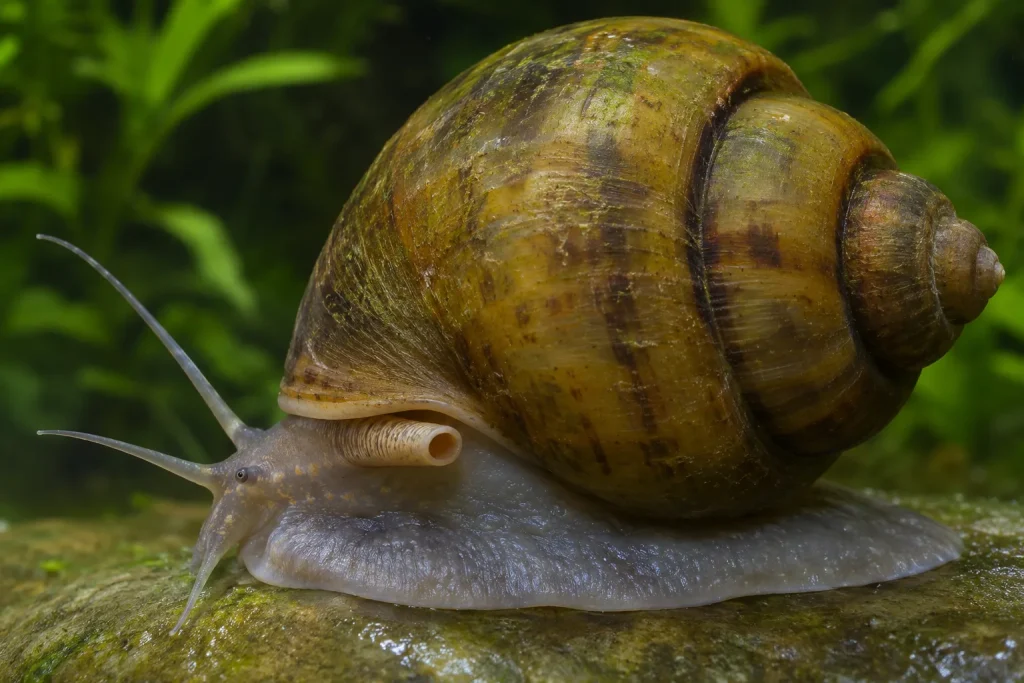
Up to 6 cm
Typical adult length 4–6 cm.






A large South American apple snail that regularly comes to the surface for air and lays bright egg clutches above the waterline. It has a strong appetite for plants and needs a roomy aquarium with a secure lid.
The shell is large and rounded, with deep channels between each whorl. Wild snails are usually olive, brown, or yellow-brown with darker bands, although yellow and golden forms are also common in captivity.
Apple snails are often sold under loose or incorrect common names, so do not identify this species from the shop label alone. Look for the deep channels between the shell whorls, along with the shell opening, operculum, adult size, and known origin. It is easily confused with other Pomacea species that are less destructive in planted tanks.
Females usually grow a little larger than males. Telling the sexes apart from the outside is difficult unless the mantle cavity can be examined or mating and egg laying have been observed.
Use a spacious aquarium with a secure lid, but leave several centimetres of warm, humid air between the water and the cover. The snail needs this space for breathing and egg laying. Choose sturdy decor, provide strong filtration, and maintain enough calcium and alkalinity to keep the shell healthy.
An active grazer that moves over the substrate, glass, hardscape, plants, and water surface while searching for food.
It can be kept alone or with other apple snails, provided the aquarium has enough food, space, and filtration. It does not need companions to feel secure.
It is not territorial, although several large snails may crowd one another and compete heavily when food is placed in a single area.
Keep it with peaceful tank mates that will leave its tentacles and exposed body alone. Puffers, loaches, large cichlids, and other snail-eating fish are unsuitable. It is also a poor choice for most planted aquariums because it may eat healthy plants as well as damaged leaves.
Neutral to alkaline water with moderate hardness is best for healthy shell growth. Soft, acidic, or calcium-poor water can leave the shell worn, pitted, or eroded.
A large omnivorous snail with a particularly strong appetite for plant matter. It eats aquatic plants, vegetables, algae, carrion, and most prepared sinking foods.
Do not expect algae alone to provide enough food. Offer regular plant-based meals and remove leftovers before they foul the water. Strong filtration and routine maintenance are important because a large, well-fed snail produces a noticeable amount of waste.
Males and females are separate. The female climbs out of the water and lays a firm, bright pink or red egg clutch above the waterline. In warm, humid conditions, the young usually hatch after about one to two weeks.
You can write a note about what worked for you, or send a photograph. We check everything before it appears here.
Marisa cornuarietis