
Explainer
Peaceful Freshwater Fish
A peaceful freshwater community is built by matching behavior, adult size, social needs, water chemistry, and swimming space—not by choosing fish that happen to be sold under a “community” label. A species can be nonpredatory and still create stress if it is territorial, too active, kept in the wrong group size, or housed with slow fish that cannot compete for food.
For beginners, the safest plan is to choose one water-chemistry range and then select fish that occupy different parts of the aquarium without conflicting. Research adult size before purchase, keep schooling fish in appropriate groups, and leave enough capacity for the fish to grow. A calm community usually comes from conservative stocking and compatible behavior rather than from adding as many peaceful species as possible.
What Makes a Freshwater Fish Peaceful?
Peaceful generally means a fish is unlikely to hunt, injure, or repeatedly harass suitable tank mates. It does not mean the fish has no social behavior. Schooling fish can chase one another, livebearer males may pursue females, and bottom dwellers can compete for the same resting places.
Adult size changes the risk. A fish that is harmless as a juvenile may later swallow smaller tank mates. Mouth size, natural diet, territorial behavior, and activity level are more useful than a simple peaceful/aggressive label.
Compatibility also depends on space. Even normally calm fish may become stressed or competitive when crowded into a tank without enough swimming room or cover.
Small Peaceful Schooling Fish
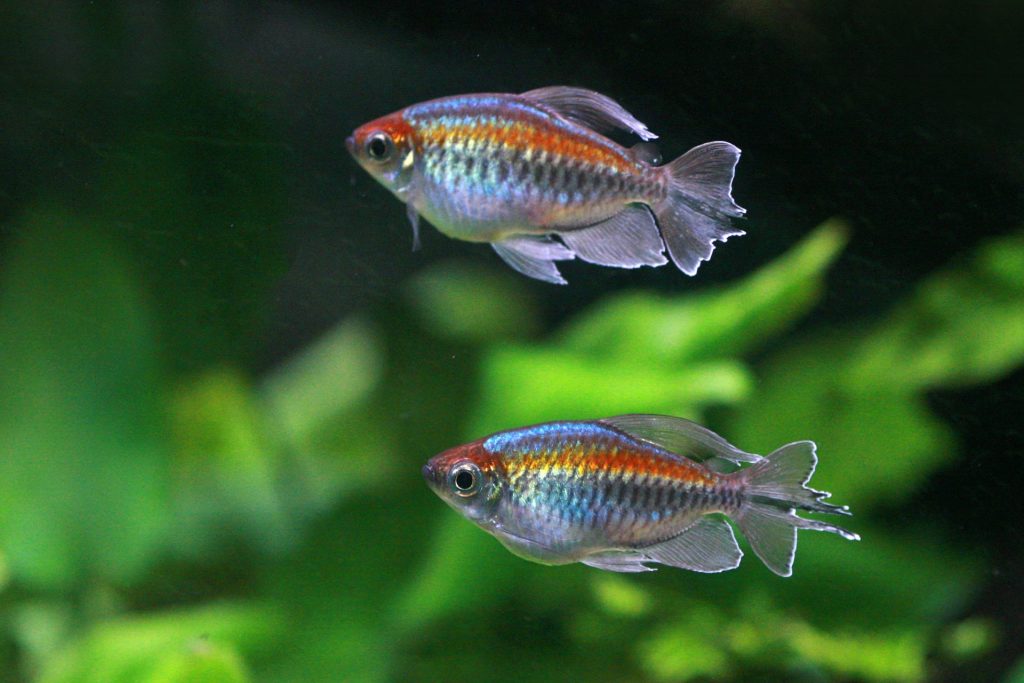
Small rasboras and many small tetras are popular community choices because they use midwater space and show natural group behavior. Choose species whose temperature and hardness needs overlap with the rest of the aquarium.
Keep schooling species in a proper group rather than buying two or three of many different fish. A larger single-species school often behaves more naturally and creates a calmer visual display.
Some small fish will eat shrimplets or very tiny fry even when they are peaceful toward adult fish. Peaceful does not mean safe for every smaller animal.
Peaceful Bottom-Dwelling Fish
Corydoras catfish are classic community bottom dwellers when kept in suitable groups on an appropriate substrate. Different Corydoras species vary in adult size and preferred temperature, so research the exact species.
Otocinclus can also fit peaceful planted communities, but they need mature grazing surfaces and supplemental food. They should not be purchased solely to clean algae.
Bottom space can become crowded before the upper aquarium looks full. Avoid stacking several bottom-dwelling species into a small footprint simply because each species is peaceful.
Livebearers in Peaceful Communities
Guppies, endlers, platies, and similar livebearers can be lively community fish, but their mineral preferences often differ from soft-water species. Compatibility should include hardness, not just temperament.
Livebearers reproduce readily when males and females are kept together. Plan for fry before stocking rather than assuming the population will remain constant.
Male pursuit can also stress females when sex ratios and cover are poor. A peaceful species still needs a social setup that prevents one individual from receiving constant attention.
Choosing a Peaceful Centerpiece Fish
A centerpiece fish should be chosen after the schooling and bottom-dwelling fish, not before. Consider its territory, adult size, feeding style, and whether long fins or slow movement will conflict with active tank mates.
Some fish, including bettas and gouramis, vary by individual and species. They may work in carefully planned communities but should not be presented as universally peaceful.
Have a backup plan if an individual becomes territorial. Aquariums are biological communities, and individual behavior cannot be guaranteed from a care sheet.
Compatibility Checklist Before Buying
Compare temperature, GH, KH, pH tolerance, adult size, diet, social group size, swimming zone, and activity level. If one fish needs hard alkaline water and another requires very soft acidic conditions, peaceful behavior does not make the pairing ideal.
Check the aquarium’s footprint as well as volume. Long active swimmers need horizontal room; bottom groups need usable floor area; territorial species need visual boundaries.
Finally, calculate the complete adult stocking plan. Buying fish one visit at a time without a final plan is how peaceful tanks become crowded tanks.
How to Build the Community Gradually
Cycle the aquarium fully before normal stocking and add fish in sensible stages so filtration can adapt to the waste load. Quarantine new fish when practical.
Provide plants, wood, rocks, or other appropriate structure to break sight lines and give shy fish somewhere to retreat. Keep open swimming areas for species that need them.
Observe feeding after every addition. A compatible community is one in which timid fish still eat, schooling fish show normal behavior, and no individual is forced to hide constantly.
Frequently Asked Questions
What Are Good Peaceful Freshwater Fish for Beginners?
Many small rasboras, tetras, Corydoras, and suitable livebearers can work, but the best choice depends on tank size and water chemistry.
Can Peaceful Fish Eat Shrimp?
Yes. A fish can be peaceful toward other fish and still eat shrimplets that fit in its mouth.
Should I Keep Many Different Schooling Species?
Usually a proper group of fewer species produces better social behavior than several undersized schools.
Are Bettas Peaceful Community Fish?
Some individuals work in communities and others do not. Tank mates, space, and individual temperament matter.
Can Hard-Water and Soft-Water Fish Live Together?
Some tolerate overlapping conditions, but choose species whose long-term water requirements genuinely overlap rather than forcing a compromise.
Do Peaceful Fish Still Need Hiding Places?
Yes. Cover and visual barriers reduce stress and let fish choose between social interaction and retreat.
How Quickly Should I Stock a Community Tank?
Stock gradually after the aquarium is cycled, allowing time to observe behavior and water quality after additions.