Skip to content
Menu

Species profile

Cardinal Tetra

Paracheirodon axelrodi

Common names: Cardinal Tetra, Red Neon Tetra
Recognized speciesTetras
Cardinal Tetra (Paracheirodon axelrodi)

Adult size

Up to 3.5 cm

Typical adult length 3–3.5 cm.
Up to 3.5 cm

Countries of origin

  • See all stock from Brazil
  • See all stock from Colombia
  • See all stock from Venezuela

Good fit for your tank?

Good fit for

  • A mature tank of 55 L or more with a group of 10, which makes them school tightly
  • Warm, soft, slightly acidic water at 23 to 29 °C, ideally tannin-stained
  • A dimly lit planted tank with floating plants, where the red stripe glows

Think carefully if

  • Your tank is newly set up: cardinals are sensitive to young, unstable water
  • You keep angelfish or large gouramis, which will pick them off
  • Your water is hard and alkaline, or the tank swings in temperature

A small blackwater shoaling fish with a full-length red band below a blue line. It enjoys warmer water than the Neon Tetra and looks best in a large group.

Appearance and Identification

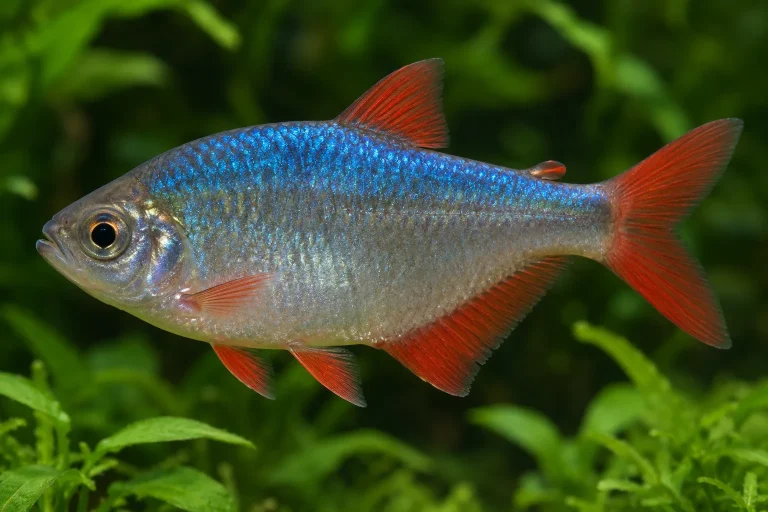
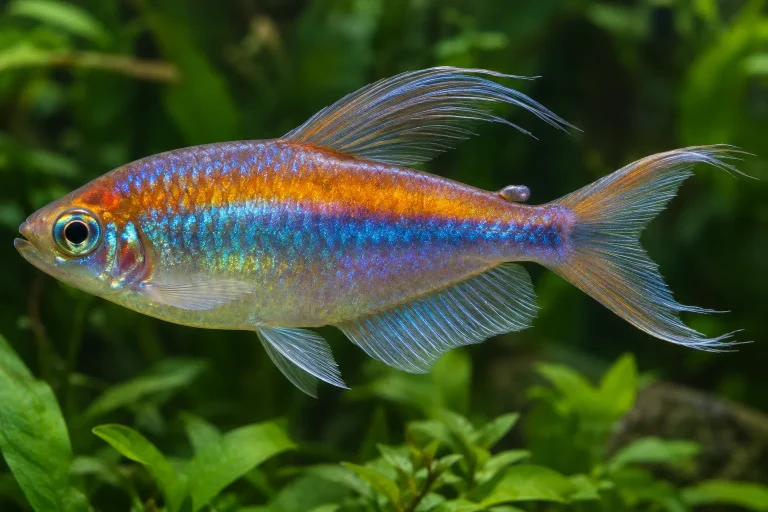
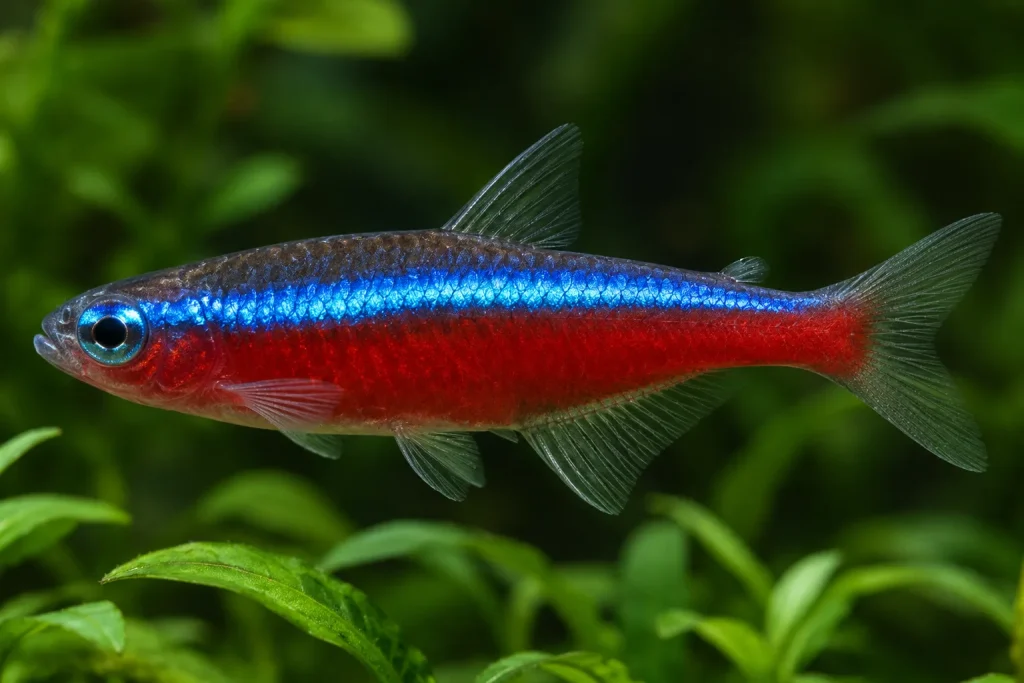
A slim fish with an electric blue line along the upper body and a deep red band along the whole lower flank from head to tail.

The full-length red band separates this fish from the Neon Tetra, whose red covers only the rear half of the body.

Mature females are rounder-bodied and slightly larger than males. The difference is easiest to see when fish are in breeding condition.

Tank Requirements

Suggested filter
About 220–280 litres an hour
Suggested heater
About 50–75 W for this tank
Minimum tank volume
55 litres
Minimum tank length
60 cm
Minimum group size
8
Recommended group size
10
Activity level
Active
Flow preference
Low to moderate
Planting preference
Heavily planted
Hiding places
Yes
Lid recommended
Yes
Jumping risk
Low

Provide a mature aquarium with dim light, floating plants, wood, or leaf litter, along with open space to swim as a group. A dark substrate helps bring out the colour.

Behaviour and Tankmates

A peaceful schooling fish that swims in a tight group when kept in good numbers and feels secure in shaded water.

Keep at least 8 to 10, and more if space allows. A large group looks better and behaves more naturally.

Not territorial.

Works well with corydoras, small rasboras, dwarf cichlids, and other peaceful soft-water fish. Avoid large gouramis, adult angelfish in smaller tanks, and active fish that outcompete them for food.

Check tankmates for this species

Water Parameters

Temperature
23–29 °C
pH
3.5–7.5
GH
1–12
Stability importance
Important

Soft, acidic water is ideal, and wild-caught fish do best at the more acidic end. Avoid pushing the pH down quickly to reach a target.

Parameter caveat
Wild-caught and farm-bred fish are both sold, and wild fish are much less tolerant of hard water. Ask which you are buying and acclimate slowly.

Feeding

Diet types
Insectivore, Omnivore
Feeding frequency
Once or twice daily
Preferred foods
  • Fine micro granules or crushed flakeUse a particle size the fish can swallow whole, and feed only what is eaten within a couple of minutes.
  • Frozen or live daphnia and cyclopsSmall crustaceans add variety and help bring adults into breeding condition.
  • Frozen or newly hatched brine shrimpA good small meat food a few times a week rather than the only food.

An omnivore that eats small invertebrates in the wild and accepts small prepared foods in the aquarium.

Use very small food, and feed where the group gathers so shy fish get a share.

Breeding

Breeding type
Egg Scatterer
Breeding difficulty
Difficult
Brood or egg count
Typically dozens to over 100 small eggs
Incubation
1 days
Parental care
None
Baby foods
  • Infusoria or parameciumNeeded for the first days after fry become free-swimming, because the fry are very small.
  • Fine powdered fry foodUse sparingly as a supplement, and siphon out anything left uneaten.
  • Newly hatched brine shrimpIntroduce once the fry are large enough to swallow it, usually after several days.
  • MicrowormsA useful next step for fry that are still too small for brine shrimp.

An egg-layer best spawned as a pair in a dim, dedicated tank with very soft, acidic water. Eggs fall through mesh or onto fine plants, and adults should be removed once eggs appear. The eggs and fry are sensitive to bright light.

Habitat and Origin

Geographic origin
Amazon Basin, Brazil, Colombia, South America, Venezuela
Natural habitat
Blackwater, Freshwater Stream, Slow River
Aquarium contexts
Breeding Aquarium, Planted Aquarium
Audience level
Beginner

Classification

Profile type
Recognized species
Genus
Paracheirodon
Family
Characidae
Species group
Fish, Tetras

Have you kept this species?

You can write a note about what worked for you, or send a photograph. We check everything before it appears here.

Share a note or photo

JPG, PNG, or WebP, up to 5 MB.