








Species profile
Green Spotted Puffer
Dichotomyctere nigroviridis
Common names: Green Spotted Puffer, GSP, Spotted Green Puffer
Recognized speciesPufferfish
Adult size
Up to 17 cm

Up to 17 cm
Countries of origin
Good fit for your tank?
Good fit for
- A dedicated brackish tank with strong filtration
- A keeper who enjoys an intelligent fish that recognises its owner
Think carefully if
- You need it to stay small or peaceful
- You also keep shrimp or snails you want to protect, because this puffer will eat them
- You do not want to mix and measure marine salt
A boldly spotted puffer that is sold everywhere but grows to 17 cm, turns mean with age and lives longest in brackish water. It is not a community fish.
Appearance and Identification
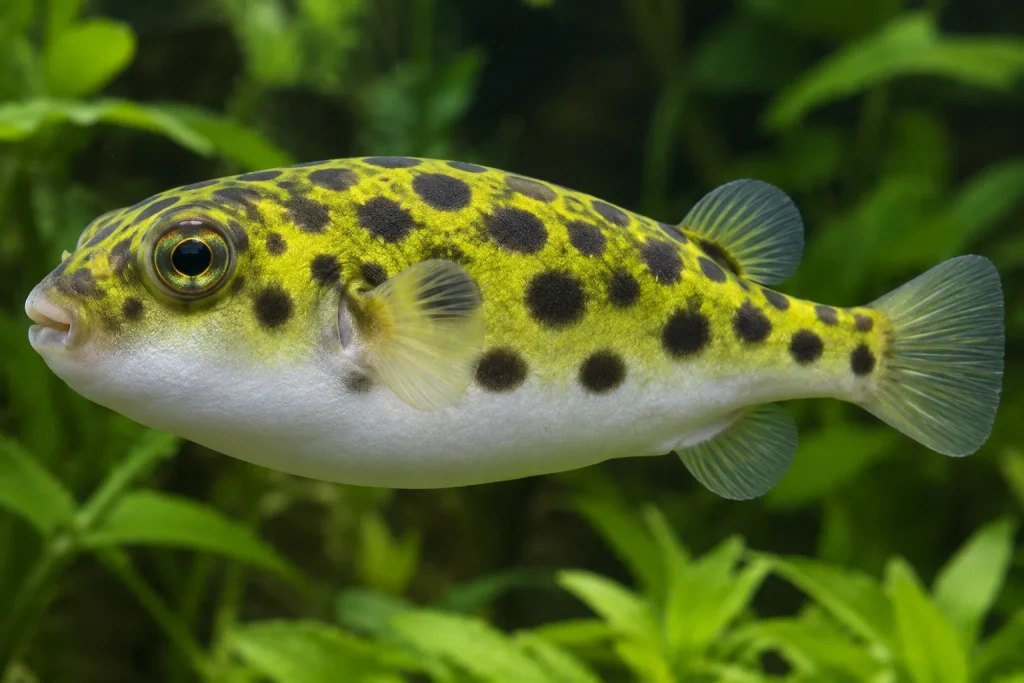
A green-gold back covered in round dark spots, above a clean white belly. Young fish look harmless and often have stronger spots.
Often confused with the Green Puffer, Dichotomyctere fluviatilis, which has a different spot pattern and needs more salt. Dichotomyctere sabahensis is also sold under this name.
No known external differences. It is seemingly impossible to sex by eye.
Tank Requirements
- Suggested filter
- About 430–540 litres an hour
- Suggested heater
- About 100–150 W for this tank
- Minimum tank volume
- 108 litres
- Minimum tank length
- 120 cm
- Minimum group size
- 1
- Recommended group size
- 1
- Activity level
- Active
- Flow preference
- Moderate
- Planting preference
- Mixed planting and open space
- Hiding places
- Yes
- Lid recommended
- Yes
- Jumping risk
- Low
Use a sandy bottom, rocks and wood, with open swimming space. Plants may be chewed, and few survive salt, so choose tough ones such as Java Fern, or use artificial plants. It is very sensitive to poor water.
Behaviour and Tankmates
Active and inquisitive, and it often learns to beg for food. Some fish become spiteful with age.
Often best alone. Fish are sometimes kept together in big tanks, but fighting is common.
Can be highly aggressive towards other puffers and tankmates.
Not a true community fish. It may nip the fins of slow or long-finned fish. In a large brackish tank, robust, active fish such as scats, monos and archerfish are sometimes used, but the risk remains. It will eat shrimp and snails.
Water Parameters
Brackish water at about SG 1.005 is usually suggested for adults. It is found in both fresh and brackish water in the wild, and sources disagree on whether salt is essential. It does appear to live longer with it.
Parameter caveat
Puffers are messy feeders and sensitive to waste, so keep up regular water changes and use a filter rated for a larger tank.
Feeding
- Diet types
- Carnivore
- Feeding frequency
- Daily
- Preferred foods
- Snails and mussels in the shellEssential. Crushing shells wears down the beak, which never stops growing.
- Crab legs, prawns and cocklesFeed unshelled where you can, for the same reason.
- EarthwormsA useful meaty food, and many puffers take them readily.
A carnivore that needs snails and unshelled shellfish to keep its beak worn down, alongside worms and frozen food.
Check the beak regularly. If it overgrows, the fish can no longer eat and the teeth may need to be trimmed by someone experienced.
Breeding
- Breeding type
- Substrate Spawner
- Breeding difficulty
- Difficult
- Parental care
- Paternal care
Rarely achieved and only in brackish water. Eggs are laid on flat rocks, and the male guards them.
Habitat and Origin
- Geographic origin
- Cambodia, India, Indonesia, Malaysia, Myanmar, Philippines, Southeast Asia, Sri Lanka, Thailand, Vietnam
- Natural habitat
- Brackish Water, Estuary, River
- Aquarium contexts
- Brackish Aquarium, Needs Brackish Water, Species-Only Aquarium
- Audience level
- Advanced
Classification
- Profile type
- Recognized species
- Genus
- Dichotomyctere
- Family
- Tetraodontidae
- Species group
- Fish, Pufferfish
- Previous scientific names
- Tetraodon nigroviridis, Former genus, and still the name used in many shops.
Have you kept this species?
You can write a note about what worked for you, or send a photograph. We check everything before it appears here.
Share a note or photo
Humpback Puffer
Pao palembangensis
- Care level
- Advanced
- Adult size
- 19.5 cm
- Minimum tank
- 108 litres
- Temperature
- 24–28 °C
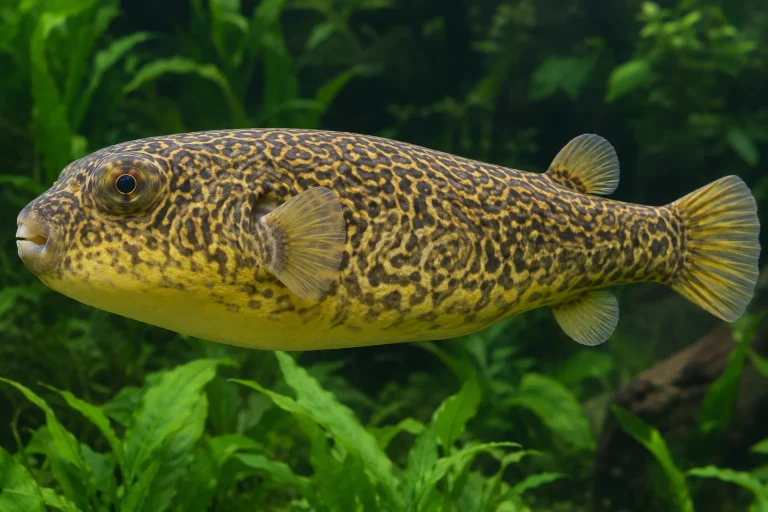
Mbu Puffer
Tetraodon mbu
- Care level
- Specialist
- Adult size
- 75 cm
- Minimum tank
- 1944 litres
- Temperature
- 24–26 °C
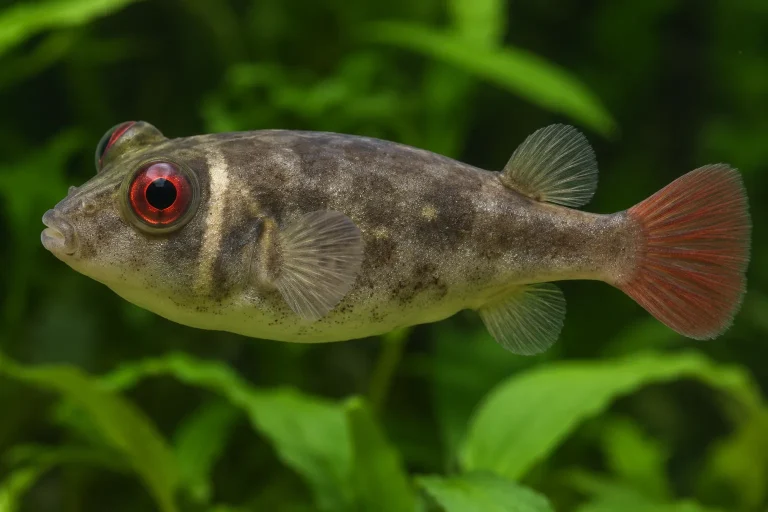
Red-tailed Redeye Puffer
Carinotetraodon irrubesco
- Care level
- Intermediate
- Adult size
- 4.5 cm
- Minimum tank
- 54 litres
- Temperature
- 20–28 °C