
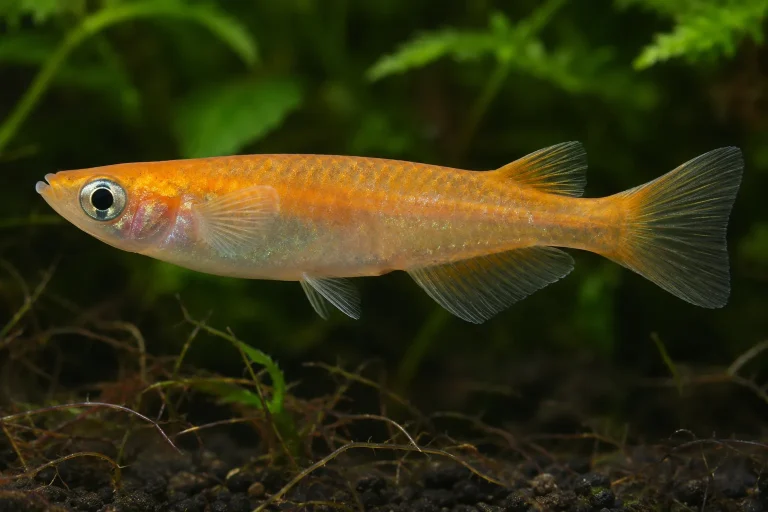
Medaka (Japanese Ricefish)
Oryzias latipes
- Care level
- Beginner
- Adult size
- 3–3.6 cm
- Minimum tank
- 40 litres
- Temperature
- 16–22 °C
Species profile
Oryzias javanicus
Common names: Javanese Ricefish, Java Medaka, Javanese Medaka
Up to 3.5 cm




A small, peaceful fish from coastal Southeast Asia, usually from brackish water, and it does well in hard water with a little salt. Keep a group of at least 6 in 40 litres or more.
A small, peaceful fish from coastal Southeast Asia, usually from brackish water, and it does well in hard water with a little salt. It is fairly easy to breed.
Check the scientific name when buying, as common names vary between sellers and countries.
Mature females are usually rounder in the belly, and males are usually slimmer and often brighter.
A long tank with open swimming water, plants around the edges and steady filtration suits this fish. A darker substrate and some floating plants usually bring out its colour.
Active and social, and most settled when kept with its own kind.
Keep a group of at least 6, and more if you can. Larger groups are calmer and show better colour and behaviour.
Not territorial, although males may spar and display.
Suits a community of similar-sized, peaceful fish that like the same water. Avoid large predators, which will treat it as food. It may eat baby shrimp.
Fairly tolerant of different water, if it is clean and stable.
A small surface-feeding omnivore. Feed fine flake and small frozen foods.
Feed small amounts, and remove anything left after a few minutes.
Lays eggs on plants or in the substrate, depending on the species, and many keepers collect the eggs to raise separately. Some species have eggs that survive long dry periods.
You can write a note about what worked for you, or send a photograph. We check everything before it appears here.
Oryzias latipes

Oryzias latipes var Platinum
Oryzias celebensis
Oryzias woworae