Skip to content
Menu

Species profile

Kribensis

Pelvicachromis pulcher

Common names: Kribensis, Krib, Rainbow Krib
Recognized speciesCichlids
Kribensis (Pelvicachromis pulcher)

Adult size

Up to 10 cm

Typical adult length 7–10 cm.
Up to 10 cm

Countries of origin

  • See all stock from Benin
  • See all stock from Cameroon
  • See all stock from Nigeria

Good fit for your tank?

Good fit for

  • A peaceful community with one pair of cichlids
  • A keeper who wants to watch parents raise fry
  • A planted tank with several caves

Think carefully if

  • Your tank is short of floor space
  • You keep very small bottom dwellers
  • You have delicate plants in soft substrate

A colourful, small West African cichlid that lives near the bottom and breeds in caves. It is among the easier cichlids to keep, and it is especially interesting to watch with fry.

Appearance and Identification

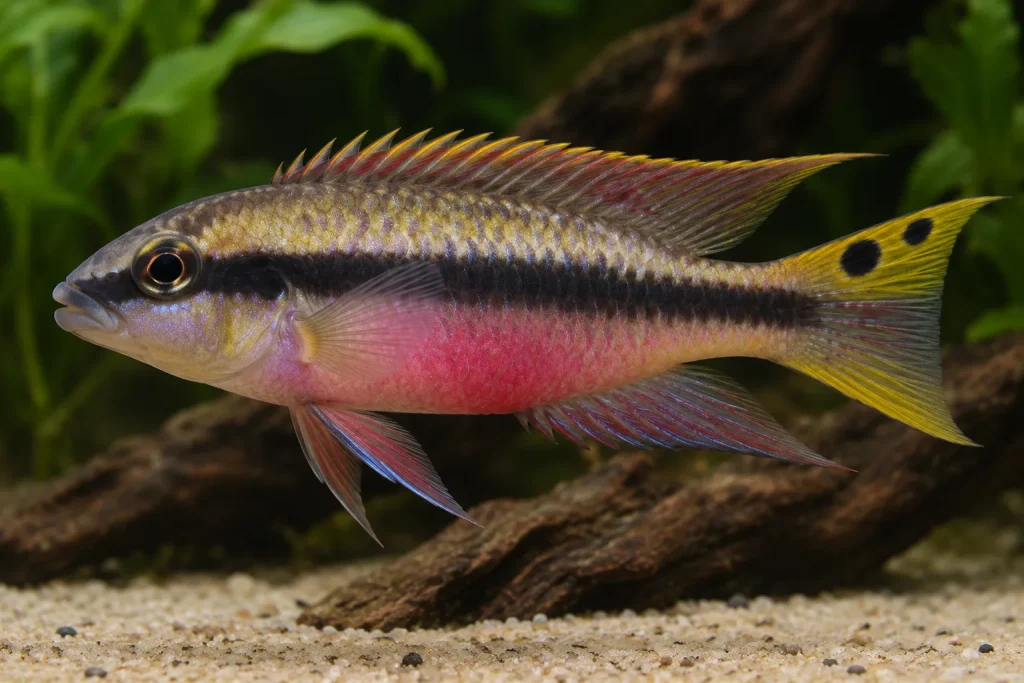
A slim, colourful cichlid with a dark lateral stripe, a yellow-edged tail with eye spots, and pink to red on the belly. Females are rounder and show a deep purple belly when ready to spawn.

Other Pelvicachromis species look similar, so check the species name if you keep or breed them seriously. Albino fish are also sold.

Males are larger and have pointed dorsal, caudal, and anal fins. Females are rounder-bodied and develop a deep purple belly when ready to spawn.

Tank Requirements

Suggested filter
About 280–350 litres an hour
Suggested heater
About 75–100 W for this tank
Minimum tank volume
70 litres
Minimum tank length
60 cm
Minimum group size
2
Recommended group size
2
Activity level
Moderate
Flow preference
Low to moderate
Planting preference
Moderately planted
Hiding places
Yes
Lid recommended
Yes
Jumping risk
Low

Provide caves, flower pots, or coconut shells, with plants that can handle some digging. Use soft substrate, because this fish moves mouthfuls of sand and small gravel.

Behaviour and Tankmates

Active and curious, mostly near the bottom. Pairs dig, defend caves, and lead their fry around the tank.

Keep in pairs. More than one pair needs a large tank with separate territories.

Territorial, especially when breeding. A pair can dominate the lower part of the aquarium.

Suitable with small characins, barbs, danios, rasboras, corydoras, gouramis, and loricariids. Avoid large or vigorous species, and keep catfish away from eggs and fry.

Check tankmates for this species

Water Parameters

Temperature
24–27 °C
pH
5–7.5
GH
0–12
Stability importance
Important

Soft to moderately hard water is suitable. Water chemistry can affect the proportion of male and female fry, according to breeders.

Parameter caveat
Acclimate slowly and keep nitrate low. Most fish sold are farm-bred and more adaptable than wild stock.

Feeding

Diet types
Insectivore, Omnivore
Feeding frequency
Once or twice daily
Preferred foods
  • Small sinking cichlid granulesUse as a staple, and make sure food reaches the bottom of the tank.
  • Frozen bloodworm, daphnia, or brine shrimpGood for condition and for bringing pairs into spawning colour.
  • Spirulina or vegetable flakeAdds plant matter to the diet.

An omnivore that sifts the substrate for small invertebrates and plant matter.

Feed near the bottom so food is not all taken by midwater fish first.

Breeding

Breeding type
Cave Spawner
Breeding difficulty
Easy
Brood or egg count
Up to 300 eggs
Incubation
3 days
Parental care
Biparental care
Baby foods
  • Newly hatched brine shrimpThe main first food once fry are free-swimming, and it gives good growth.
  • MicrowormsUseful for fry that stay close to the floor of the tank.
  • Finely crushed flake or fry powderUse as a supplement, and siphon out leftovers to protect water quality.

A cave spawner that forms monogamous pairs. The female lays up to 300 eggs on a cave roof or wall, and the male guards the territory. Eggs hatch in 2 to 3 days, and fry become free-swimming at 7 to 8 days, when both parents lead them around the tank.

Habitat and Origin

Geographic origin
Africa, Benin, Cameroon, Captive Bred, Nigeria, West Africa
Natural habitat
Freshwater River, Freshwater Stream, Vegetated Shoreline
Aquarium contexts
Breeding Aquarium, Planted Aquarium
Audience level
Intermediate

Classification

Profile type
Recognized species
Genus
Pelvicachromis
Family
Cichlidae
Species group
Cichlids, Fish

Have you kept this species?

You can write a note about what worked for you, or send a photograph. We check everything before it appears here.

Share a note or photo

JPG, PNG, or WebP, up to 5 MB.