
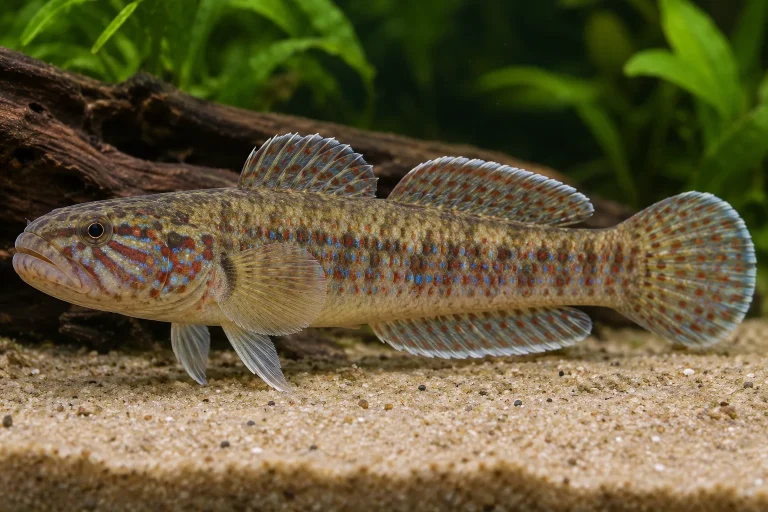
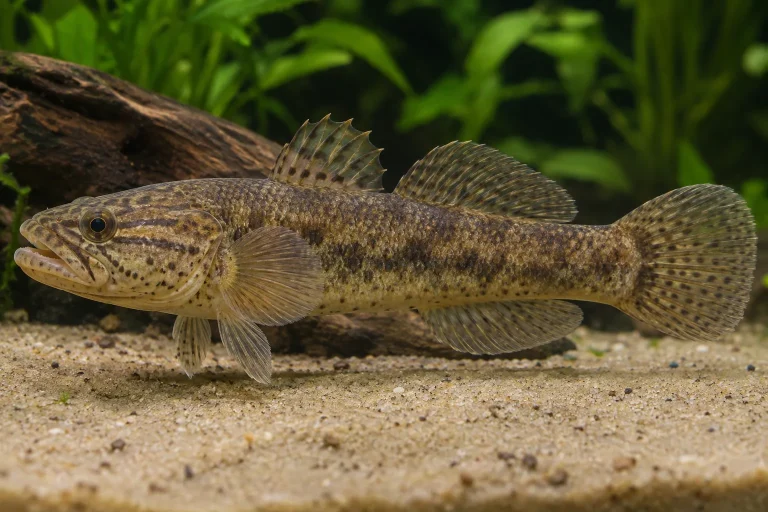
Tolson’s Snakehead Gudgeon
Giuris tolsoni
- Care level
- Specialist
- Adult size
- 8–12 cm
- Minimum tank
- 180 litres
- Temperature
- 22–28 °C
Species profile
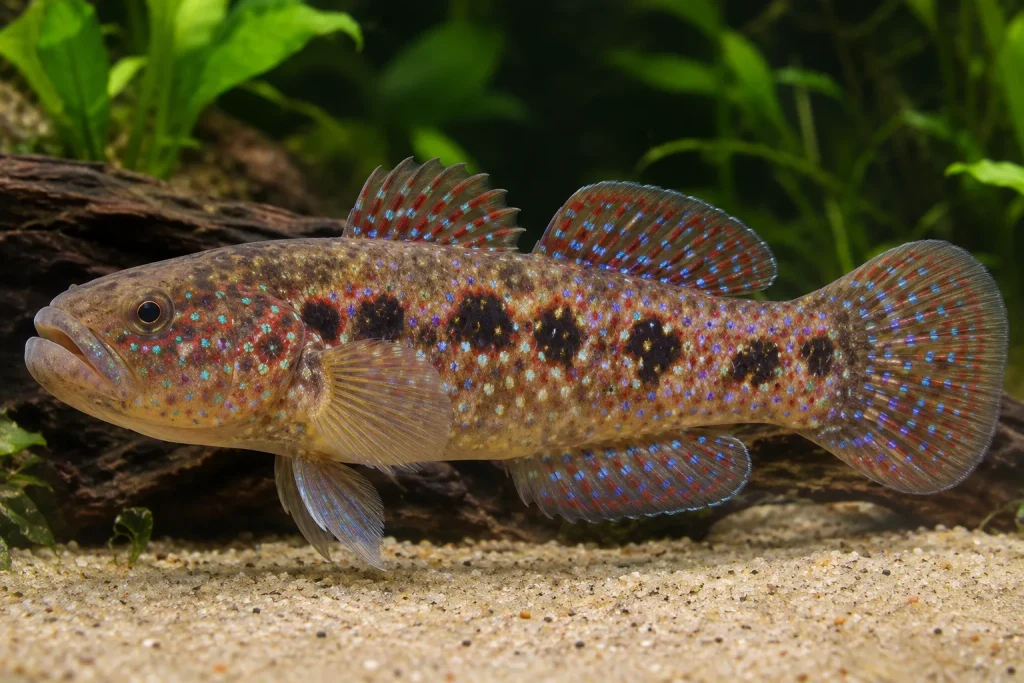
Mogurnda adspersa
Common names: Southern Purple Spotted Gudgeon, Southern Purplespotted Gudgeon, Purple-spotted Gudgeon
Up to 14 cm
Typical adult length 7–14 cm.


Southern Purple Spotted Gudgeon is a a robust Australian sleeper gudgeon with a broad head, brown to olive body, irregular purple-blue spots, reddish fin markings, and stronger colour in mature displaying males.
Southern Purple Spotted Gudgeon is a robust Australian sleeper with a broad head, large mouth, and a brown, olive, or yellow-brown body. Dark side blotches are surrounded by red, pale, and iridescent blue or purple spots, while mature males may show stronger facial bars and red spotting in the fins. Its colour varies with mood, background, and breeding condition.
A relatively large Mogurnda from eastern Australian drainages. Use the accepted spelling “purple-spotted” or “purplespotted” and retain locality information because regional Mogurnda can be difficult to identify.
Mature males are usually larger and more strongly coloured, especially across the head and fins during courtship. Females are commonly less intense in colour and become fuller when carrying eggs. Subordinate males may remain dull, so behaviour and body shape should be considered alongside colour.
Use a spacious, securely covered aquarium with a broad footprint, strong filtration, and several separated territories. Dense plants, wood, rock, shaded retreats, and firm spawning surfaces should be combined with open feeding space. A pair must be watched carefully because a dominant fish may become forceful when defending a site.
This is a confident bottom-oriented ambush predator that spends time close to cover and makes rapid attacks on moving food. Adults may become territorial around caves, wood, or spawning surfaces. Their size, mouth, and feeding response make them much less suitable for a gentle small-fish community than their calm resting behaviour may suggest.
A single specimen is the safest default. A compatible pair may be kept in a larger structured aquarium, but close observation and a separation plan are necessary.
Adults defend shelters and males guard spawning sites. Use multiple visual barriers and do not force unrelated adults into a confined footprint.
Tankmates must be robust, too large to swallow, and able to avoid a territorial bottom predator. Small schooling fish, ornamental shrimp, fry, and delicate bottom dwellers are unsuitable. Other large gudgeons or cichlids should be attempted only in a very spacious aquarium with multiple territories and a plan for separation.
Maintain clean, stable freshwater with moderate mineral content and strong oxygenation. The species uses slow or still vegetated waters but does not tolerate accumulating organic waste.
Some links may earn us a commission on qualifying purchases, at no extra cost to you. Check suitability, price and availability with the seller. How affiliate links work
 Manual aquarium siphon and gravel cleaner
A manual siphon for routine aquarium water changes and accessible waste removal. The seller lists a hose approximately 1.6 m long.
Control the flow and keep the intake clear of fish and delicate planting. Clean the areas appropriate for your substrate and layout rather than disturbing the entire planted bed.
 Dr. Tank tap-water conditioner – 250 ml
A tap-water conditioner option for the moderately mineralised water described in this profile. The seller states that it treats chlorine/chloramine and contains added minerals.
Use the current label instructions for the water being treated. Check the formulation against your water and stocking; this mineral-containing product is not automatically recommended for very soft-water setups.
Feed quality carnivore pellets together with varied frozen or live worms, insect larvae, and crustaceans. Large adults may hunt small fish, but feeder fish are unnecessary and introduce nutritional and disease risks. Use measured portions and maintain excellent filtration because rich foods and a substantial fish can produce considerable waste.
Offer measured portions once daily or slightly less for mature adults. Remove uneaten rich food promptly and monitor body condition.
The pair spawns on a firm submerged surface, and the male guards and fans the adhesive eggs. Courtship and territory defence can become intense, so provide several sites and be ready to separate an injured fish. Once hatched, the fry require very small live food and clean rearing water. A dedicated breeding aquarium is safer than attempting to raise fry in a mixed display.
You can write a note about what worked for you, or send a photograph. We check everything before it appears here.
Giuris tolsoni
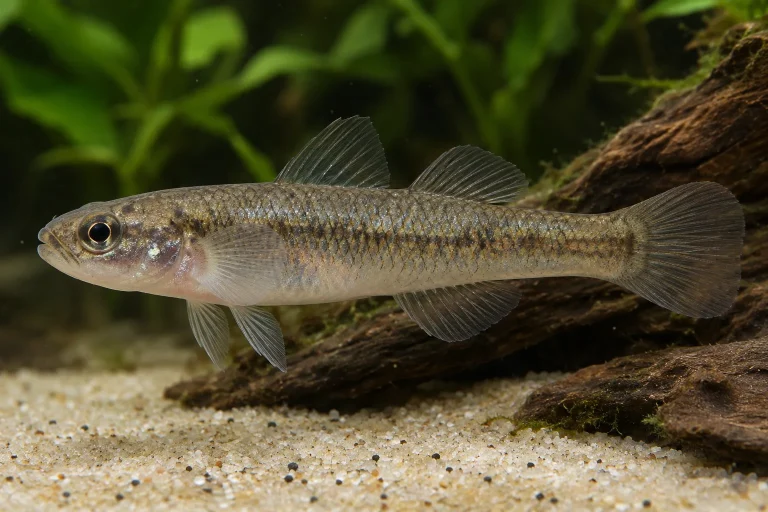
Hypseleotris cyprinoides
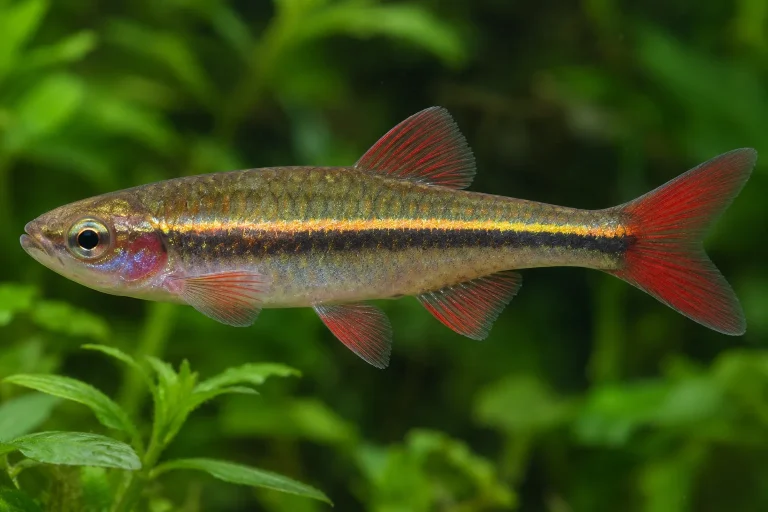
Tanichthys albonubes
Giuris charpini