Skip to content
Menu

Species profile

Tail Spot Pygmy Corydoras

Corydoras hastatus

Common names: Tail Spot Pygmy Corydoras, Tail-spot Pygmy Cory, Micro Catfish, Pygmy Cory, Pygmy Corydoras

Recognized speciesCorydoras

Adult size

Up to 3.2 cm

Up to 3.2 cm

Countries of origin

  • See all stock from Argentina
  • See all stock from Bolivia
  • See all stock from Brazil
  • See all stock from Paraguay
  • See all stock from Uruguay

Good fit for your tank?

Good fit for

  • A peaceful community tank with similar-sized fish

Think carefully if

  • You only want to keep one or two, because this fish needs a group of 6 or more

A tiny cory, only about 3 cm long, with a dark spot at the base of the tail. Keep a group of at least 6 in 54 litres or more.

Appearance and Identification

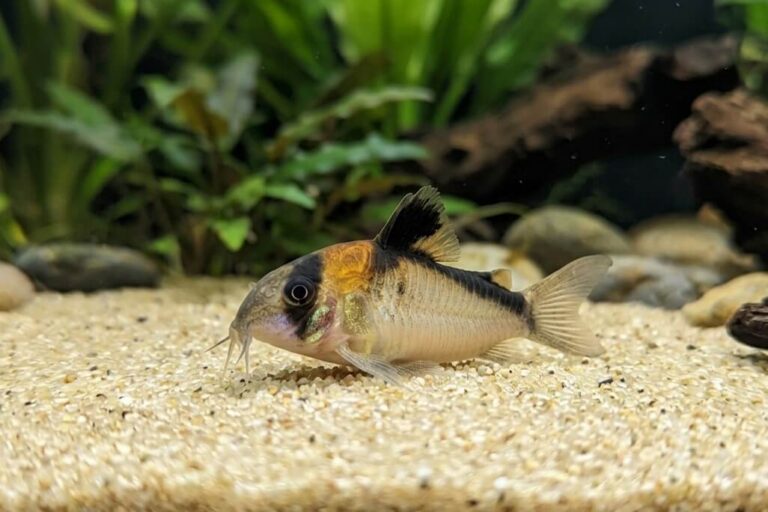
A tiny cory, only about 3 cm long, with a dark spot at the base of the tail. Unlike most corys, it spends much of its time swimming in open water as a shoal.

Check the scientific name when buying, as common names vary between sellers and countries.

Females are larger and rounder, and they look broader when viewed from above.

Tank Requirements

Suggested filter
About 220–270 litres an hour
Suggested heater
About 50–75 W for this tank
Minimum tank volume
54 litres
Minimum tank length
60 cm
Minimum group size
6
Recommended group size
10
Activity level
Moderate
Flow preference
Low to moderate
Planting preference
Moderately planted
Hiding places
Yes
Lid recommended
Yes
Jumping risk
Moderate

Use a soft sand bottom, because rough gravel can wear down its barbels, and keep the water clean. It sometimes darts to the surface for air, which is normal.

Behaviour and Tankmates

A peaceful, sociable bottom-dweller that spends the day rooting through the sand in a group.

Keep a group of at least 6, and more if you can.

Not territorial.

An ideal community fish, with small, peaceful fish that like similar water. It does not eat algae or clean the tank, so it needs its own food.

Check tankmates for this species

Water Parameters

Temperature
20–26 °C
pH
6–7.5
GH
2–12
Stability importance
Important

Fairly tolerant of different water, if it is clean and stable.

Parameter caveat
Keep up regular water changes, and acclimatise new fish slowly.

Feeding

Diet types
Omnivore
Feeding frequency
Daily
Preferred foods
  • Sinking pellets or wafersFeed after lights-out if faster fish take everything first.
  • Frozen bloodworm and brine shrimpOffer several times a week.
  • Blanched vegetablesCourgette or cucumber add variety for fish that graze.

Eats small invertebrates in the wild. Feed sinking foods that reach the bottom.

Feed small amounts, and remove anything left after a few minutes.

Breeding

Breeding type
Egg Scatterer
Breeding difficulty
Easy
Parental care
None
Baby foods
  • InfusoriaNeeded for the first days, because most fry are very small.
  • Newly hatched brine shrimpIntroduce as soon as the fry can take it.

An egg scatterer with no parental care. Adults eat eggs and fry, so use a separate tank with fine plants, moss or mesh on the bottom, and remove the adults after spawning. The fry need very small foods at first.

Habitat and Origin

Geographic origin
Argentina, Bolivia, Brazil, Paraguay, South America, Uruguay
Natural habitat
Floodplain, Lake, Swamp
Aquarium contexts
Planted Aquarium
Audience level
Beginner

Classification

Profile type
Recognized species
Genus
Corydoras
Family
Callichthyidae
Species group
Corydoras, Fish

Have you kept this species?

You can write a note about what worked for you, or send a photograph. We check everything before it appears here.

Share a note or photo

JPG, PNG, or WebP, up to 5 MB.