Skip to content
Menu

Species profile

Three-Spot Gourami

Trichopodus trichopterus

Common names: Three-Spot Gourami, Blue Gourami, Gold Gourami, Opaline Gourami
Recognized speciesGouramis
Three-Spot Gourami (Trichopodus trichopterus)

Adult size

Up to 15 cm

Typical adult length 10–15 cm.

Up to 15 cm

Countries of origin

  • See all stock from Cambodia
  • See all stock from China
  • See all stock from Indonesia
  • See all stock from Laos
  • See all stock from Malaysia
  • See all stock from Myanmar
  • See all stock from Thailand
  • See all stock from Vietnam

Good fit for your tank?

Good fit for

  • A robust community of medium-sized fish
  • A keeper with hard or variable tap water
  • A hardy fish for a larger aquarium

Think carefully if

  • Your tank has small, slow, or long-finned fish
  • You plan to keep several males
  • You expect it to stay small

A very hardy, medium-sized gourami sold in blue, gold, and opaline forms. It adapts to almost any water, but some adults become aggressive, so choose tankmates with care.

Appearance and Identification

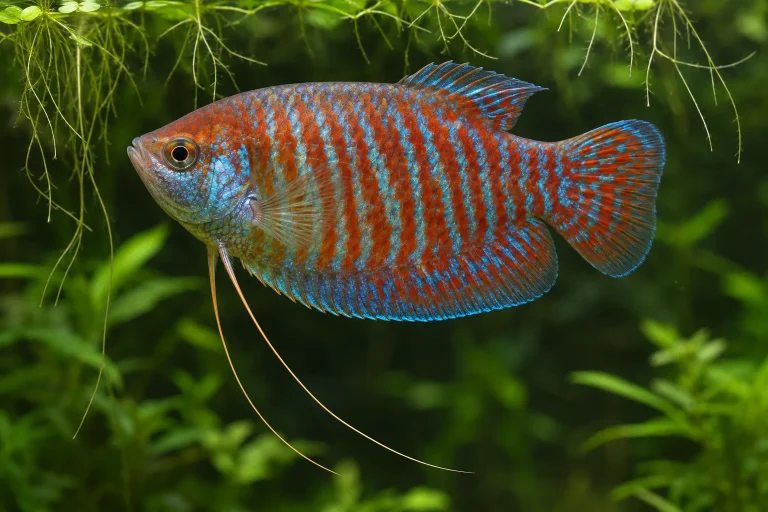
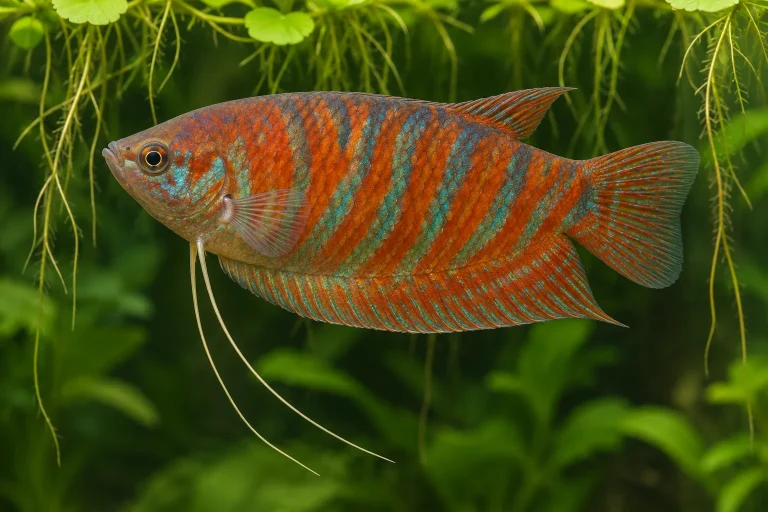
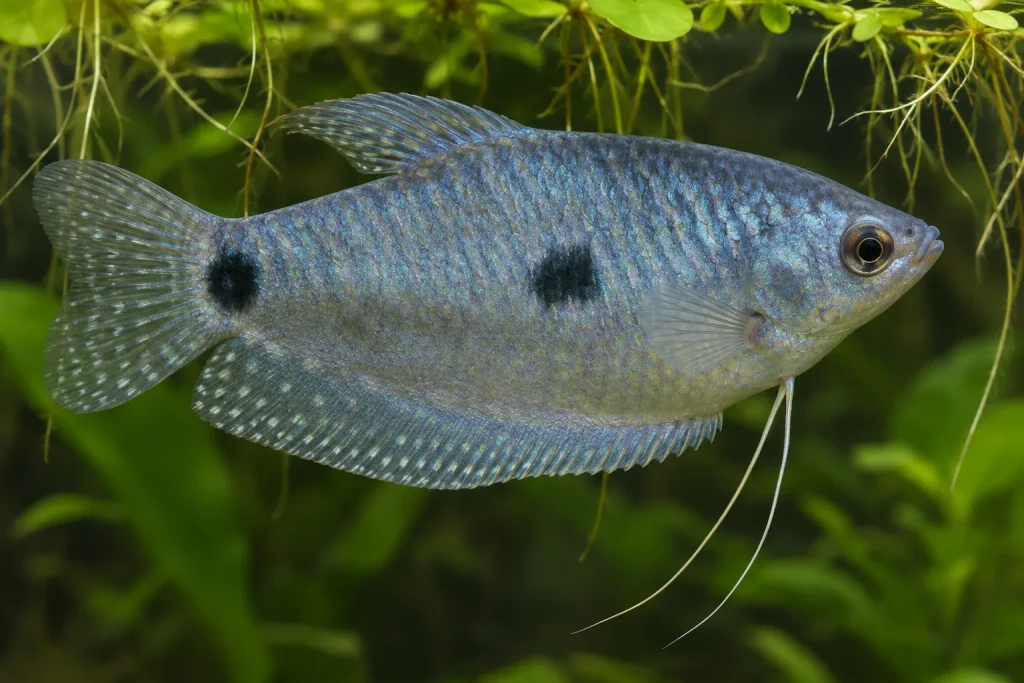
A flattened oval body in blue-grey, gold, or marbled opaline, with two dark spots on the flank, plus the eye forming the third. The long pelvic fins are thread-like.

Blue, gold, and opaline fish are colour forms of one species, and care is the same for each. A pointed dorsal fin is the easiest way to spot a male.

Males are larger, with a pointed dorsal fin. Females are smaller with a rounder belly.

Tank Requirements

Suggested filter
About 160–240 litres an hour
Suggested heater
About 75–125 W for this tank
Minimum tank volume
80 litres
Minimum tank length
90 cm
Minimum group size
1
Recommended group size
3
Activity level
Moderate
Flow preference
Low
Planting preference
Moderately planted
Hiding places
Yes
Lid recommended
Yes
Jumping risk
Low

Provide floating plants and plenty of cover to break sightlines. Keep surface flow low, and allow more space if keeping more than one fish.

Behaviour and Tankmates

Usually calm when young, but some adults, particularly males, become aggressive with age.

Can be kept singly. If keeping more than one, use one male with females in a larger tank.

Males are territorial, and bullying can increase as the fish matures.

Best with robust medium or large tankmates such as barbs, larger characins, loricariids, loaches, and other gouramis. Avoid small fish and shrimp.

Check tankmates for this species

Water Parameters

Temperature
24–30 °C
pH
5.5–8.5
GH
3–35
Stability importance
Normal

One of the most adaptable aquarium fish. Warmer temperatures suit it, and water changes still matter despite its tolerance.

Parameter caveat
Gouramis breathe air from the surface, so keep the surface accessible and the air above it warm with a lid.

Feeding

Diet types
Insectivore, Omnivore
Feeding frequency
Once or twice daily
Preferred foods
  • Small floating pellets or quality flakeThese fish feed readily from the surface. Choose a small size and feed sparingly.
  • Frozen or live daphnia and brine shrimpOffer a few times a week for variety and condition.
  • Frozen bloodworm or mosquito larvaeUse as an occasional rich treat rather than a daily food.

An omnivore that takes most prepared and frozen foods, along with plant matter.

A varied diet with plant matter suits it well. This fish will overeat if given the chance.

Breeding

Breeding type
Bubble Nest
Breeding difficulty
Easy
Brood or egg count
Often several hundred to over 1,000 eggs
Incubation
1 days
Parental care
Bubble-nest care
Baby foods
  • Infusoria or parameciumEssential for the first days, because labyrinth fry are tiny and cannot yet take larger food.
  • Vinegar eels or microwormsIntroduce as the fry grow, and offer in small amounts to protect water quality.
  • Newly hatched brine shrimpIntroduce once the fry can swallow it, usually after one to two weeks.

A bubble nester. Males build nests under floating plants, and eggs hatch in about 20 to 30 hours. Keep 2 to 3 females per male, remove females after spawning, and remove the male after the fry become free-swimming.

Habitat and Origin

Geographic origin
Asia, Cambodia, Captive Bred, China, Indonesia, Laos, Malaysia, Myanmar, Southeast Asia, Thailand, Vietnam
Natural habitat
Pond, Rice Field, Slow River, Swamp
Aquarium contexts
Breeding Aquarium, Large Aquarium
Audience level
Intermediate

Classification

Profile type
Recognized species
Genus
Trichopodus
Family
Osphronemidae
Species group
Fish, Gouramis

Have you kept this species?

You can write a note about what worked for you, or send a photograph. We check everything before it appears here.

Share a note or photo

JPG, PNG, or WebP, up to 5 MB.